










Ask any hospital procurement manager what takes up the most time in their week, and the answer is rarely clinical. It is chasing backorders, reconciling invoices across a dozen different vendors, and managing supplier relationships for products that should simply arrive on schedule without requiring follow-up. Choosing the right wholesale medical supply company upfront is one part of a broader shift in why healthcare providers are rethinking medical supply procurement strategies, but most facilities do not evaluate suppliers rigorously before committing.
The US medical equipment and supplies distribution industry includes more than 10,000 establishments with combined annual revenue of approximately $230 billion, yet pressure to control healthcare expenditures is intensifying price negotiations for wholesalers and prompting customers to consolidate their supplier base, according to First Research industry analysis. With that many options in the market, the challenge is not finding a supplier. It is identifying which one will actually perform consistently once the contract is signed and the relationship moves from sales calls to daily operations.

What to Evaluate Before Committing
Product Range and Category Depth: A wholesale supplier worth committing to should cover the full breadth of what a facility needs from a single account. At the protective and procedural layer, that means disposable exam gloves in bulk, PPE at wholesale volume, medical gowns, and surgical drapes. At the diagnostic and specimen level, it means specimen collection supplies and surgical instruments sourced through quality-controlled channels. For monitoring and equipment, it means pulse oximeters, patient monitors, and durable medical equipment available without requiring a separate vendor relationship for each category.
A supplier who covers orthopedic supplies alongside sharps containers, specimen collection kits alongside surgical drapes, and PPE alongside DME bulk supplies reduces the number of accounts a procurement team has to manage without sacrificing product availability in any single category.
Pricing Transparency and Custom Quotes: Unit pricing in wholesale medical supply is rarely fixed in the way retail pricing is. Volume discounts, contract pricing, and category-specific negotiations all play a role, and a supplier who is unwilling to provide itemized, customized quotes before a contract is signed is one who will be difficult to work with when pricing disputes arise afterward. Ask for written quotes broken down by product line, and compare not just the headline rate but what is included in the delivery and account management terms.
Delivery Reliability and Lead Times: A wholesale supplier who ships reliably on a standard lead time is considerably more valuable than one who offers the lowest unit cost but requires constant follow-up on delayed orders. Confirm what the standard lead time is for high-turnover items like nitrile gloves, underpads, surgical gauze, and exam table paper, as well as what the escalation process is when something ships late or arrives damaged. Next-day delivery availability is worth asking about specifically, since urgent restocking needs arise in every clinical setting regardless of how well the facility plans.
Backorder Handling: How a supplier handles backorders is often more revealing than how they handle routine orders. Ask directly: what happens when a product is temporarily unavailable? Do they notify proactively or wait to be asked? Do they offer a substitution or simply leave the order open? A supplier with a clear, communicative backorder process causes significantly less operational disruption than one who goes silent when availability tightens.
Account Support and Relationship Quality: The size of a supplier’s catalog matters less than the quality of support behind it. A dedicated account contact who knows a facility’s ordering patterns, flags potential supply issues before they become problems, and responds quickly to queries is worth more in daily practice than a lower list price with no one to call when something goes wrong.
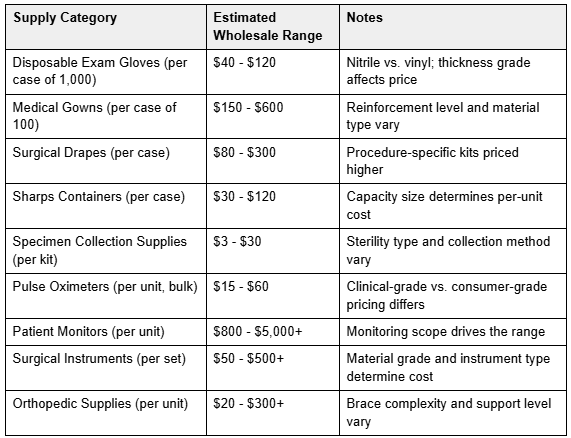
Wholesale Supply Cost Reference by Category
Below is a general cost reference for commonly purchased categories at wholesale volume:
Applying the Checklist
For facilities currently reviewing their sourcing options, HSS Medical Supply is a wholesale medical supply company serving hospitals, clinics, and healthcare providers across New York, North Carolina, New Jersey, and Massachusetts. The company offers a broad selection of durable medical equipment and everyday consumables, along with custom quotes to support ongoing procurement needs across a wide range of medical supply categories.

The Contract Is the Beginning, Not the End
Signing with a wholesale supplier is not the finish line. It is the start of an operational relationship that will affect clinical supply availability every week. Facilities that evaluate suppliers rigorously before committing, rather than defaulting to whoever responds first or quotes lowest, are better positioned to catch problems early and to hold a supplier to the terms that were agreed.
The questions above take an hour to ask. The answers save considerably more than that over the life of the contract.


