






By: Leslie Duvall
There are records that politely request your attention, and then there are records that grab you by the collar, drag you across the room and demand to know what the hell you’re waiting for. DPB’s “God Mode” belongs enthusiastically to the second category.
This is Christian hip-hop with absolutely no interest in behaving itself.
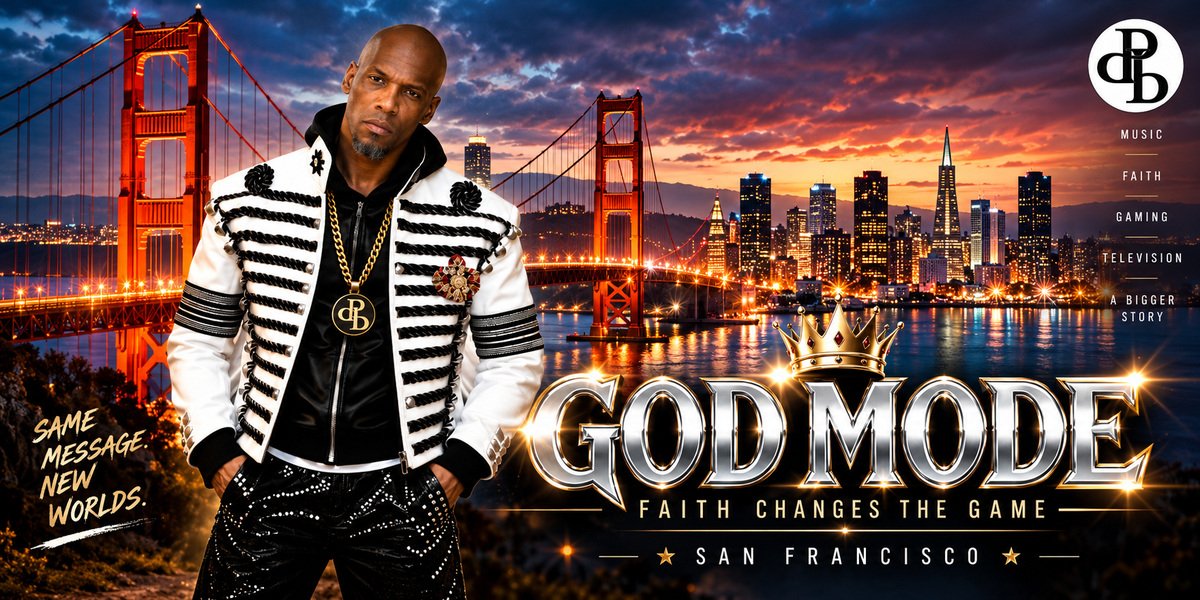
DPB, David Paul Brooks, veteran rapper, minister, entrepreneur and indefatigable believer in the transformative possibilities of music, has taken one of gaming culture’s great fantasies and turned it into a theological battle cry. In video games, God Mode is where mortality gets switched off. Bullets bounce away. Enemies become inconveniences. The rules everybody else follows suddenly don’t apply.
DPB hears that phrase and thinks: Christianity.
Naturally.
And somehow, the crazy thing works.
“God Mode” originally surfaced in 2022 before being resurrected as part of DPB’s 2026 album Undefeated and receiving a renewed radio push. It has since become one of the defining statements of the project, climbing to No. 2 on Christian Music Weekly’s Rhythmic Airplay chart.
But forget the chart for a minute.
Listen to the attitude.
“Jesus Christ is the God Code.”
There’s your song.
There’s practically your entire review.
It’s a wonderfully audacious line because it compresses two universes that aren’t supposed to fit together, Sunday morning salvation and Saturday-night gaming, into six words. You can almost hear a thousand theology professors simultaneously reaching for their red pens.
DPB doesn’t care.
He’s already on to the next declaration.
Healing. Deliverance. Freedom. Revival.
“God Mode” doesn’t develop like a carefully argued sermon. It erupts like a tent revival happening inside an arcade while somebody outside has parked a car with subwoofers large enough to alter weather patterns.
And repetition is the weapon.
DPB hammers his phrases until they stop being lyrics and become slogans, then keeps hammering until the slogans become chants. This is one of those places where hip-hop and church music reveal that they’ve been distant cousins all along. Repetition isn’t laziness when you understand how crowds work. It’s ritual.
James Brown knew it.
Preachers know it.
Rappers know it.
Say something once and people hear you. Say it five times and they start saying it with you.
DPB has been around long enough to understand the difference.
More than three decades into his journey through Christian hip-hop, he isn’t approaching “God Mode” like a young rapper desperately auditioning for relevance. There’s something liberating about hearing an artist who has stopped asking whether he’s invited to the party.
DPB brought his own party.
The song reportedly originated after Brooks prayed for direction and subsequently had a dream carrying the idea that Christians were waiting for God to give them something they already possessed: spiritual authority.
Whether you’re Christian, atheist, undecided or presently worshipping at the Church of Sunday Football, that’s an interesting premise because underneath the theology is a recognizable human disease.
We wait.
For permission.
For success.
For somebody to notice us.
For conditions to become perfect.
For Monday.
For January.
For our lives to finally begin.
DPB’s response is basically: What if they’ve already begun?
That’s where “God Mode” becomes more interesting than the average inspirational record. There’s no mistaking its theology; DPB isn’t disguising Jesus behind some generic language about “the universe,” but the emotional mechanism travels remarkably well.
The track isn’t asking you to admire DPB.
It’s trying to activate you.
Which makes the next part almost inevitable.
DPB has been exploring the possibility of turning “God Mode” into a video game, along with discussions surrounding a potential television extension of the concept. And normally, hearing that a song might become a multimedia franchise would inspire visions of marketing executives rubbing their hands together around a conference table.
Here, though?
It actually makes sense.
The damn song already thinks it’s a video game.
It has a title, a code, a mission, obstacles, power and a worldview. Half the conceptual work is sitting there waiting for somebody to pick up a controller.
A “God Mode” game could turn DPB’s central argument into literal action: characters facing adversity, making decisions, discovering abilities and learning that real power isn’t necessarily the brute-force variety. Television could expand the same idea into characters and stories.
Whether either project ultimately reaches screens remains to be seen, but the possibility reveals something important about DPB.
He’s still restless.
That’s impressive.
A lot of artists spend their later careers defending whatever they did 20 years earlier. DPB seems more interested in asking what he hasn’t done yet. Music leads to film. Film leads to gaming. Gaming leads who knows where.
Maybe that’s why Undefeated is such an appropriate album title.
Survival in music isn’t glamorous. It means watching formats die. Labels disappear. Radio change. Audiences fragment. Genres mutate. Technologies arrive promising salvation and leave carrying everybody’s lunch money.
DPB has survived anyway.
And “God Mode” doesn’t sound like a survivor limping toward nostalgia. It sounds like somebody charging into whatever comes next.
Is it excessive?
Absolutely.
Is it corny sometimes?
Of course.
So was Little Richard. So were KISS. So are tent revivals, superhero movies, professional wrestling and every truly magnificent thing that understands restraint is occasionally the enemy of fun.
“God Mode” doesn’t whisper its convictions because DPB isn’t whispering anything.
He believes.
He raps.
He repeats.
The beat hits.
And somewhere between the pulpit and the PlayStation, the whole ridiculous, sincere, gloriously over-the-top machine catches fire.


