









By Nolan Mercer
San Francisco has always been a city of competing images. It is the postcard city of the Golden Gate Bridge, cable cars, painted Victorians, rolling fog, and impossible hills. It is also the global capital of digital reinvention, where apps promise to improve human connection while people increasingly experience life through carefully edited screens. Walk a few blocks from a luxury tower or gleaming technology campus, however, and the distance between innovation and basic human need becomes painfully visible.
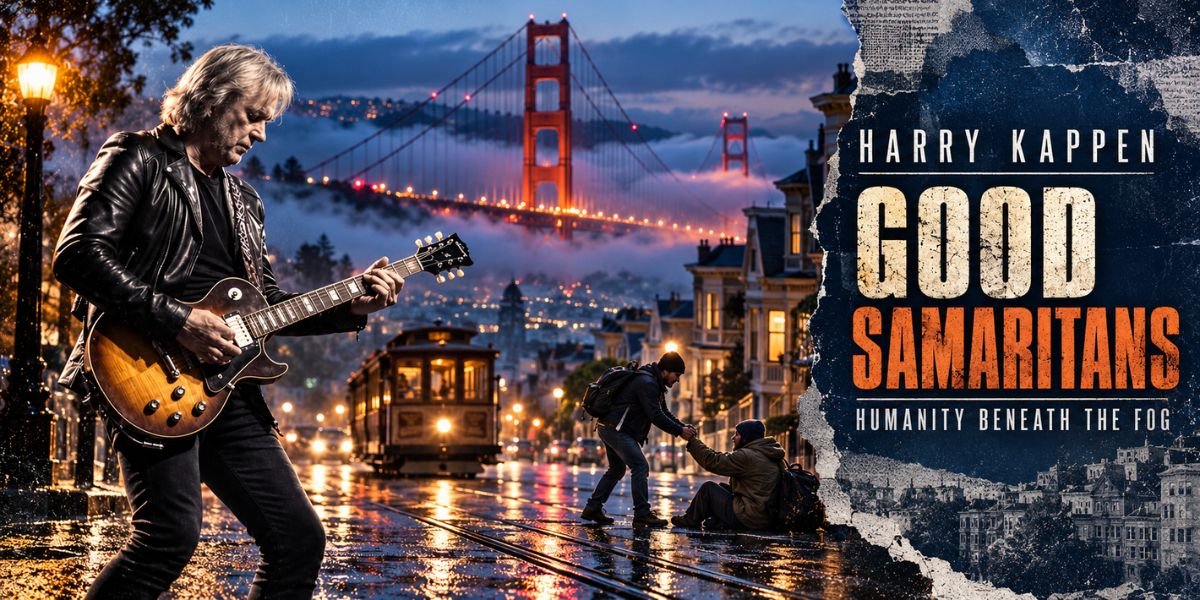
That contradiction makes San Francisco a fitting place to encounter Harry Kappen’s “Good Samaritans.”
Taken from After the Crossing, Kappen’s first album recorded after moving from the Netherlands to Mexico, the single is an energetic rock song dedicated to people who offer help without demanding recognition. They do not document their compassion, announce their moral credentials, or wait for public approval. They see another person struggling, step forward and do what needs to be done.
Kappen opens the song by describing a marketplace of manufactured fulfillment: “flashy words for every soul” and a dream that promises to make its buyer whole. It sounds like advertising, self-help rhetoric, and social-media branding compressed into one seductive pitch. In a region where nearly every human problem seems to inspire a new platform, product or investment opportunity, the language feels especially sharp.
The song’s world is filled with “plastic smiles,” “golden sunsets,” and “sculpted skies.” Every photograph is flattering. Every experience has been arranged for maximum appeal. Pain is not confronted; it is filtered. Tears are transformed into champagne before they can make anybody uncomfortable.
San Francisco knows something about attractive surfaces. The Bay can look silver beneath the fog, orange beneath the evening sun, and impossibly blue on a clear afternoon. Yet beauty here has never erased hardship. The city’s most compelling story is often found in the tension between the view being photographed and the life unfolding just outside the frame.
Kappen builds “Good Samaritans” around that same tension. His verses describe a culture obsessed with appearances, while the chorus turns toward people who stop “in the rain” to share another person’s pain. These are not fantasy superheroes. They are neighbors, strangers, social workers, volunteers, nurses, outreach workers, and commuters who decide that someone else’s crisis matters more than their own schedule.
Musically, the song carries enough force to keep its message from becoming a lecture. Kappen performed, sang, and produced the track himself, constructing a firm rock arrangement driven by urgency rather than ornament. The guitars give the record muscle, while its forward-moving rhythm suggests action. This is not music about admiring goodness from a safe distance. It calls for participation.
Mexican singer Danna Gomez joins Kappen in the choruses, strengthening the sense that compassion must become communal. Her voice helps lift the refrain beyond one man’s argument. The song begins as an observation and gradually becomes a shared declaration: the people who quietly help others may be the only ones capable of saving us.
Kappen has described “Good Samaritans,” like the preceding single “Distant Shore,” as a musical nod to David Bowie. The influence is present less as imitation than as dramatic intelligence. Bowie understood how glamour, artifice, and constructed identities could expose deeper truths. Kappen similarly uses the bright language of contemporary self-presentation to reveal the loneliness and indifference beneath it.
The message carries additional weight because Kappen spent more than 20 years working in youth care as a music therapist. He also taught in an international master’s program in music therapy. His faith in human connection did not begin as a songwriting concept. It emerged from professional experience with people and families navigating real pain.
In San Francisco, “Good Samaritans” lands as both challenge and tribute. It challenges a culture that can measure engagement with extraordinary precision yet still struggle to recognize the person asking for help on the sidewalk. At the same time, it honors those who continue to show up: the volunteers serving meals in the Tenderloin, the neighbors organizing mutual aid, the strangers helping someone onto a Muni bus, and the people who stay beside another human being when walking away would be easier.
Kappen’s strongest lyric may be his observation that Good Samaritans remain “unseen” and “never trending.” Online culture rewards visible gestures, especially when they arrive with dramatic footage and a marketable caption. But meaningful assistance is often private, repetitive, and inconvenient. It does not always produce a satisfying before-and-after story. Sometimes compassion means returning tomorrow, and the day after that, without expecting the world to notice.
That is the moral center of “Good Samaritans.” Kappen is not condemning beauty, ambition, or technology. He is asking what they are worth if they cannot lead us toward one another.
San Francisco has long imagined itself as a laboratory for the future. Kappen’s single suggests that the most important innovation may also be the oldest: noticing another person, extending a hand, and remaining long enough to help. Beneath the fog, screens, and golden light, that simple act still carries the power to save a city, and perhaps the people who call it home.


