










By Natalie Johnson
Over the past year, while studying at Stanford Graduate School of Business, I spoke with more than 150 operators, founders, executives and investors across 16 industries, and wrote a working paper on how small and mid-sized companies are adopting artificial intelligence. The industries varied, but the same pattern appeared repeatedly: capable employees were spending large parts of their day transferring information, reconciling records and compensating for software that did not work together.
In field services, technicians may record the parts used on a job on paper slips that the office later uses to prepare the invoice. If a slip goes missing, the company can end up paying for parts it installed but never charged the customer for.
These gaps consume employee time and can leave revenue uncollected. They also give
businesses a concrete place to begin improving how work gets done.
Access to AI tools is only the starting point
Almost every company can buy the same chatbots, meeting recorders and writing assistants at roughly the same price. They are useful, but they leave the company’s underlying operations largely unchanged. The insurance broker can now draft a client email faster and still has to re-enter the entire client record after every sale.
The larger opportunity lies in redesigning the workflow. Information can be captured once, checked against existing records and written into every system that needs it. Employees can intervene when something is incomplete or unusual rather than processing every case manually.
Some of this requires AI, especially when information arrives through emails, scanned documents or inconsistent forms. Some of it is conventional engineering, such as connecting systems, managing records and enforcing business rules. Meaningful implementations usually require both.
The economic value is not limited to cutting costs. In many service businesses, employee time constrains revenue. A brokerage that reduces administrative work can handle more clients and spend more time finding new business.
The same workforce can support a larger business because more of its time goes toward work customers value.
Implementation takes more than a software license
Building these systems requires someone to understand how the work is actually performed, including the exceptions experienced employees have learned to handle over years. Existing systems must be connected, duplicate records reconciled and unwritten business rules made explicit. The new workflow then has to be tested against the awkward cases that rarely appear in a demonstration but appear constantly in daily operations.
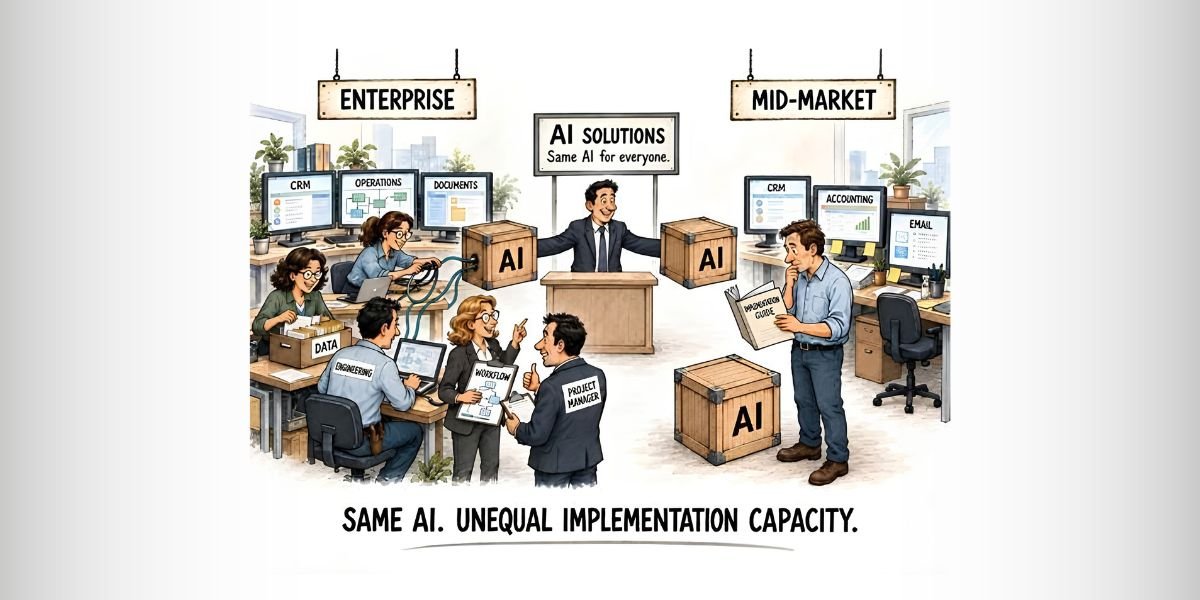
Large enterprises generally have more resources to take this on: internal technology teams, specialists and budgets for experimentation. They are better placed to absorb a failed pilot, learn from it and try again.
Smaller companies face a different calculation. The owner of a regional brokerage, accounting practice or field-services company may know exactly which workflow should be fixed first. What the business often lacks is the technical team to build the system, the management capacity to
oversee it and the financial room to absorb an unsuccessful first attempt.
Among the operating companies in my interview sample, 89 percent had gone no further than
adding chatbots to existing work. Only 8 percent had rebuilt even one workflow from beginning
to end, while 3 percent had created the connected operating foundation required to go further.
That is the real AI divide now emerging. Access to the tools is becoming widely distributed. The
capacity to implement them is not.
Making implementation affordable
Investors pursuing AI-enabled roll-ups illustrate one way the economics of implementation could work. By acquiring several similar businesses, they can fund a central technology team that spreads the cost across the group, reuses integrations and improves the system over time.
Independent operators need a way to access comparable support without having to become
part of a larger group.
Some software companies already combine their products with hands-on implementation, particularly in the enterprise market. Small and mid-sized businesses need access to the same kind of support at a price they can afford, with a provider responsible for understanding the workflow, connecting the systems and making sure the solution works in day-to-day operations.
For these businesses, implementation needs to be part of what they buy, rather than another project their team has to figure out.
Where smaller businesses can start
Not every small business should attempt an ambitious transformation. Some first need better systems, cleaner data or more consistent processes. Many, however, already have an obvious place to begin: the workflow employees complain about most, where the same information is copied, checked and entered all day again. To decide whether it is worth tackling first, look at how often it happens, how much employee time it consumes and its effect on customer service, costs or revenue.
The goal is not to install more AI, but to return people’s time to work that produces revenue, strengthens customer relationships or requires genuine judgment.
Unless implementation becomes easier to buy, the companies with the most to gain from AI may remain the least able to put it to work.
Website: https://www.red6.ai/


