









By: Jilian Defoe
The distance between nine cents a share and a sale to WPP is not a straight line, and it does not run through a single turning point or a single brilliant strategic decision. For 24/7 Media, it ran through a credit line from a Swiss publishing company acquired through a merger with Real Media, a thousand cold calls made with the specific instruction to ask every no for a referral, an investor dinner where the company was described as still alive with considerable surprise by everyone in the room, a phone call to a woman named Judy with forty-five minutes left on the Nasdaq clock before delisting became permanent, a trip to Japan where David’s recently graduated son received a standing ovation from a group of investors for reasons nobody has ever fully explained, and a 2006 dinner with an economist who told them a recession was coming and gave them two options before the rest of the market had processed the information.
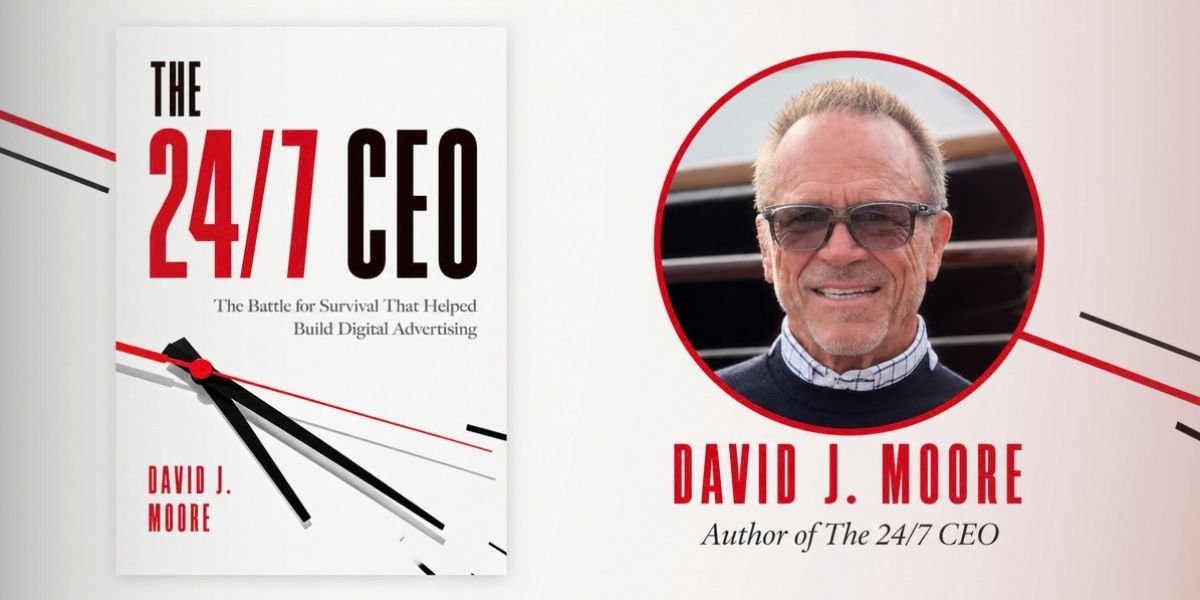
David Moore’s memoir The 24/7 CEO traces all of that distance in a way that makes it simultaneously extraordinary and instructive. The extraordinary parts are the specific incidents, each of which could have gone the other direction with minimal changes to the circumstances. The instructive part is the pattern visible across all of them: each survival was earned through a willingness to do the unglamorous, uncomfortable, and sometimes absurd thing that most people were no longer willing to do at that stage.
What the Real Media Merger Actually Bought
The first genuine stabilization came through the merger with Real Media, which brought a credit line from PubliGroupe and better ad serving technology. That credit line was not transformative in a dramatic sense. It was stabilizing in a fundamental sense: for the first time in a long time, there was something behind them that could absorb a bad week without triggering an immediate crisis.
The technology mattered as much as the capital. Real Media’s ad serving capability let 24/7 execute the original insight properly: that all inventory has value if you are willing to sell it and have the tools to deliver it reliably. That combination of better tools and a functioning credit line was the platform from which everything that followed was built.
From there, the recovery was accumulated one press release and one investor call at a time. Ten consecutive press releases in ten days to hold the stock above the delisting threshold. A phone call to Judy that bought four crucial days. Funding from Japanese investors who came to the meeting specifically because David and his son had made the trip in person. A thousand cold calls in which every rejection was treated as a potential introduction to someone who might say yes. The compounding of those small actions over eighteen months was what eventually made the sale possible.
The WPP Relationship and What It Became
Mark Read, who later became chief executive of WPP, praised the book publicly and credited David with teaching him a great deal. David says that acknowledgment matters more to him than the acquisition price, and he explains why with specificity.
When WPP acquired 24/7, Mark was running WPP Digital and was technically David’s supervisor within the organization. He never acted like it. He championed 24/7 inside a very large organization that didn’t always know what category to put it in or what to do with its particular capabilities. GroupM initially refused to work with 24/7, which created a confrontation at a WPP quarterly meeting when Sir Martin Sorrell discovered that 24/7 was doing more business with WPP’s competitors than with WPP’s own operating companies. He gave David and Irwin Gotlieb twenty-four hours to propose a solution. The solution was Xaxis.
Mark was also in the room in the summer of 2008 when David told Sir Martin that he could not continue as CEO because he needed to be present for his wife’s illness. He had effectively offered WPP an easy exit from a complicated situation. Sir Martin instead asked what David wanted to do. David said Chairman. Sir Martin said done, and the compensation and benefits remained unchanged. Mark’s role in making that possible was real, and David acknowledges it directly.
When the person who bought your company says he learned from you, what David hears is that the relationship was never purely transactional. That distinction is rare enough in business at that level that he considers himself genuinely fortunate to have experienced it.
David Moore’s full account of how 24/7 Media went from the edge of delisting to an acquisition by WPP appears in The 24/7 CEO.


