









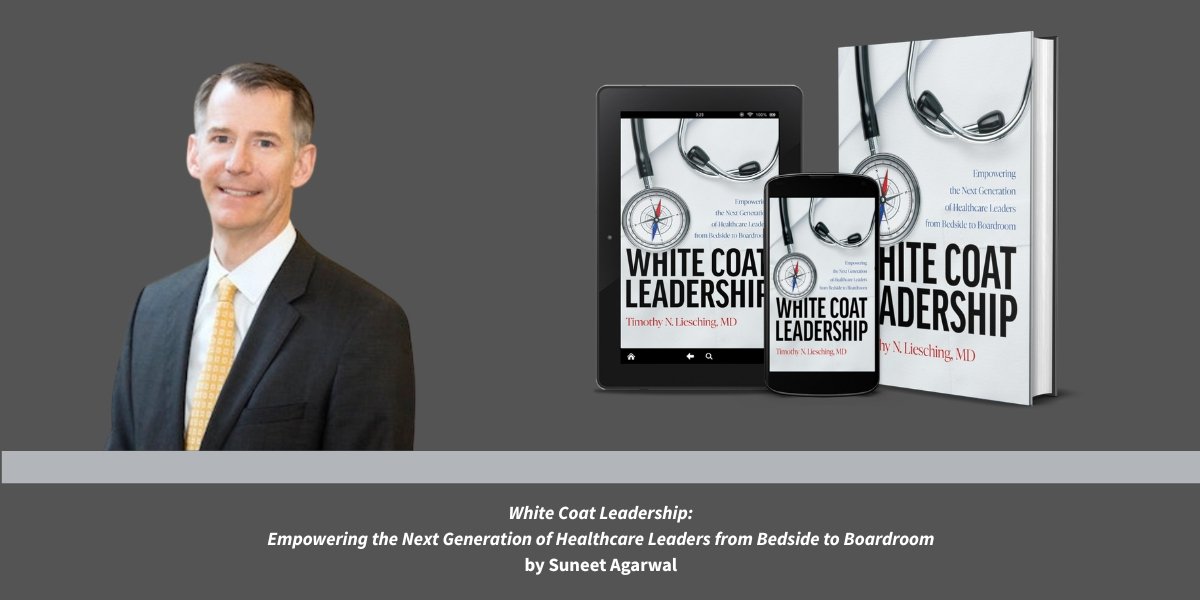
By: Marcus Ellington
There is a moment many clinicians don’t talk about openly.
It happens right after the promotion. The title changes. The responsibilities expand. And instead of feeling accomplished, there’s a quiet sense of pressure building underneath it all.
Timothy does not pretend that moment is rare. In fact, he sees it as the starting point for most leadership struggles in healthcare. The issue is not capability. It is a mindset.
For years, clinicians have been trained to solve problems directly. Precision matters. Speed matters. Outcomes depend on individual performance. Then leadership enters the picture, and suddenly that same approach starts working against them.
The instinct to do everything becomes the very thing that creates overwhelm.
The Shift from Doing to Building
Timothy frames the first real transition in a way that feels almost uncomfortable at first.
Your job is no longer to solve every problem.
It sounds simple, but in practice, it cuts against years of conditioning. Leadership, as he describes it, is less about personal execution and more about creating an environment where others can perform at a high level without constant intervention.
That means setting direction with clarity. It means building systems that actually function. It means trusting people to carry responsibility instead of pulling everything back to yourself.
When that shift happens, something changes. The feeling of drowning starts to fade, not because the workload disappears, but because it is no longer sitting on one person’s shoulders.
Excellence without Ego Is Not What It Sounds Like
In high-performance environments, the word ego carries a strange tension. Remove it completely, and some worry standards will drop. Keep it unchecked, and it starts to distort decision-making.
Timothy pushes back on that assumption.
Excellence without ego does not lower standards. It raises them.
The difference shows up in focus. The ego tends to center performance around the individual. Excellence expands that focus outward. It asks whether the system is working, whether outcomes are improving, and whether the team is actually getting better over time.
Leaders who operate this way become more open to feedback. They adjust faster. They stop protecting ideas and start improving them.
It is a subtle shift, but it changes how decisions are made and how progress is measured.
When Leadership Becomes the Bottleneck
One of the more honest parts of Timothy’s perspective comes from his own early experience.
He believed strong leadership meant being involved in everything. Knowing every detail. Solving problems quickly. Being the person everyone relied on.
For a while, that approach looked effective. Then it started to break down.
The team became dependent. Growth slowed. Every decision is funneled through one person. What felt like control was actually limiting scale.
That realization forced a different approach. Step back. Define priorities. Let others lead within their roles.
It was not an easy adjustment, but it changed how success was measured. Less about personal output. More about what the team could achieve collectively.
That distinction matters more than most leaders realize.
The Gap No One Talks about Enough
Healthcare systems today are under constant pressure. Cost. Burnout. Complexity. All of it is stacking at once.
Timothy points to a specific failure that keeps repeating.
Strategy often sounds strong in meetings. It looks solid on paper. But it does not always translate into the daily reality of frontline teams.
That gap erodes trust quickly.
Clinicians are already navigating time constraints and emotional fatigue. When leadership decisions add complexity without removing friction, it becomes clear that something is off.
Strong leadership closes that gap. It connects high-level thinking with real-world execution in a way that actually makes work easier, not harder.
Without that connection, even good ideas lose credibility.
You Can Feel Leadership before You Measure It
Walk into any healthcare organization, and there is an immediate sense of whether things are working or not.
Timothy describes it as something you can feel before you can quantify.
In strong environments, there is clarity. People understand priorities. Communication flows without friction. There is alignment that shows up consistently across teams.
In weaker environments, the opposite happens. Messaging shifts depending on who you talk to. Teams operate in isolation. There is a visible gap between what leadership says and what people experience.
Another signal is how problems are handled.
In healthy cultures, problems are surfaced and addressed. In struggling ones, they are avoided, normalized, or pushed aside.
That difference alone can determine whether an organization improves or slowly deteriorates over time.
The Intersection That Defines Sustainability
Timothy’s background in finance, clinical care, and executive leadership gives him a broader perspective than most.
He does not separate these areas. He sees them as interconnected.
Finance brings accountability. Medicine brings purpose and human impact. Leadership requires balancing both without compromising either.
Sustainable systems sit right at that intersection.
You cannot deliver high-quality care without financial stability. At the same time, financial success without trust and clinical excellence does not last long.
That balance is where long-term performance actually lives.
What a Self-Sustaining Team Really Looks Like
There is a lot of talk about high-performing teams, but fewer clear descriptions of what that looks like in practice.
Timothy keeps it grounded.
A self-sustaining team does not rely on constant oversight. Roles are clear. Accountability is shared. People feel both empowered and responsible for outcomes.
Communication is natural, not forced. Problems are handled at the point where they occur rather than being unnecessarily escalated.
These teams are not static. They learn. They adjust. They evolve based on results.
Leadership still plays a role, but it shifts toward direction, culture, and obstacle removal rather than managing every detail.
That is where scale becomes possible.
Leadership Starts before the Title
One of the more useful takeaways from Timothy’s perspective is that leadership does not begin with a promotion.
It starts much earlier.
Clinicians can begin by paying attention to how systems function. Where inefficiencies show up. How teams interact under pressure.
Taking initiative in small ways matters. Leading a project. Mentoring a colleague. Offering ideas that improve workflow.
Equally important is understanding how decisions are made beyond the clinical setting. Financially. Operationally. Culturally.
That broader awareness separates those who eventually lead effectively from those who struggle once they get there.
Rethinking What Leadership Actually Means
If there is one belief Timothy challenges directly, it is this.
Leadership is not a position.
Titles may define authority, but they do not define influence. Some of the most impactful leaders operate without formal recognition. They shape culture through how they show up, how they communicate, and how they support others.
When leadership is seen as a set of behaviors instead of a role, something shifts across the entire organization.
More people step into responsibility. More voices contribute to change. Progress becomes less dependent on hierarchy and more driven by collective effort.
In a system as complex as healthcare, that shift is not just helpful. It is necessary.
Because the future of leadership will not be built on control.
It will be built on clarity, trust, and the willingness to let others lead.
His broader perspective on clinician leadership is explored in his book, available on Amazon and Barnes & Noble.


