








By: David Marshall
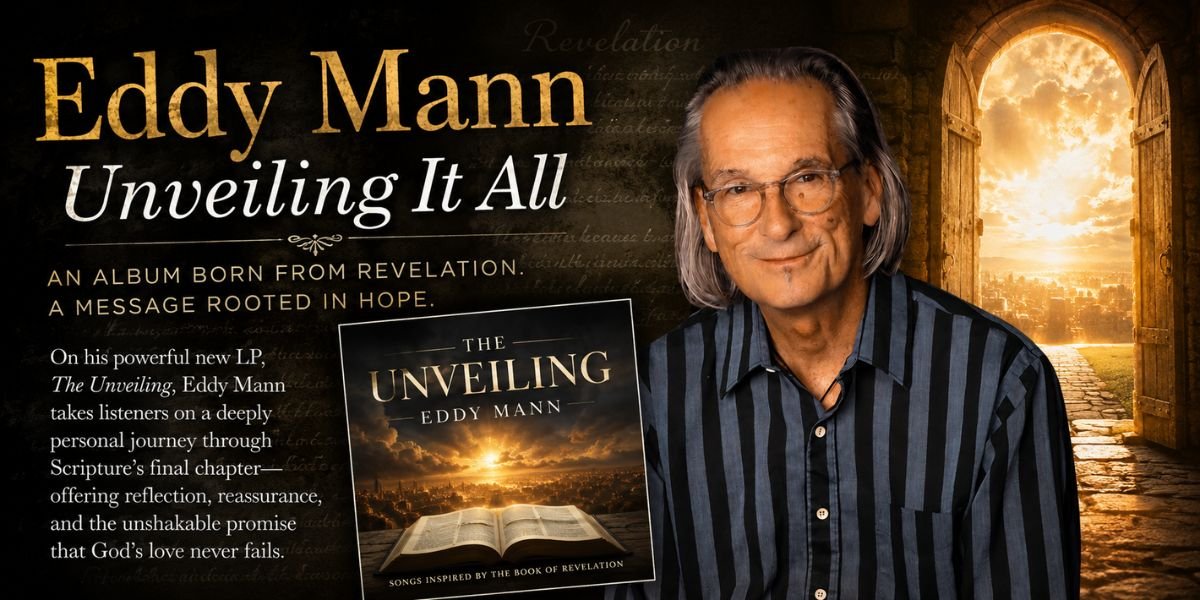
There’s a temptation whenever an artist announces an album inspired by the Book of Revelation to expect bombast. Bigger guitars. Bigger choirs. Bigger declarations about the end of the world. After all, Revelation has supplied enough fire, brimstone, beasts, and cosmic spectacle to fuel centuries of religious imagination.
Eddy Mann isn’t interested in any of that.
On The Unveiling, he does something far more difficult. He strips Revelation down until what’s left isn’t apocalypse, it’s people.
That’s what makes this record work.
Mann has spent years establishing himself as one of Christian music’s most dependable independent voices. He has never chased trends, and he doesn’t begin now. Instead, he leans on what has always served him best: thoughtful songwriting, understated arrangements, and lyrics that trust the listener enough not to overexplain every spiritual truth.
The opening track, “I’m Coming (Remix),” announces the record’s purpose without fanfare. The lyric isn’t about escaping judgment; it’s about living honestly before a God who already knows everything. “You know the things I do… You know my thoughts… You know my intentions.” There’s nowhere to hide, but strangely, that’s where the comfort begins. The repeated promise, “Hold on tightly, I’m coming,” lands less like prophecy than reassurance.
That’s an important distinction because The Unveiling refuses to exploit fear.
“Oh That I’d Walk with You” is one of those songs whose simplicity sneaks up on you. Its repeated plea to walk with Christ in white garments carries centuries of Christian hope inside a handful of carefully chosen words. Mann doesn’t decorate the idea. He lets it breathe.
The same can be said for “The Key of Love,” which quietly argues that love, hope, and trust are inseparable. It isn’t trying to impress anyone with theological vocabulary. It succeeds because the song understands something great spiritual music has always known: complicated truths often arrive dressed in simple language.
“We Are” and “Worthy” move naturally into worship without abandoning the singer-songwriter intimacy that defines the album. These aren’t arena anthems built for lighting rigs and dramatic crescendos. They’re songs that feel equally at home in a sanctuary, a living room, or through headphones during a solitary walk.
The emotional pivot comes with “I Heard, I Saw, And I Watched.” Revelation’s terrifying sequence of conquest, war, famine, death, and martyrdom unfolds almost journalistically. Mann never sensationalizes the imagery. In fact, his restraint becomes the song’s greatest strength. The quiet delivery forces listeners to confront the words themselves instead of hiding behind musical theatrics.
Then comes one of the album’s finest moments.
“I Will Never Know the Desert Again” offers one of Scripture’s most comforting promises: the end of hunger, thirst, fear, and separation. Mann sings it with remarkable tenderness. The Lamb becomes Shepherd, and Revelation’s frightening landscape suddenly opens into green pastures. It’s easily the emotional centerpiece of the record because it reminds listeners what Revelation ultimately points toward: not catastrophe, but restoration.
“The Fall” examines Babylon’s collapse with poetic restraint, emphasizing that worldly power has always been temporary. The song isn’t triumphant; it’s reflective. Mann understands that God’s justice isn’t about celebration over destruction but about the arrival of something infinitely better.
Closing with “Where the Gates Never Close” and “Hallelujah,” The Unveiling reaches its natural destination. Peace replaces uncertainty. Worship replaces waiting. The final songs don’t feel like a grand finale as much as a gentle arrival home.
What separates Eddy Mann from so many contemporary Christian artists is that he trusts songs more than production and conviction more than volume. There’s no attempt to manufacture emotional responses here. The emotion comes honestly because the writing comes honestly.
That’s increasingly rare.
The Unveiling doesn’t pretend to unlock every mystery in Revelation, nor should it. Instead, it reminds us that the Bible’s final book isn’t merely about endings; it’s about faithfulness, perseverance, and the promise that hope survives every trial.
In a musical landscape where louder often masquerades as deeper, Eddy Mann has quietly created one of the year’s most thoughtful Christian albums. He isn’t unveiling secrets.
He’s unveiling faith.
And that’s far more enduring.


