







By Zach Miller
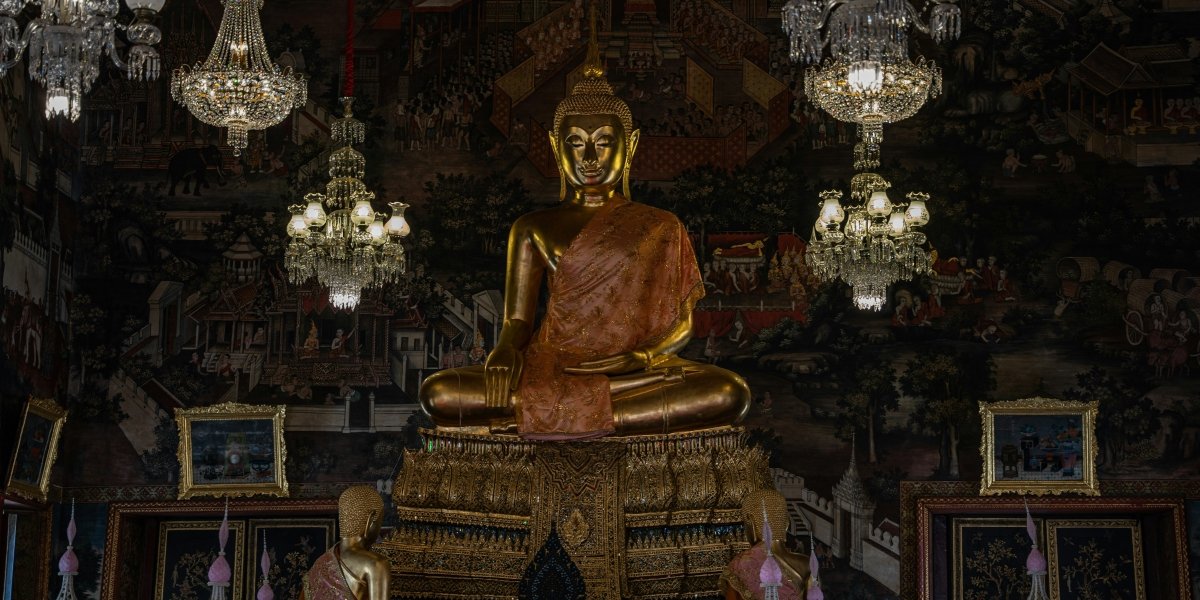
Every Christmas, John Chachas and his parents traveled from Ely, Nevada to San Francisco for the holidays. Ely sits in a remote stretch of the Great Basin, roughly six hours from the Bay Area by the roads of the time, and the trips were an event. Of all the sights the city offered a boy from the Nevada high desert, one made the deepest impression: a nearly eight-foot gilded Buddha standing in the center of Gump’s ground floor, surrounded by jade, silver, and imported Asian art.
“That Buddha made such an impression on me growing up,” Chachas recalled decades later.
It wasn’t the last impression Gump’s would make on him.
A Nevada Boy and the Store He Never Forgot
Gump’s had been a San Francisco institution since 1861, when brothers Solomon and Gustave Gump opened it as a mirror-and-frame shop near what would become Union Square. The store rebuilt after the 1906 earthquake, shifted its identity toward Asian art and luxury goods, and spent the following century outfitting the homes of the California wealthy. Franklin D. Roosevelt bought ship models and smoking jackets there. Sarah Bernhardt found a bronze snake for her Cleopatra role. Items from Gump’s buying trips through the Far East ended up at William Randolph Hearst’s San Simeon estate.
By the time Chachas was making his childhood Christmas visits, the store had been through several ownership changes and was one of the few remaining places in American retail where the merchandise told a coherent story about taste. The Buddha on the ground floor was a Qing dynasty piece. The store had acquired it during a 1957 buying trip in Kyoto for roughly $800.
Chachas left Ely, went to Columbia, then Harvard Business School, and built a career in investment banking at First Boston, Merrill Lynch, and Lazard. By 2005, he was a deal banker with three decades of experience structuring transactions in media and adjacent industries. When Hanover Direct, which had owned Gump’s since the 1990s, decided to sell, Chachas assembled a group of investors and put together an $8.5 million bid, including $500,000 of his own money.
The Fee He Never Got Paid
The deal closed. Then came the question of his arrangement fee.
In lieu of the $250,000 fee for arranging the transaction, he asked a different question: how about giving him the Buddha instead?
Jed Pogran, the former Gump’s president, later recalled it as an afterthought, a way to close the paperwork without writing a check. “I don’t think anyone realized how fine a thing this was,” he said. Chachas had a clearer sense of what he was getting. The store had paid $800 for it in 1957. A 2007 appraisal put its value at $240,000, roughly what he had asked for in cash. The arrangement came with one condition: the Buddha had to stay put. Chachas agreed, and pledged to swap in a replica if he ever removed the original.
“I think they were just happy not to have to write me a check,” he recalled. “So they said, ‘Fine.'”
His instinct was consistent with how he approaches deals generally. In nearly three decades of advising on transactions including the $18 billion buyout of Clear Channel Communications and Disney’s sale of ABC Radio, his work has centered on separating what a company is actually worth from the structure of how it has been run. Other investors looked at a Qing dynasty Buddha sitting on a retail floor and saw a decorative fixture. Chachas looked at it and saw a negotiable asset, one that would be worth considerably more than the fee he had been unable to collect in cash.
From $225,000 to $4 Million
Gump’s went through more ownership changes in the years that followed. Sales slumped under pressure from e-commerce and catalog competitors. The store filed Chapter 11 bankruptcy in August 2018 and began liquidation. Two days before Christmas, after 157 years on Post Street, the doors closed.
The Buddha, as agreed, had no sale tag. Chachas arranged a $25,000 replica through a 3D printing company in Utah, made the swap, and took the original home.
In May 2019, he consigned it to Christie’s in Hong Kong. The auction house described the statue as an “important and monumental” piece of religious statuary, the largest known of its type. An undisclosed buyer paid 31.3 million Hong Kong dollars, roughly $4 million. Nearly 18 times the fee Chachas had originally sought for arranging the 2005 deal.
“Sometimes it’s better to be lucky than smart,” he said.
He used the proceeds to buy Gump’s back. The price for the intellectual property, brand name, trademarks, and customer list was $650,000. He had funded a brand relaunch with an artifact he had taken instead of a paycheck fourteen years earlier.
Small on Purpose
The reopened Gump’s launched in October 2019 near its original Union Square address. The new space covered 2,400 square feet against the former flagship’s 17,000. Chachas described it from the start as a test rather than a triumphant return. “We felt the only way to really evaluate this was to take a swing at it for four months and see if our customers are there.”
Merchandise was pulled back to five categories: jewelry, gifts, home decor, entertaining, and holiday items from 65 of the store’s 125 former vendors. Furniture and apparel stayed out. His daughter Anne Chachas, who took charge of the relaunch, described the goal plainly: “Gump’s is such a remarkable company with such an amazing history, and we really want to keep that story alive.”
The customers came. The store survived COVID. As of early 2026, Gump’s continues to operate at 250 Post Street, in its 165th year in San Francisco.
What’s Actually Worth Saving
There is a consistent thread across how Chachas thinks about investment. He has spent his career in industries built on accumulated institutional trust: media, broadcasting, luxury retail. The relationship between a brand and its audience is the business. The transmitters and the inventory are how you maintain it.
This is why his concern about the destruction of local news carries the same weight as his decision to rescue Gump’s from a bankruptcy auction. When a local newspaper closes, the building and printing equipment are replaceable. The relationship between a community and a source of accountability that took a generation to build cannot be reconstructed by launching a website.
What Chachas acquired in June 2019 was a store that had survived earthquakes, wars, the Great Depression, and a century and a half of shifting tastes. In the end, it was a management team that mistook capital for strategy that brought it down. The question he tested in October 2019 was whether 158 years of accumulated trust between a retailer and its customers could survive a bankruptcy, a relaunch, a pandemic, and a city government that had stopped performing its basic functions.
So far, the answer appears to be yes. The Buddha replica, as promised, found a new home in the relaunched store.
The test continues.


