











Every stored card has an expiry date. That’s obvious. What’s less obvious is how many businesses still treat this as a customer problem rather than an infrastructure one.
When a card expires, gets lost, or is reissued by the bank, the next recurring charge fails. The customer didn’t cancel. They didn’t even know anything had changed. But the payment broke anyway, and the revenue walked out with it.
Network tokenization fixes this at the root. Instead of storing raw card numbers (PANs) that go stale the moment a bank reissues a card, it replaces them with tokens issued by the card networks themselves. These tokens update automatically when the underlying card changes. The customer does nothing. The payment goes through.
What Happens When a Card Gets Tokenized at the Network Level
Most payment teams have worked with tokens before. Gateway tokens, specifically. But gateway tokenization and network tokenization solve different problems, and confusing the two creates blind spots in your payment stack.
Here’s how they compare:
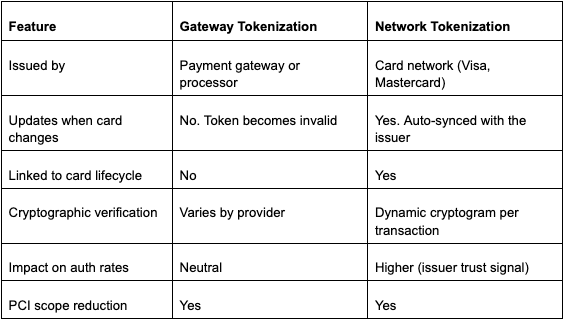
Gateway tokens keep raw card numbers out of your systems. That’s useful for PCI compliance. But they’re static. When the card behind them changes, the token breaks and you’re stuck chasing the customer for updated details.
Network tokens don’t have that problem. They’re linked to the card at the issuer level, so when a bank reissues the card, the token updates without anyone lifting a finger.
The Card Lifecycle Problem That Quietly Bleeds Revenue
Here’s a number that doesn’t get enough attention: somewhere between 20% and 30% of stored cards turn over every year. Expiries, replacements, fraud-related reissues. It happens constantly.
For a subscription business processing thousands of renewals each month, that’s involuntary churn at scale. Customers who wanted to keep paying, lost to a technical gap they never even saw.
Most businesses try to patch this reactively. Account updater services. Retry logic. “Please update your card” emails that sit unread in a promotions tab. These tools help, but they’re chasing a problem that’s already happened.
Network tokenization flips the sequence. The token stays synchronised with the card’s real-time status at the issuer. When the bank issues a new number, the token updates before the next charge fires. The customer doesn’t notice a thing.
What This Actually Does to Authorisation Rates
Issuers pay close attention to how a transaction is presented. A tokenized transaction backed by a network-issued cryptogram signals legitimacy in a way that a raw PAN simply can’t. The issuer sees a current, verified credential. The approval odds go up.
Businesses that adopt network tokenization typically report a two to four-percentage-point increase in authorisation rates. On a base of millions of monthly transactions, that’s recovered revenue you’d otherwise write off as failed billing.
And it compounds. Fewer declines mean fewer support tickets, fewer dunning emails, and fewer customers accidentally lost because a payment silently failed. Anyone who’s managed a subscription operation at scale knows how fast those costs stack up.
Security Without the Conversion Tax
There’s always been a tension in payments between locking things down and keeping the checkout smooth. More security usually means more steps for the customer. More steps mean more abandoned carts.
Network tokenization doesn’t play that game. The token carries no exploitable value on its own. It’s domain-restricted, tied to a specific merchant and channel, and paired with a cryptogram that changes every transaction. If someone intercepts it, they’ve got nothing usable.
Platforms like Juspay have built network tokenization into their orchestration layer, so merchants can activate it across multiple processors without stitching together separate integrations. That removes the barrier that’s kept a lot of mid-market businesses from accessing network-level tokens.
Where This Fits in a Modern Payment Stack
It isn’t something you switch on in isolation. It works best as part of a broader orchestration setup: intelligent routing, smart retries, multi-processor failover. The pieces reinforce each other.
The businesses getting the most out of it treat tokenization as foundational infrastructure, not a feature toggle. When every stored credential is a network token, the entire stack gets more resilient. Higher approvals. Lower fraud. Cleaner reconciliation.
Take Away
Card lifecycle management has been a reactive, manual process for too long. Network tokenization changes that by keeping stored credentials current at the network level, automatically. The result is fewer silent failures, stronger authorisation rates, and a security model that doesn’t punish the customer experience. For any business that stores a card on file, it’s not an optional upgrade. It’s how modern payment infrastructure should work.
Disclaimer: This content is for informational purposes only and is not intended as financial advice, nor does it replace professional financial advice, guidance, or recommendations. Always consult with a qualified financial professional before making any financial decisions.


