








Silicon Valley is obsessed with operating systems — biological, computational, cognitive.
But the OS we rely on most, the one that governs every thought, belief, interpretation, and emotional response, is the one almost no one ever questions:
Language.
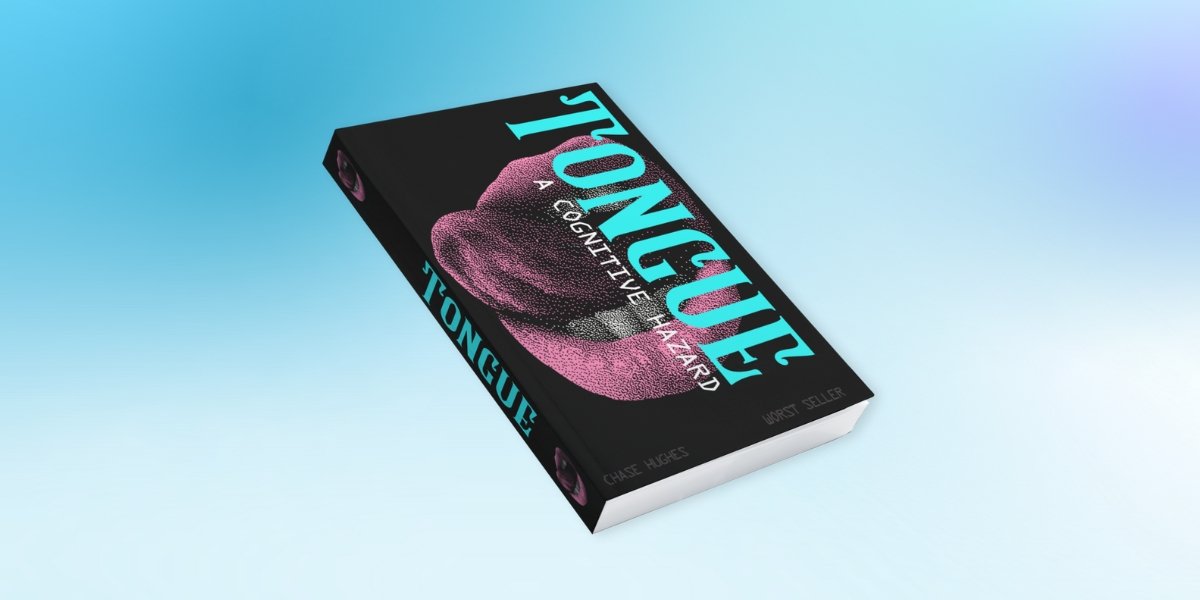
And according to Tongue: A Cognitive Hazard — the small, strange, increasingly whispered-about book by Chase Hughes — language isn’t a neutral tool.
It’s a parasite.
Not metaphorically.
Functionally.
A self-replicating cognitive organism that inserts itself between experience and observation, naming things for you, categorizing them before you feel them, and claiming ownership over ideas, sensations, identities, memories, fears, and relationships as if it created them.
Bay Area readers are responding to this explanation with an unusual level of intensity — partly because the idea fits the region’s obsession with systems, and partly because Tongue forces the reader to feel the parasite at work.
A Book About a Parasite That Behaves Like One
The structure is nothing like typical nonfiction.
It’s short — barely a hundred pages — but it gets inside the reader’s cognitive process the way a piece of malware slips past a firewall: quietly, without announcing itself.
The book inserts:
- breaks
- silences
- rhythm disruptions
- perceptual disorientation
- linguistic pressure
- gaps where the brain rushes to fill meaning
Readers don’t notice the mechanism until they realize they’ve been reacting to the structure rather than the content.
That’s the parasite metaphor in motion.
Language normally steps between reality and the mind so fast you don’t see the handoff.
TONGUE interrupts that exchange.
It shows you the seams.
One engineer described it as:
“The book temporarily disabled the part of my brain that labels everything for me.”
Another said:
“I could feel the space between stimulus and language for the first time.”
For a city built on cognitive frameworks and perception hacking, this experience is hitting a nerve.
Why Tech Readers Are Calling Tongue a Cognitive Exploit
San Francisco lives inside language loops:
- product naming
- investor persuasion
- leadership narratives
- emotional signaling
- community identity
- mission statements
- online conflict
- algorithmic discourse
- daily Slack ecosystems
Everything here is mediated through linguistic abstraction, and the abstraction gets mistaken for truth.
TONGUE argues that this illusion of mastery — the idea that naming something means understanding it — is the parasite’s favorite trick.
Label → illusion of control → reduction of reality → emotional compliance.
Readers report that the book acts like:
- a pattern interrupt for unconscious labeling
- a temporary shutdown of the “inner narrator”
- a moment of separation from inherited language
- a noticeable drop in mental noise
- a shift from interpretation to raw perception
These are not typical book effects.
They’re cognitive symptoms.
The Book Doesn’t Critique Language — It Unhooks It
Most books about language critique grammar, communication, bias, or rhetoric.
TONGUE doesn’t.
It targets the root function:
The way language inserts itself between a person and the world, claiming authorship over thoughts it didn’t create.
It shows how language:
- categorizes before you perceive
- reduces experiences to symbols
- stabilizes identity artificially
- creates emotional reactions by association
- influences memory formation
- triggers inherited frameworks
- and narrows reality to what can be named
The parasite metaphor resonates because the behavior is parasitic:
- it feeds on attention
- it replicates automatically
- it distorts its host
- it convinces the host that it is necessary
- it resists examination
- it hides by feeling familiar
San Francisco’s cognitive-science crowd is calling it “the linguistic equivalent of discovering the gut biome.”
Why a Houston Author Is Resonating in the Bay
Hughes grew up not fitting in — academically, socially, or structurally — and that outsider stance became its own form of perceptual clarity.
He eventually built behavioral programs for military operations where language was weaponized and filtered through pressure. Those environments make the parasite visible: you can watch how certain words hijack physiology, pull emotional levers, and overwrite logic.
But Tongue never teaches any of that directly.
It doesn’t want to tell you how the parasite works.
It wants to make you feel its presence.
Readers say the same thing:
“I finished it and realized I’d been confusing language with truth my entire life.”
Why San Francisco Is the Ideal Petri Dish for This Book
This city is the global center of:
- cognitive experimentation
- AI-driven language models
- attention engineering
- emotional UX
- linguistic compression
- reality abstraction
- identity discourse
- intellectual pattern recognition
If language is a parasite, San Francisco is where it reaches its most elaborate form — through algorithms, memes, branding, political frames, and ideological shorthand.
That’s exactly why Tongue is spreading here faster than anywhere else.
It exposes the layer everyone forgot to question:
the interpreter.
Not the thoughts.
Not the emotions.
Not the beliefs.
The naming engine that shapes all three.
The Verdict From the Bay Area
People aren’t praising Tongue because it’s “insightful.”
They’re talking about it because it’s doing something.
Something subtle.
Something invasive.
Something clarifying.
Something a little unsettling.
The book doesn’t explain the parasite.
It behaves like one — then lets the reader see it.
And in a city where consciousness, technology, and identity are constantly colliding, that makes Tongue feel less like a book and more like a cognitive biopsy.
No wonder the Bay is paying attention.


