






By: Larry Good
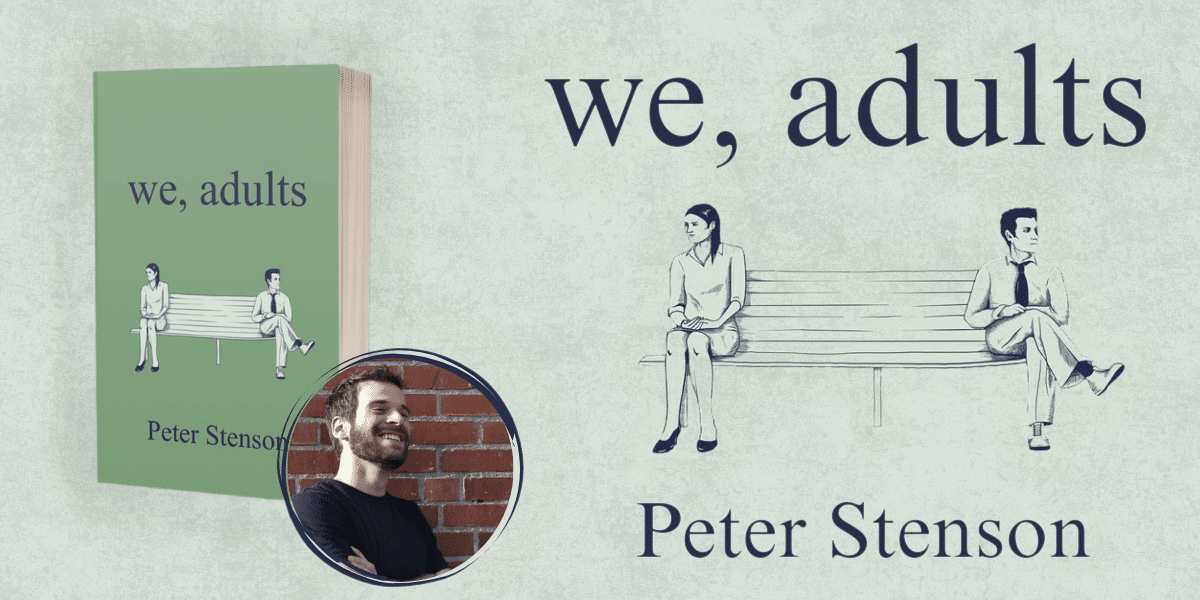
Peter Stenson’s latest novel, We, Adults, is an intriguing departure from his previous works, characterized by a unique structure and a deep exploration of flawed, complex characters. In this interview, Stenson delves into his creative process and the rationale behind his distinctive narrative choices. He reveals that the novel’s diverse modalities—ranging from memoir to screenplay—stem from his own difficulty in maintaining focus and his fascination with varied personal experiences of a single event. Stenson’s candid discussion touches on his approach to screenwriting, his penchant for writing “damaged” characters, and the deeply personal motivations driving his storytelling. Explore the mind behind this compelling new work and the shift from his earlier speculative fiction to a more introspective, realist narrative in We, Adults.
The structure of We, Adults is unusual, as it’s told in distinct sections in different modalities (memoir, screenplay, college admission essays, etc.). Why did you choose to write the novel in this way?
Two reasons: the first is that my brain struggles to maintain focus over 300 pages. I get bored. Maybe this is due to Sesame Street or TikTok or ADHD or maybe it’s because I spent the first decade of my writing career focused on short stories – I don’t know, only that it’s more true than not. Sustaining a singular narrative for the duration of a novel is a slog for me. The second reason is because I’m obsessed with the idea of how people experience the same event differently. This novel centers around a singular event, more or less. The different POVs and modalities are representative of the characters’ experiences in the world. Each character informs the employed modality in an effort to authentically illustrate how the character experienced the singular event.
As a follow-up question, there’s a full-length screenplay as one of the sections of the novel. Do you write screenplays?
No. God no. Much too concise of a format for me. I have an allergic reaction to structure and plot points and “hitting the right beat.” I’d never attempted to write drama of any sort before this novel. I think I bought a how-to book and read a few screenplays (Chinatown, Ordinary People, American Beauty) and was like, I’m ready! It was fun. I think montages are like a cheat code to pacing and emotional reactions, something about the blending of images to sound, so I made sure to put in a few of those. But no, the format is not really my jam.
The characters in your novel—your novels, to be fair—are deeply flawed. Some people have said they can come across as unlikable, which I can see, but wouldn’t agree with. I’d say they are more damaged than unlikeable if that distinction makes sense. What compels you to write your characters like this?
Thank you for pulling your punches with the euphemism of “damaged.” I’d probably go a step further and call them broken. But broken in the sense that we’re all broken. We’re all walking around pretending that we’re not thinking about some person in third grade who said we had a big head or about a partner we cheated on or the death of a loved one or that we mask our mental health issues for the sake of those around us. This is kind of broken. That we’re not okay but we’re okay. Living with the duality of thinking selfish stuff, horrible stuff even, while being, for the most part, decent people. I think that’s really what I wanted to show through these characters. They’re complex and they’re damaged and they’re trying to wrestle away esteem anyway they can, while, at the same time, be good people. I think this is real. If a stranger had access to my thoughts, your thoughts, they’d be like, yikes, that person’s kind of a jerk. Or worse. Because we are. All of us. But people don’t hear those thoughts. And realist fiction that doesn’t present this feels a bit like whitewashing our experiences as humans.
And when you write about your characters, you’re letting us see and feel all of this, and letting us also explore their myriad connections between people?
Exactly. Because it’s all so lonely, life. Crushingly so. Debilitatingly so. I think it’s probably true for everyone. I mean, at their cores, right? How could it not be? Maybe I’m wrong here. Maybe there are people who go through their days and feel perfectly loved and connected with the world and all its inhabitants. I’m not this way. I don’t know how to be. So, I have to get my connection in the mediums it arrives. Art is a big part of this. My students. My family. My writing. Trying to allow “damaged” characters a morsel of connection, oftentimes with undesirable outcomes. Because that’s all I’ve ever wanted.
This desire is certainly evident in your latest novel, We, Adults, which is your fourth published novel. This book, however, is a departure from your previous works, which have been speculative fiction. What prompted this change of genre and style?
I don’t care all that much about the distinctions and designations between genres. Especially between “genre” and “literary.” A story is a story, no? Sure, there are certain tropes and conventions that come into play when you’re writing different types of stories, but at their core, I want my work to be about characters. That’s what I truly care about. What happens in the story, whether it be an affair like in We, Adults or a murderous cult-like in Thirty-Seven, is merely the vehicle in which my characters emotionally get from point A to point B. This is to say my “genre” novels are going to be character-driven, and honestly, my more “literary” or realist fiction is going to be weird. Not completely sure why. The way my brain is wired? How do I experience the world? Massive amounts of psychedelics at an early age? Who knows.
We, Adults Available on Amazon!
Published by: Khy Talara


