







By: Ariana Chan
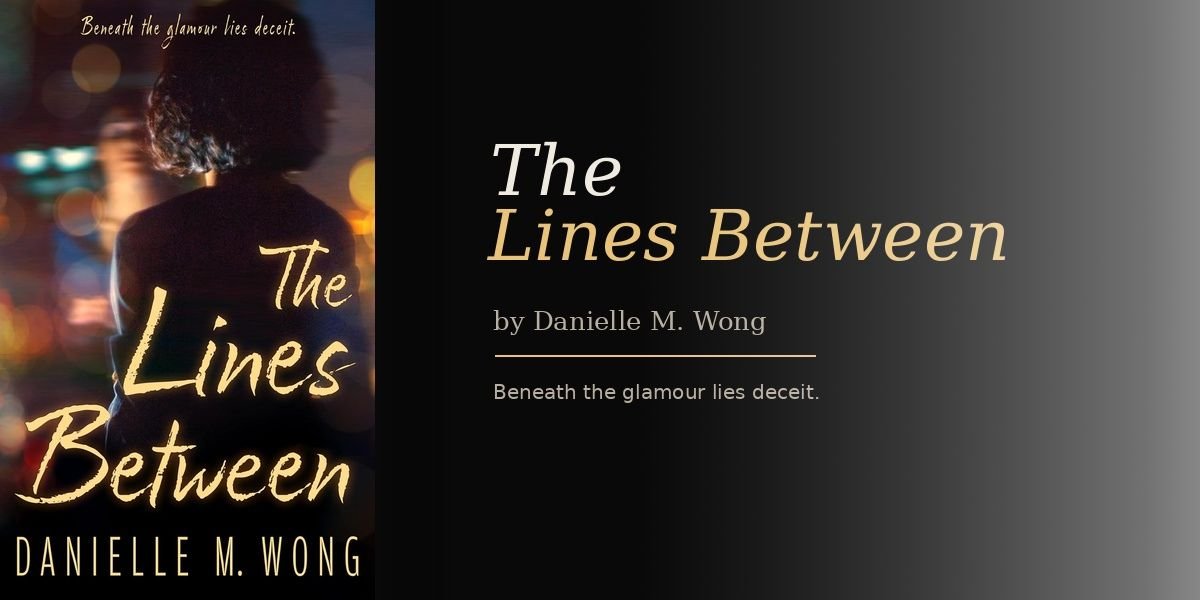
Precision is the quality that separates great psychological thriller fiction from merely good thriller fiction, and it is the quality that Danielle M. Wong brings to The Lines Between in abundance. Every scene is doing exactly what it needs to do, every piece of information is arriving at exactly the right moment, every character’s behavior is coherent with everything we know about who they are and what they need, and the cumulative effect of all that precision is a novel that builds to its eventual revelations with the satisfying inevitability of something that was designed from the beginning to arrive exactly here and to produce exactly this effect.
The Hollywood setting provides the perfect environment for a story that is fundamentally about the gap between what is presented and what is true, because that gap is the organizing principle of celebrity culture, the thing that the entire industry exists to manage and maintain. Wong understands this not just as a thematic observation but as a structural one, and she builds her novel’s entire architecture around the specific ways that gap operates in the world she has chosen to inhabit. The deception in The Lines Between is not an anomaly in an otherwise authentic world. It is the natural expression of a world built on managed appearances, and that systemic quality is what gives the novel its particular and lasting psychological resonance.
Stevie Young is the protagonist that this particular story required, someone whose professional expertise in reading the gap between presentation and reality makes her uniquely equipped to understand what is happening around her and uniquely vulnerable to the specific danger that understanding creates. Wong traces her journey through the novel with the character sensitivity of a writer who cares about the people she is writing about and wants the reader to care about them too, and the result is a thriller in which the eventual revelations matter on a personal level as well as a narrative one.
The multiple perspectives and epistolary elements accumulate with the patient precision that distinguishes Wong’s structural intelligence throughout, each new angle on the story’s events deepening rather than merely complicating the reader’s understanding, each new piece of documentary evidence providing a different register of information that the reader has to evaluate against the testimony of narrators whose reliability is itself part of what the novel is exploring. That layering produces a reading experience that rewards attention at every level, and that arrives at its conclusion with the complete and deeply satisfying logic of something constructed with total care.
The Lines Between is precise and propulsive and psychologically sophisticated, and it is one of the best psychological thrillers currently available to any reader willing to give it the attention it richly deserves and generously rewards.
If you love psychological thrillers in which everything is precisely where it needs to be, every scene earning its place, every piece of information arriving at exactly the right moment, and every revelation satisfying because it has been built toward with complete intelligence and complete care, The Lines Between by Danielle M. Wong is the novel you have been looking for. Pick up your copy on Amazon today and experience what it feels like when a writer with complete mastery of her craft decides to deploy every bit of it in service of a story this worth telling.


