






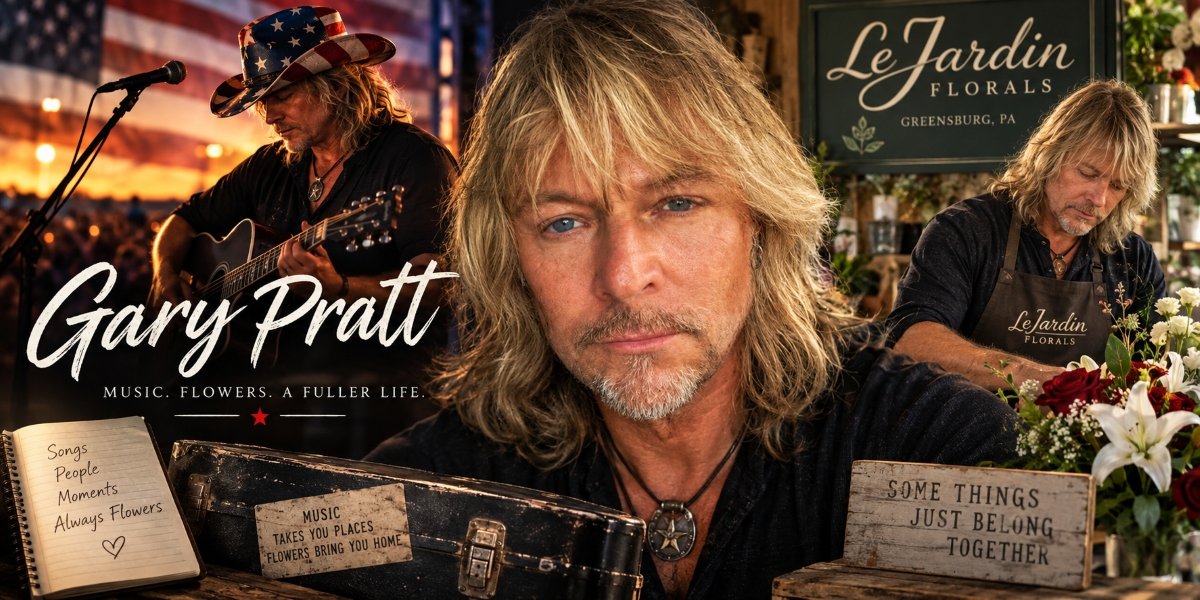
Gary Pratt has spent much of his adult life arranging things.
Sometimes they’re roses, lilies and greenery, assembled by hand until color, shape and texture communicate something the customer cannot quite say. Sometimes they’re words and melodies, organized into country songs about love, loss, faith and the strange business of being alive.
And sometimes they’re fireworks.
For Gary Pratt, the Pennsylvania country singer whose career has steadily expanded from regional stages to international charts, the distance between florist and entertainer isn’t as great as it might initially appear. Both professions involve emotion. Both demand an understanding of presentation. Both require knowing when to add something, and when to leave well enough alone.
In Greensburg, Pennsylvania, Pratt is the owner of LeJardin Florals, a business that has established him within the community independently of his musical career. Long before some listeners discovered his records, customers knew Pratt as the man they called when life demanded flowers: weddings, anniversaries, celebrations, funerals and those ordinary days when somebody simply needed to know they were remembered.
Local recommendations accumulated over the years, frequently singling out Pratt’s creativity and original approach to floral design. There is an interesting symmetry here. A florist works with material that is beautiful precisely because it won’t last forever. A country songwriter spends much of his time trying to make fleeting moments last forever.
Pratt does both.
His musical story stretches back more than a decade, rooted in the small coal-mining town of Slickville, Pennsylvania, and built through years of performing rather than through an overnight industry coronation. Along the way, he has shared stages with country veterans including Pam Tillis, Lorrie Morgan, Ronnie Milsap, Dwight Yoakam, Neal McCoy and Crystal Gayle.
There were festivals. Clubs. Regional shows. Awards. Nominations. Long drives. New songs. Another recording session. Another audience to win over.
That persistence became Pratt’s calling card.
He earned the International Singer-Songwriters Association’s Songwriter of the Year honor in 2021 and collected multiple Josie Music Awards nominations. Other recognition followed, including an ISSA Male Emerging Artist award and independent music honors. His songs found chart success, while his audience continued growing beyond western Pennsylvania.
Yet Pratt’s music has never seemed particularly interested in abandoning western Pennsylvania.
That’s important.
There remains something unmistakably local about his persona, the sense that the guy singing onstage might still remember your name when the lights come back on. Pratt’s appeal isn’t built around the fantasy of being unreachable. It’s built around connection.
His 2021 album Something Worth Remembering demonstrated the more reflective side of that connection. Dedicated to his late brother, the project mixed Pratt’s originals with songs from established Nashville writers. Its title track came from Tony Arata, the Grammy-nominated songwriter behind Garth Brooks’ “The Dance.”
Loss gave that record weight.
But Pratt has never remained permanently fixed in sadness.
His more recent partnership with vocalist Kate Szallar has opened another chapter. Performing as Pratt & Szallar, the pair have developed a stage identity encompassing original country music, contemporary hits, ballads, Christian material and classics. Their relationship as musical partners has increasingly become part of Pratt’s evolving career.
Which brings us to “4th of July.”
Released July 3, 2026, the Gary Pratt featuring Kate Szallar single may be one of the most revealing songs of his career precisely because it refuses to take itself too seriously.
The title suggests patriotism.
The song offers passion.
“4th of July” is essentially a love song with fireworks, and its smartest joke arrives immediately: the story begins on an ordinary February night.
Pratt and Szallar aren’t standing beneath fireworks. They’re inside. Two people are discovering that attraction can make winter feel like summer and an otherwise forgettable evening feel like a national holiday.
The metaphor is gloriously uncomplicated.
Love goes boom.
Pratt doesn’t require a philosophical treatise beyond that.
Kate Szallar’s presence gives the record its necessary second heartbeat. Rather than merely hearing a man describe romantic electricity, the listener hears two voices participating in it. The duet format makes the flirtation communal.
Behind them is Adam Ernst, the Nashville musician and producer who has played on recordings by Bailey Zimmerman, Mickey Guyton and Chase Matthew. Ernst produced “4th of July” and performed every instrument on the track, giving the recording a remarkable unity. It is contemporary enough for today’s country marketplace but retains the melodic directness that has always suited Pratt best.
The song also reveals something about where Gary Pratt stands now.
After years of building a catalog, earning awards and surviving the emotional weather that inevitably enters any long career, he sounds comfortable having fun.
That’s no small achievement.
The music business worships youth, reinvention and the mythology of sudden discovery. Pratt’s career represents another tradition entirely: accumulation.
One gig becomes a hundred.
One listener becomes an audience.
One song becomes a catalog.
One creative life supports another.
Perhaps that’s why the florist story matters.
At LeJardin, Pratt creates something beautiful for people during the most important moments of their lives. Then he walks onto a stage and tries to do essentially the same thing with music.
Flowers and songs are both gestures.
They say congratulations.
They say I’m sorry.
They say I remember.
They say I love you.
And every so often, as on “4th of July,” they simply say that tonight feels pretty good.
After all these years, Gary Pratt is still arranging things.
Only now there are fireworks in the bouquet.


