








By: Julian Marks
San Francisco has always been a city caught between holding on and letting go. Neighborhoods change. People arrive chasing something and leave when the rent, the ambition or the heartbreak becomes too much. Fog swallows the skyline and then disappears as though it had never been there. Beauty and instability somehow occupy the same block.
That makes San Francisco an unexpectedly perfect setting for Cello’s“Stay Here.”
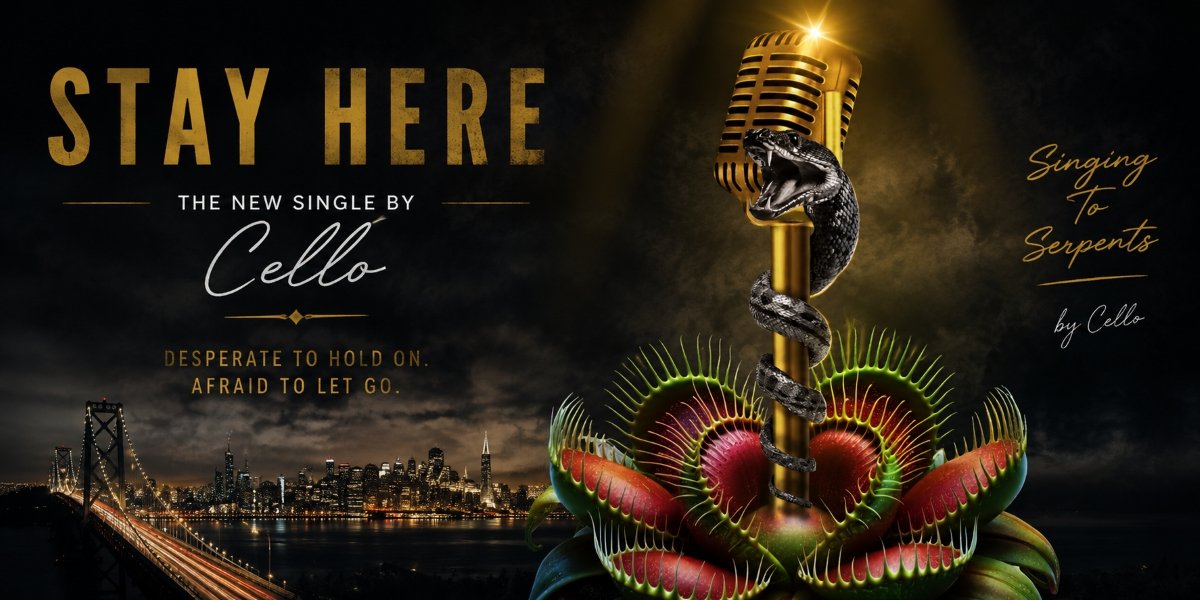
The 3:12 opening track from the Pittsburgh artist’s nine-song Singing to Serpents album is built around precisely that contradiction: desperately wanting somebody to remain while sensing that everything might already be falling apart. Released as part of the LP on March 1, 2026, “Stay Here” establishes the emotional vocabulary that Cello develops throughout the record.
This isn’t a postcard love song.
It’s romance with its hazard lights flashing.
From its opening moments, “Stay Here” drops the listener into an emotional situation already in progress. There’s little introduction because Cello doesn’t need one. His narrator is moving, physically and psychologically, and we’re suddenly riding alongside him.
Other critics have described the song in terms of traffic, desperation, lust and emotional recklessness, and that’s an appropriate reading. The imagery suggests somebody navigating streets while simultaneously navigating a relationship that feels essential and unsustainable.
In San Francisco, you can practically supply the scenery yourself.
Imagine headlights bouncing off wet pavement on Van Ness. A car cuts toward Market. The Bay Bridge glows somewhere behind you. Somebody in the passenger seat hasn’t said anything for five minutes, and suddenly that silence becomes louder than whatever is playing through the speakers.
Then comes the plea.
Stay.
That’s the emotional center of the song, but Cello doesn’t treat those words as a conventional romantic gesture. The repeated refrain becomes increasingly obsessive, almost as though saying something enough times might prevent reality from happening.
Repetition is crucial to Cello’s songwriting.
On “Stay Here,” it functions less like a pop songwriter trying to implant a hook than a thought the narrator cannot stop revisiting. One critical assessment of Singing to Serpents identified this looping quality as central to Cello’s writing: phrases recur like intrusive thoughts, turning emotional fixation into musical structure.
That’s where the song becomes particularly interesting.
Cello has been open about living with autism and ADHD, and while “Stay Here” shouldn’t be reduced to a song about neurodivergence, its heightened emotional focus and repetition offer an intriguing window into his broader artistic perspective. His songs frequently seem less interested in describing thoughts than reproducing the experience of being trapped inside them.
“Stay Here” doesn’t tell us that someone is obsessed.
It makes obsession audible.
That distinction separates Cello from countless artists working around the increasingly crowded intersection of alternative pop, hip-hop and confessional songwriting.
There’s another San Francisco connection here, too.
This city has historically rewarded musicians willing to be strange.
From the psychedelic revolution of Haight-Ashbury to punk at the Mabuhay Gardens, San Francisco’s most interesting musical movements rarely emerged because somebody decided to follow the prevailing commercial formula. They happened because artists found audiences willing to tolerate, and occasionally celebrate, experimentation.
Cello belongs philosophically to that tradition.
“Stay Here” isn’t psychedelic rock, punk or anything else easily filed beneath the city’s historical banners. But it shares their resistance to cleanliness. Cello allows the seams to remain visible.
His narrator can be romantic and reckless.
Tender and aggravating.
Vulnerable and arrogant.
The relationship can feel like salvation one second and catastrophe the next.
That’s why the track works.
EARMILK characterized “Stay Here” as an unusually blunt and introspective song in which weakness and strength coexist, while another review called it one of Singing to Serpents’ strongest moments precisely because it refuses to settle emotionally.
There is no sanitized protagonist here.
Cello isn’t auditioning to become somebody’s perfect boyfriend. He’s documenting what wanting another person can actually resemble when longing overwhelms good judgment.
And sometimes love looks ugly up close.
That’s the risk Cello takes.
Contemporary pop frequently presents vulnerability after it has been processed, edited and made inspirational. The singer suffered, learned the lesson, wrote the chorus and emerged stronger.
“Stay Here” catches the singer before the lesson.
He’s still inside it.
That makes the song feel wonderfully unresolved.
By the final moments, you haven’t been given a clear answer about whether this relationship survives. That’s almost beside the point. The important thing is the desperation contained within the request itself, the primal human terror that somebody important might walk away.
San Francisco knows something about impermanence.
Buildings disappear. Scenes vanish. Friends move away. Lovers become memories. Even the fog refuses to stay.
Against that backdrop, Cello’s simple request suddenly sounds enormous:
Stay here.
Maybe that’s why this Pittsburgh artist’s song feels strangely native to a city three thousand miles away.
Because underneath the atmospheric production, restless language and emotional turbulence, “Stay Here” isn’t really asking for permanence.
It’s asking for one more moment before everything changes.
And in San Francisco, that’s practically a civic anthem.


