









By: Jessica Smith
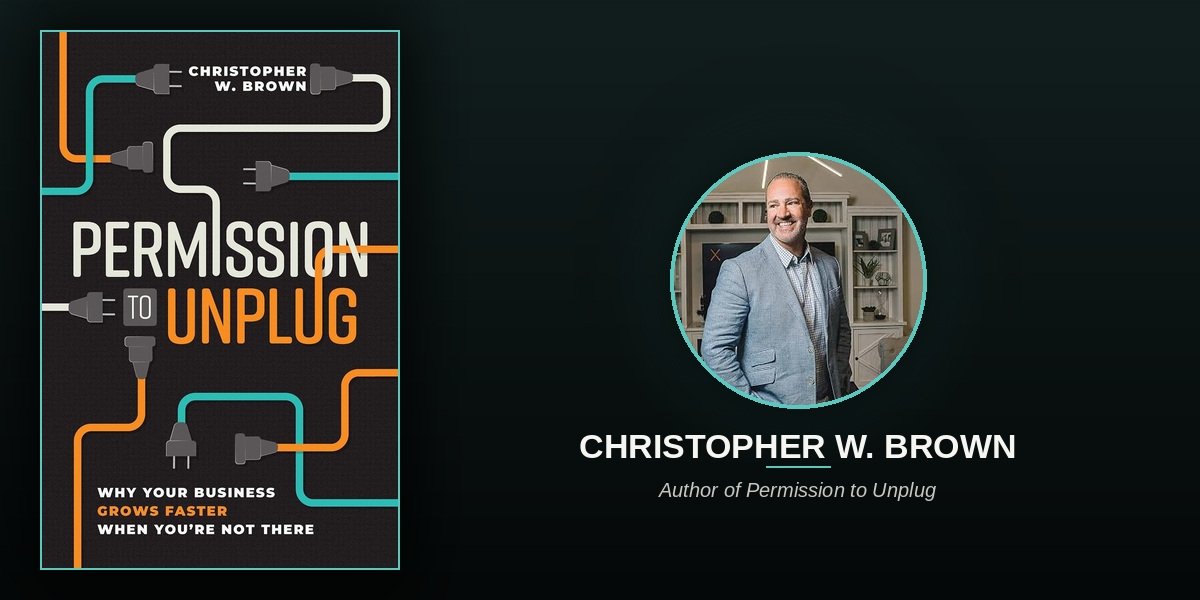
The title of Christopher Brown’s book sounds like a permission slip, which is exactly what it is. Permission to Unplug: Why Your Business Grows Faster When You’re Not There makes an argument that runs directly against the dominant culture of entrepreneurship. And it makes it clear, not just from personal experience but from neuroscience research, that most business leaders have never encountered in a context that makes it feel immediately applicable to their daily decisions.
When founders and executives believe constant presence equals leadership, they operate on an assumption that feels like common sense and, in practice, becomes a major barrier to the growth they’re trying to build. A business organized around a single person’s constant involvement is not scalable. It is a dependency structure that caps potential at the limits of one person’s time, attention, and energy. And one person’s time, attention, and energy, however extraordinary, is a finite resource that eventually runs out.
Christopher spent thirty years learning this lesson the hard way. Three decades of building companies that couldn’t survive without him, that he was proud of building, that he wore as a badge of commitment. Then a month-long family cruise across the South Pacific proved that they could survive without him. Then a heart attack on June 1, 2016, proved that the stakes of not changing the model were existential in a way that quarterly revenue projections had never captured.
What the Brain Actually Needs
The neuroscience Christopher incorporates into the book makes the case in terms that go beyond personal preference or leadership philosophy. When people disconnect genuinely, not just physically absent while mentally consumed by notifications and concerns, their brains function differently in ways that are measurable and significant. Creativity increases. Resilience improves. The capacity for complex problem-solving expands. The default mode network, the brain system associated with creative insight and long-range thinking, activates more fully when it is not perpetually crowded out by the reactive demands of constant operational presence.
Christopher’s most significant business insights didn’t happen sitting in his office. They happened while traveling, while exercising, while spending meaningful time with the people in his life. Experiences are not distractions from building a business. They are fuel for the kind of leadership that builds something genuinely worth having. The entrepreneur who never unplugs is not working at full capacity. They are working at a diminished fraction of it, mistaking busyness for effectiveness and exhaustion for commitment, and producing less strategic value than they would if they stepped away more often.
The Shift From Busy to Intentional
The book’s core framework is a shift from being busy to being intentional, and that shift requires several things most entrepreneurs resist until they have no choice but to confront them. It requires redefining what success actually looks like beyond calendar fullness and hours worked. It requires building systems that remove the founder as the operational bottleneck. It requires creating teams that can handle decisions without constant oversight and escalation. And it requires treating experiences not as a luxury earned after sufficient productivity but as a strategic investment in the quality of leadership the business needs.
The irony Christopher has lived and documented is real and specific. When you unplug intentionally, you don’t become a weaker leader. You return with more creativity, better perspective, stronger relationships, and the clarity to make better decisions than constant presence ever produced. The disconnection that feels risky turns out to be the investment that makes the reconnection more valuable.
The First Step
Christopher is practical about where this starts for leaders who are skeptical or simply don’t know how to begin. Most entrepreneurs don’t need to disappear for thirty days tomorrow. They need to remove themselves from one responsibility that drains their energy and replace it with a system, delegation, or an automated process that handles it reliably without their involvement.
Free up one Friday. Delegate one recurring task. Take one long weekend completely unplugged and let the business prove to itself, and to you, that it can function without your constant presence. The goal of that first step is not rest. It is proof. And once an entrepreneur has experienced that their company can survive and even thrive without them, the whole conversation about what leadership actually requires becomes permanently different.
If you’ve built something meaningful but quietly wonder if this pace is sustainable, Permission to Unplug by Christopher Brown is available now on Amazon.
Disclaimer: This content is for general informational purposes only and should not be considered as financial advice. The content is not intended to be a substitute for professional financial advice, investment advice, or any other type of advice. You should seek the advice of a qualified financial advisor or other professional before making any financial decisions.


