Christopher Brown Says a Faster Way to Grow Your Business Might Be to Stop Being There So Much. The Science Backs Him Up.

By: Jessica Smith

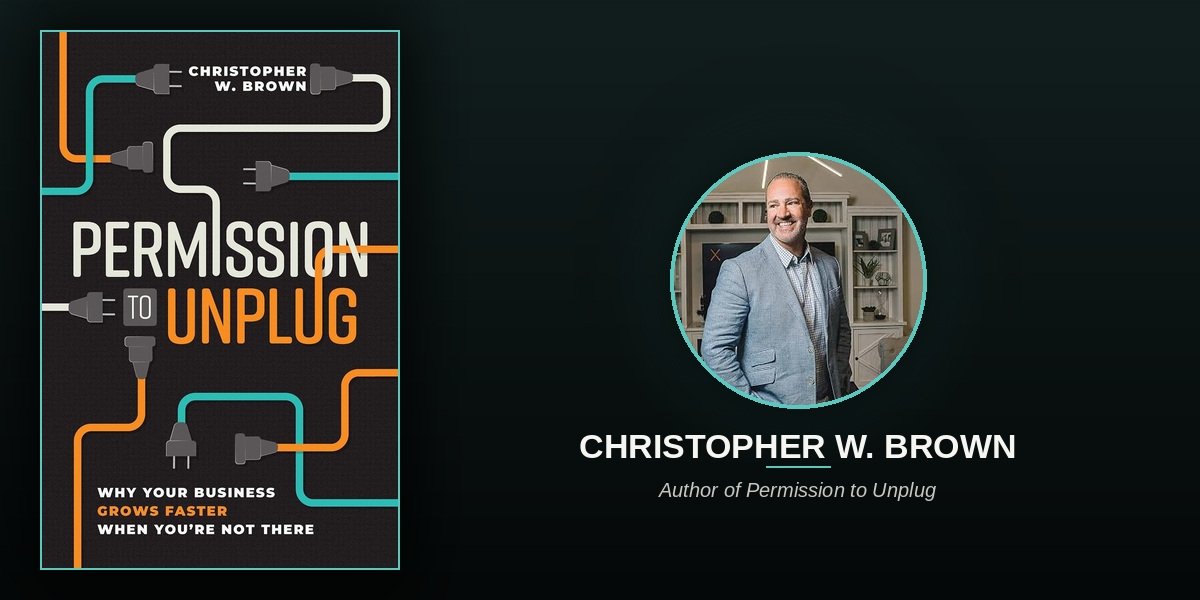
The title of Christopher Brown’s book sounds like a permission slip, which is exactly what it is. Permission to Unplug: Why Your Business Grows Faster When You’re Not There makes an argument that runs directly against the dominant culture of entrepreneurship. And it makes it clear, not just from personal experience but from neuroscience research, that most business leaders have never encountered in a context that makes it feel immediately applicable to their daily decisions.

When founders and executives believe constant presence equals leadership, they operate on an assumption that feels like common sense and, in practice, becomes a major barrier to the growth they’re trying to build. A business organized around a single person’s constant involvement is not scalable. It is a dependency structure that caps potential at the limits of one person’s time, attention, and energy. And one person’s time, attention, and energy, however extraordinary, is a finite resource that eventually runs out.

Christopher spent thirty years learning this lesson the hard way. Three decades of building companies that couldn’t survive without him, that he was proud of building, that he wore as a badge of commitment. Then a month-long family cruise across the South Pacific proved that they could survive without him. Then a heart attack on June 1, 2016, proved that the stakes of not changing the model were existential in a way that quarterly revenue projections had never captured.

What the Brain Actually Needs

The neuroscience Christopher incorporates into the book makes the case in terms that go beyond personal preference or leadership philosophy. When people disconnect genuinely, not just physically absent while mentally consumed by notifications and concerns, their brains function differently in ways that are measurable and significant. Creativity increases. Resilience improves. The capacity for complex problem-solving expands. The default mode network, the brain system associated with creative insight and long-range thinking, activates more fully when it is not perpetually crowded out by the reactive demands of constant operational presence.

Christopher’s most significant business insights didn’t happen sitting in his office. They happened while traveling, while exercising, while spending meaningful time with the people in his life. Experiences are not distractions from building a business. They are fuel for the kind of leadership that builds something genuinely worth having. The entrepreneur who never unplugs is not working at full capacity. They are working at a diminished fraction of it, mistaking busyness for effectiveness and exhaustion for commitment, and producing less strategic value than they would if they stepped away more often.

The Shift From Busy to Intentional

The book’s core framework is a shift from being busy to being intentional, and that shift requires several things most entrepreneurs resist until they have no choice but to confront them. It requires redefining what success actually looks like beyond calendar fullness and hours worked. It requires building systems that remove the founder as the operational bottleneck. It requires creating teams that can handle decisions without constant oversight and escalation. And it requires treating experiences not as a luxury earned after sufficient productivity but as a strategic investment in the quality of leadership the business needs.

The irony Christopher has lived and documented is real and specific. When you unplug intentionally, you don’t become a weaker leader. You return with more creativity, better perspective, stronger relationships, and the clarity to make better decisions than constant presence ever produced. The disconnection that feels risky turns out to be the investment that makes the reconnection more valuable.

The First Step

Christopher is practical about where this starts for leaders who are skeptical or simply don’t know how to begin. Most entrepreneurs don’t need to disappear for thirty days tomorrow. They need to remove themselves from one responsibility that drains their energy and replace it with a system, delegation, or an automated process that handles it reliably without their involvement.

Free up one Friday. Delegate one recurring task. Take one long weekend completely unplugged and let the business prove to itself, and to you, that it can function without your constant presence. The goal of that first step is not rest. It is proof. And once an entrepreneur has experienced that their company can survive and even thrive without them, the whole conversation about what leadership actually requires becomes permanently different.

If you’ve built something meaningful but quietly wonder if this pace is sustainable, Permission to Unplug by Christopher Brown is available now on Amazon.

Disclaimer: This content is for general informational purposes only and should not be considered as financial advice. The content is not intended to be a substitute for professional financial advice, investment advice, or any other type of advice. You should seek the advice of a qualified financial advisor or other professional before making any financial decisions.

San Francisco Robotaxi Lots Raise Housing Questions

San Francisco robotaxi lots are drawing closer scrutiny as autonomous fleets require centrally located space for parking, charging and servicing while the city struggles to move tens of thousands of proposed homes into construction. The debate centers less on whether robotaxis caused the housing slowdown and more on how scarce urban land is being used as both sectors expand.

Key Takeaways

  • Waymo vehicles were documented using a large staging yard near Fifth and Brannan streets in September 2026, highlighting the physical space required by autonomous fleets.
  • San Francisco had 75,853 units in its housing development pipeline in the second quarter of 2026, but only 3,301 were under construction.
  • The city added a net 2,669 homes in 2025, about 26% below its 10-year annual average.
  • San Francisco has already adopted additional review requirements for some fleet-charging facilities, while another charging-related zoning measure remained pending in 2026.
  • The nearby 160 Freelon affordable-housing project is under construction, making it important not to describe the Fifth-and-Brannan robotaxi activity as having displaced that development.

San Francisco Robotaxi Lots Add a New Land-Use Pressure

A large staging yard near Fifth and Brannan streets has brought the land question into clearer view.

Mission Local documented scores of Waymo vehicles moving through the site on Sept. 10, with cars leaving and returning as part of regular fleet operations. The observation illustrates a less visible requirement of driverless transportation: vehicles still need locations where they can sit between trips, receive service and prepare to return to the road.

“Autonomous vehicle fleets need places to park and charge them,” Molly Turner, a lecturer at UC Berkeley’s Haas School of Business specializing in urban technology, told Mission Local.

The demand for that space is becoming more relevant as Waymo broadens its Bay Area operations. The company expanded its autonomous service footprint in 2026, while its newer Ojai vehicles also entered regular San Francisco passenger service through the Waymo Ojai rollout.

That growth does not establish that robotaxi facilities are preventing housing construction. San Francisco development remains constrained by a wider combination of financing conditions, construction costs, project timing and lengthy development schedules.

The land-use question is narrower. Some autonomous-vehicle facilities occupy relatively large parcels or garages in areas where residential or mixed-use development is also possible. Temporary staging can be relatively easy to relocate. Charging operations requiring significant electrical equipment can create a more durable use.

That distinction matters when properties remain inactive for years between project approval and construction.

Housing Pipeline Data Shows a Larger Construction Problem

San Francisco’s own figures show that the immediate housing challenge remains converting plans into completed homes.

The Planning Department reported 75,853 new units in the development pipeline for the second quarter of 2026. Only 3,301, or about 4%, were under construction. Another 37,577 units were tied to major multi-phase projects, including Treasure Island, Candlestick Point, Parkmerced, Pier 70 and other large developments.

The city also recorded a net addition of 2,669 homes in 2025. That was approximately 26% below the 10-year annual average of 3,622 units, according to the Planning Department’s housing inventory.

Those figures sit against San Francisco’s Regional Housing Needs Allocation of 82,069 homes for the 2023-2031 planning cycle. The allocation represents a citywide housing target across multiple income levels rather than a yearly construction requirement.

Large projects continue to change as developers attempt to make construction workable. The proposed Pier 70 housing expansion, for example, would add roughly 600 homes to that project’s potential residential capacity if approved.

The Fifth-and-Brannan area also illustrates why parcel-level distinctions are important.

Part of the broader 598 Brannan development previously involved land set aside for affordable housing. That parcel became the 160 Freelon project, which is now being built as an 85-unit, 100% affordable development. The building reached its structural topping-out milestone in May 2026, and project information lists completion in 2027.

That current status means the robotaxi staging yard observed near Fifth and Brannan should not be presented as evidence that the 160 Freelon homes were replaced by autonomous vehicles.

Instead, the site demonstrates a broader pattern. Dense San Francisco neighborhoods can contain active construction, entitled projects, vacant land, parking facilities and emerging transportation infrastructure within a small geographic area.

Fleet Charging Can Make Short-Term Land Uses More Durable

San Francisco has already adjusted its planning rules to account for the growth of fleet charging.

An ordinance enacted in March 2024 requires conditional-use authorization when private parking lots or vehicle-storage lots in Production, Distribution and Repair districts are converted to fleet-charging uses. Planning documents specifically noted that the category can include autonomous-vehicle fleets.

The city has also reviewed charging operations at individual properties. A project at 825 Sansome Street, for example, involved 30 private fleet chargers on the upper level of an existing garage alongside 18 public chargers at ground level.

A separate proposal introduced in April 2026 would impose temporary conditional-use requirements on certain unattended nighttime electric-vehicle charging locations outside specified industrial districts. City records continued to list that measure as pending committee action.

Those regulations reflect a practical difference between ordinary parking and charging infrastructure. A simple surface staging lot may be cleared when a property owner is ready to build. A site with electrical upgrades, charging equipment and longer-term operating arrangements may take more effort to convert to another use.

That does not mean charging facilities permanently remove land from the housing pipeline. It means the duration and infrastructure attached to each site matter when evaluating its future development potential.

San Francisco robotaxi lots therefore represent one element of a much larger development equation, not a demonstrated cause of the city’s housing shortfall. The more immediate constraint remains the gap between the number of homes proposed and the number reaching construction. The longer-term land-use issue is whether fleet facilities remain temporary or become established uses on sites that could eventually support additional housing.

Frequently Asked Questions

Are San Francisco robotaxi lots stopping housing construction?

There is no clear evidence that San Francisco robotaxi lots are a primary cause of slow housing construction. City data point to a broader gap between proposed projects and active construction, with financing, project timing and development feasibility also affecting housing production.

Why do robotaxis need large parking or charging sites?

Autonomous fleets require places for vehicles to wait between trips, charge, receive maintenance and be cleaned. Operators also have an incentive to position those facilities near areas where passenger demand is concentrated.

How many homes are in San Francisco’s development pipeline?

San Francisco Planning reported 75,853 new pipeline units in the second quarter of 2026. Of those, 3,301 were under construction and about half were associated with major multi-phase developments.

Is housing being built near the Fifth-and-Brannan robotaxi site?

Yes. The nearby 160 Freelon development is an 85-unit affordable-housing project under construction, with completion scheduled for 2027. Its status is an important reason not to characterize the nearby robotaxi staging operation as having displaced that housing project.