








There’s a point where Alan Griesinger’s work stops feeling like literary analysis and starts feeling like something else entirely.
Less about books. More about being.
In this part of his inquiry, Alan Griesinger takes a question that already feels heavy and makes it harder to ignore.
What does it mean to be a living soul?
And then he adds another layer.
Do completely different traditions, like Eastern meditation and Western religious thought, end up pointing to the same place?
It Starts With Something Almost Too Simple
Breathing.
Not philosophy. Not theology. Not an argument.
Just breathe.
In his third book, Alan opens and closes with a poem about following the breath. In and out. Nothing complicated about it.
But the longer you sit with that idea, the less simple it feels.
Breathing is constant. It keeps going whether you are paying attention or not. Most of the time, you are not.
That gap matters.
Because the moment you start paying attention, something shifts. The mind slows down a little. The noise drops just enough to notice what is actually happening.
Not in theory. Right now.
The Practice That Keeps Pulling You Back
Alan treats this practice like a compass.
Whenever his thinking drifted too far into abstraction, he came back to the breath.
That tells you something.
It is easy to get lost in ideas about meaning, purpose, the soul. You can talk about them endlessly and still feel disconnected from them.
The breath cuts through that.
It ties you to something physical and immediate while still pointing beyond itself.
You inhale from the world. You exhale back into it.
There is no separation there, at least not the kind we usually imagine.
Two Worlds That Didn’t Seem to Fit
Earlier in his life, Alan felt like he was split between two very different spaces.
On one side, the classroom. Teaching Homer, Geoffrey Chaucer, and William Shakespeare. Stories, language, tradition.
On the other side, the meditation hall. Silent, stripped down, focused on presence rather than narrative.
For a while, those worlds did not connect.
One felt intellectual. The other felt experiential.
One told stories. The other asked you to sit still and watch your mind unravel itself.
It looked like a contradiction.
The Moment They Started to Overlap
Over time, something changed.
Not suddenly. More like a slow recognition.
Both traditions were circling the same problem.
How do you live in a way that is not driven entirely by impulse, ego, or distraction?
Literature shows characters failing at that and sometimes learning.
Meditation shows you, in real time, how your own mind jumps, clings, avoids, and repeats.
Different languages. Same territory.
That realization reframed everything for Alan.
He stopped seeing them as separate paths and started seeing them as parallel attempts to describe the same experience.
The Breath and the “Breath of Life”
There is a moment where these ideas collide directly.
In the Biblical account of creation, life begins with breath. Not metaphorically. Literally.
That image stuck with Alan.
Because in meditation, breath is also the anchor. The starting point. The thing you return to when everything else pulls you away.
It creates a strange overlap.
Different traditions, different histories, different assumptions.
And yet both point to breath as something more than mechanical.
Something foundational.
Why Attention Is the Real Work
One detail in Alan’s thinking stands out.
The practice of following the breath is not about controlling your thoughts.
It is about noticing them.
That sounds small. It is not.
Because once you start paying attention, you see how little control you actually have.
Thoughts appear. Emotions rise. Attention drifts.
Again and again.
The breath does not stop.
It just waits for you to come back.
That cycle, drifting and returning, becomes the practice.
And maybe something more.
The Influence That Deepened the Question
At a certain point, Alan’s thinking was shaped heavily by Roger Scruton.
Scruton’s work is not light reading. It digs into ideas about the sacred, about meaning, about how people experience something beyond themselves without always being able to define it.
One idea in particular stands out.
Human consciousness is layered.
Like a city built over centuries. New structures on top, older ones underneath, all of it still present in some way.
But at any given moment, you only experience the present layer.
That tension between depth and immediacy is hard to hold onto.
Meditation brushes up against it. So does literature, in a different way.
The Idea of Something Shared
Scruton also points to parallels between traditions.
Different languages describe something that feels similar at its core.
In Hindu thought, there is the idea of a universal source and the individual self moving toward it.
In Western thought, there are parallel ideas, framed differently.
Alan does not try to flatten these differences.
But he does suggest they are not as disconnected as people assume.
There is a shared attempt to describe what it feels like to be part of something larger while still being an individual.
Why Ritual Still Matters
One part of the conversation that often gets dismissed is ritual.
Modern thinking tends to treat it as outdated or purely symbolic.
Alan, influenced again by Roger Scruton, pushes back on that.
Ritual is not just storytelling.
It is participation.
It lets people experience ideas physically, not just think about them.
Moments of pause, reflection, repetition. They create space to step out of constant motion.
Without that, everything blends together.
Beginner’s Mind and Starting Over
Another thread comes from Shunryu Suzuki.
The idea of “beginner’s mind.”
It sounds nice. Almost harmless.
But it carries a sharp edge.
No matter how much you think you understand, you are still at the beginning.
That can feel frustrating.
Or it can feel freeing.
Because it removes the pressure to arrive somewhere final.
Instead, you keep returning. Like the breath.
So Do These Paths Actually Meet
Alan does not force a clean answer.
He does not say Eastern meditation and Western spiritual thought are the same.
That would be too easy.
But he does suggest they overlap in a meaningful way.
Both point toward awareness.
Both push against ego.
Both create space to step back from the constant noise of identity and expectation.
And both, in their own way, circle the same question.
What does it mean to actually be here, alive, aware, and responsible for how you move through the world?
The Part That Stays With You
What lingers is not a conclusion.
It is a shift in attention.
The idea that something as ordinary as breathing could hold more weight than we give it.
Those stories and silence might be working toward the same insight from different directions.
And that being a “living soul” is not something you define once and move on from.
It is something you keep noticing.
Usually, when you slow down enough to realize you have been missing it.
Looking for something thoughtful with a sharp edge?
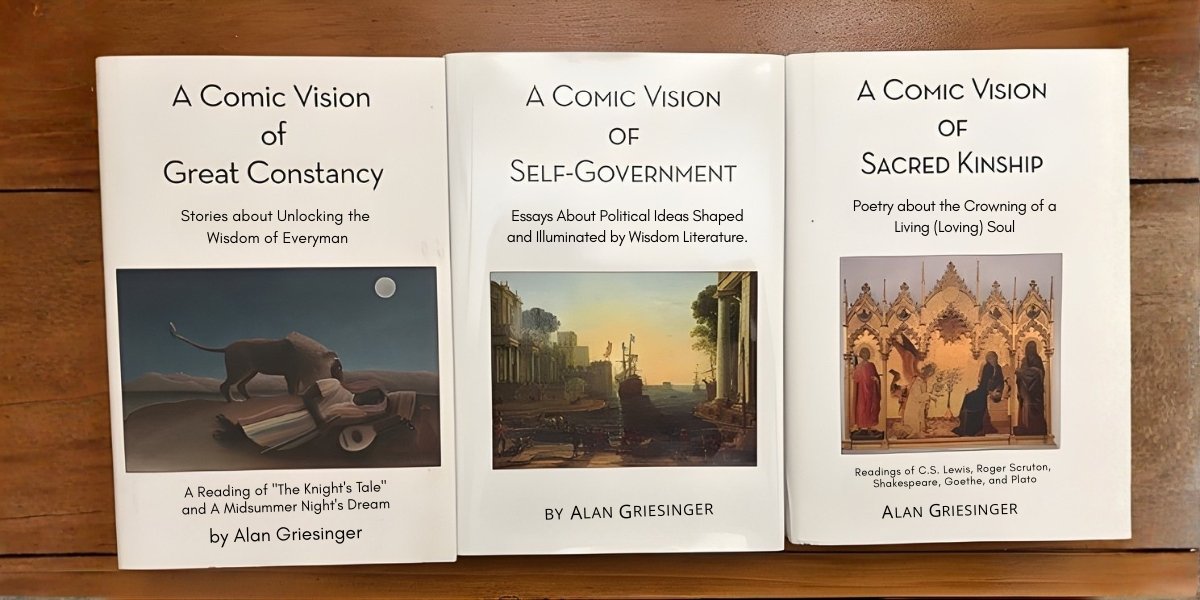
Alan Greisinger’s A Comic Vision of Great Constancy: Stories about Unlocking offers stories that mix insight, humor, and reflection in a way that stays with you.
Explore more and discover the book at: A Comic Vision


