Asi Vidal Takes Entertainment Innovation to The Blox Season 21

The pressure of a packed dance floor waiting for the beat to drop is nothing compared to the ticking clock of a high-stakes boardroom pitch. For Los Angeles-based DJ, producer, and entrepreneur Asi Vidal, these two worlds recently collided. He joined the cast of Season 21 of The Blox, a long-running competition television series for startups now spanning more than 20 seasons.

The new season brings together a roster of entrepreneurs from around the globe. Among the participants is Asi Vidal, the founder and driving force behind Angels Music Productions, who traveled from the event stages of Southern California to the fast-paced incubator environment of Oklahoma, where the season was filmed.

What Sets The Blox Apart From Other Startup Shows?

The Blox takes a different approach to business television. Season 21 features entrepreneurs locked into five relentless days where high-level strategy meets breakneck speed. From the very first challenge, execution decides everything.

The show pushes founders to their limits, placing them in an environment where innovation, leadership skills, and the ability to perform under pressure are constantly tested. For the entrepreneurs who flew into Oklahoma to film this season, there was no hiding behind polished pitch decks or marketing jargon. It was business acumen on full display.

How Angels Music Productions Shaped Asi Vidal’s Competitive Edge

Asi Vidal Takes Entertainment Innovation to The Blox Season 21


Photo Courtesy: Asi Vidal

Asi Vidal brought a perspective rooted in live entertainment to the table. As the founder of Angels Music Productions, he has built a Los Angeles-based experiential company that specializes in transforming ordinary spaces into memorable sensory experiences.

His services include professional DJ and MC hosting, high-end audiovisual production, the installation of LED walls and interactive dance floors, and immersive event experiences complete with photo booths.

Running a business where the product is a flawless, live, unrepeatable moment leaves no room for error. That exact mindset is what Asi Vidal packed in his suitcase for The Blox.

A Philosophy Built on Real-Time Feedback

Asi Vidal approaches his business with a philosophy grounded in rapid prototyping and direct audience feedback, a concept that served him well during the competitions on the show.

“You need to develop your idea until it’s ok to test it, put it out, and see how people react to it,” Asi Vidal explains. “Based on this, you improve it and make it better, or you move on to the next idea.”

This methodology is deeply rooted in his background as a DJ. When a track drops, the crowd reacts instantly. If the dance floor empties, the DJ pivots. If the energy spikes, the DJ doubles down. Asi Vidal has translated this real-time adaptability into his broader business model for Angels Music Productions, allowing him to scale his company and stay ahead of shifting event technology trends.

His appearance on The Blox highlights his path from a passionate DJ to a multifaceted entrepreneur and underscores his goal of pushing the boundaries of live entertainment through the integration of innovation, technology, and memorable human experiences.

From Rhino Star Music to the Entrepreneurial Stage

Before founding Angels Music Productions, Asi Vidal honed his entrepreneurial instincts with his first venture, Rhino Star Music. Founded as an independent record label, Rhino Star Music was driven by a mission to provide aspiring DJs and electronic music producers with high-quality sounds, versatile synth and VST presets, and essential MIDI files at accessible prices. This foundational business cemented his roots in the global electronic music community and sharpened the strategic vision and resourcefulness he now brings to the competition.

Asi Vidal Takes Entertainment Innovation to The Blox Season 21

Photo Courtesy: Angels Music Productions

What Season 21 Means for Asi Vidal and The Blox

The release of Season 21 marks a new chapter for both The Blox and its participants. The show has grown into a platform for discovering and showcasing business leaders, serving as an accelerator for the businesses involved and for the founders’ personal brands.

For Asi Vidal, the broadcast is an opportunity to demonstrate that the entertainment industry is driven by strategic business minds who know how to build, scale, and execute under the brightest lights. Season 21 of The Blox is available to stream on Amazon Prime Video, Facebook Series, the official The Blox mobile apps, and through the show’s website.

About The Blox

The Blox is an entrepreneurial competition series that brings together founders from diverse industries to compete in high-pressure, rapid-fire challenges designed to accelerate business growth. Now in its 21st season, the show is available across multiple streaming platforms.

About Asi Vidal

Asi Vidal is a Los Angeles-based DJ, music producer, and entrepreneur. Through his company, Angels Music Productions, he serves high-profile weddings, corporate events, and private celebrations, combining music, technology, and creativity to deliver immersive event experiences.

Media Contact

Angels Music Productions 

Website: www.angelsmusic.net 

Email: info@angelsmusic.net 

Phone: 949-394-2572

Bay Area Loses Iconic Dining Landmark After 43 Years

The Bay Area has seen many shifts over the years, but the closure of Chez TJ in Mountain View after 43 years stands as one of the most significant changes to the region’s fine-dining scene. This closure marks the end of a prominent chapter in the area’s culinary history. Since its founding in 1982, Chez TJ has been recognized as a staple in Silicon Valley’s food culture, offering an intimate fine-dining experience in a historic Victorian house.

Owner George Aviet confirmed the restaurant’s closure in mid-April 2026, revealing that the decision was prompted by the strain of running a Michelin-starred operation in an increasingly challenging economic climate. With this loss, Bay Area residents are left reflecting on the long-standing institution that contributed so much to local dining for over four decades.

A Legacy of Culinary Excellence

The legacy of Chez TJ reaches far beyond its reputation as a fine-dining destination. The restaurant has played a significant role in shaping the careers of some of the Bay Area’s most renowned chefs. Among the notable alumni are Christopher Kostow, who earned three Michelin stars at The Restaurant at Meadowood, and Joshua Skenes, the founder of the Michelin-starred Saison in San Francisco.

Chez TJ’s focus on contemporary French cuisine, paired with its dedication to crafting multi-course tasting menus, set a high standard for dining in the Bay Area. For over four decades, the restaurant remained a beacon for aspiring chefs and food enthusiasts alike, maintaining its position as a trusted institution within the community. As the Bay Area’s dining landscape evolved, Chez TJ remained consistent in delivering an unparalleled gastronomic experience.

The Changing Dining Trends in Mountain View

The closure of Chez TJ highlights a broader trend in Mountain View and the Bay Area. Over time, the area has transitioned toward more casual dining options, especially those tailored to the tech industry workforce. These “fast-fine” concepts, which blend quick service with high-quality food, have gained prominence, in contrast to the traditional fine dining that Chez TJ championed.

With increasing costs for both labor and real estate, maintaining a fine-dining establishment has become more difficult for many independent operators. The high overhead associated with running a labor-intensive operation in a historic building was simply no longer sustainable for Chez TJ. While there is still a thriving food scene in the Bay Area, it is clear that the market has shifted, leaving less space for traditional fine-dining venues like Chez TJ.

As commercial rents continue to rise and the demand for more accessible dining options increases, many Bay Area restaurants face the same challenges. The closure of Chez TJ serves as a reminder of the difficulty of maintaining a legacy in a market that has changed dramatically in recent years.

Challenges Faced by Michelin-Starred Restaurants

The Bay Area’s Michelin restaurant scene has been impacted by a number of changes over the years. Like many other independent fine-dining establishments, Chez TJ faced challenges in maintaining the high service standards required to keep its Michelin status. In 2025, the restaurant lost its Michelin star, a move that has been reflected in broader trends across the region. Many restaurants have had to adapt or close their doors in the face of these pressures, including the mounting operational demands of sustaining a Michelin-level restaurant.

This trend has raised questions within the industry about the future of Michelin dining in the Bay Area. Independent restaurant owners, particularly those without the backing of larger hospitality groups, have found it increasingly difficult to compete with larger chains and the pressures of high operating costs. The loss of Chez TJ is part of a growing conversation about how the restaurant industry in the Bay Area is evolving, especially in light of the financial burdens faced by fine-dining establishments.

Despite these challenges, the Bay Area dining scene remains dynamic. New restaurants continue to emerge, with several modern-ethnic fine-dining establishments earning Michelin recognition in 2025 and 2026. While the loss of an institution like Chez TJ is deeply felt, it also marks a turning point as newer chefs and culinary concepts begin to take center stage in the evolving food scene.

The Impact on the Community

Chez TJ’s closure marks the end of an era for many in the Bay Area who considered the restaurant a cornerstone of the region’s fine-dining culture. For decades, it was a place where locals celebrated milestones, marked personal achievements, and forged business deals. The intimate ambiance, paired with the high level of service and culinary expertise, made it a unique dining experience that is unlikely to be replicated.

The restaurant also provided long-term employment opportunities for many within the local hospitality industry. Some staff members, who worked at Chez TJ for over a decade, are being assisted with transitions to other local venues. The Bay Area restaurant community is stepping up to offer them opportunities, but the closure represents a significant shift in the dynamics of local fine dining.

As the Bay Area continues to evolve, many will miss the experience that Chez TJ offered. The restaurant was not just a place to eat; it was a destination, one that many patrons returned to over the years for its exceptional quality and personalized service. For some, its closure is a reminder of the fragility of independent businesses in the region’s competitive hospitality industry.

Alan Griesinger on Breath, Buddhism, and the Strange Question of Being Alive

There’s a point where Alan Griesinger’s work stops feeling like literary analysis and starts feeling like something else entirely.

Less about books. More about being.

In this part of his inquiry, Alan Griesinger takes a question that already feels heavy and makes it harder to ignore.

What does it mean to be a living soul?

And then he adds another layer.

Do completely different traditions, like Eastern meditation and Western religious thought, end up pointing to the same place?

It Starts With Something Almost Too Simple

Breathing.

Not philosophy. Not theology. Not an argument.

Just breathe.

In his third book, Alan opens and closes with a poem about following the breath. In and out. Nothing complicated about it.

But the longer you sit with that idea, the less simple it feels.

Breathing is constant. It keeps going whether you are paying attention or not. Most of the time, you are not.

That gap matters.

Because the moment you start paying attention, something shifts. The mind slows down a little. The noise drops just enough to notice what is actually happening.

Not in theory. Right now.

The Practice That Keeps Pulling You Back

Alan treats this practice like a compass.

Whenever his thinking drifted too far into abstraction, he came back to the breath.

That tells you something.

It is easy to get lost in ideas about meaning, purpose, the soul. You can talk about them endlessly and still feel disconnected from them.

The breath cuts through that.

It ties you to something physical and immediate while still pointing beyond itself.

You inhale from the world. You exhale back into it.

There is no separation there, at least not the kind we usually imagine.

Two Worlds That Didn’t Seem to Fit

Earlier in his life, Alan felt like he was split between two very different spaces.

On one side, the classroom. Teaching Homer, Geoffrey Chaucer, and William Shakespeare. Stories, language, tradition.

On the other side, the meditation hall. Silent, stripped down, focused on presence rather than narrative.

For a while, those worlds did not connect.

One felt intellectual. The other felt experiential.

One told stories. The other asked you to sit still and watch your mind unravel itself.

It looked like a contradiction.

The Moment They Started to Overlap

Over time, something changed.

Not suddenly. More like a slow recognition.

Both traditions were circling the same problem.

How do you live in a way that is not driven entirely by impulse, ego, or distraction?

Literature shows characters failing at that and sometimes learning.

Meditation shows you, in real time, how your own mind jumps, clings, avoids, and repeats.

Different languages. Same territory.

That realization reframed everything for Alan.

He stopped seeing them as separate paths and started seeing them as parallel attempts to describe the same experience.

The Breath and the “Breath of Life”

There is a moment where these ideas collide directly.

In the Biblical account of creation, life begins with breath. Not metaphorically. Literally.

That image stuck with Alan.

Because in meditation, breath is also the anchor. The starting point. The thing you return to when everything else pulls you away.

It creates a strange overlap.

Different traditions, different histories, different assumptions.

And yet both point to breath as something more than mechanical.

Something foundational.

Why Attention Is the Real Work

One detail in Alan’s thinking stands out.

The practice of following the breath is not about controlling your thoughts.

It is about noticing them.

That sounds small. It is not.

Because once you start paying attention, you see how little control you actually have.

Thoughts appear. Emotions rise. Attention drifts.

Again and again.

The breath does not stop.

It just waits for you to come back.

That cycle, drifting and returning, becomes the practice.

And maybe something more.

The Influence That Deepened the Question

At a certain point, Alan’s thinking was shaped heavily by Roger Scruton.

Scruton’s work is not light reading. It digs into ideas about the sacred, about meaning, about how people experience something beyond themselves without always being able to define it.

One idea in particular stands out.

Human consciousness is layered.

Like a city built over centuries. New structures on top, older ones underneath, all of it still present in some way.

But at any given moment, you only experience the present layer.

That tension between depth and immediacy is hard to hold onto.

Meditation brushes up against it. So does literature, in a different way.

The Idea of Something Shared

Scruton also points to parallels between traditions.

Different languages describe something that feels similar at its core.

In Hindu thought, there is the idea of a universal source and the individual self moving toward it.

In Western thought, there are parallel ideas, framed differently.

Alan does not try to flatten these differences.

But he does suggest they are not as disconnected as people assume.

There is a shared attempt to describe what it feels like to be part of something larger while still being an individual.

Why Ritual Still Matters

One part of the conversation that often gets dismissed is ritual.

Modern thinking tends to treat it as outdated or purely symbolic.

Alan, influenced again by Roger Scruton, pushes back on that.

Ritual is not just storytelling.

It is participation.

It lets people experience ideas physically, not just think about them.

Moments of pause, reflection, repetition. They create space to step out of constant motion.

Without that, everything blends together.

Beginner’s Mind and Starting Over

Another thread comes from Shunryu Suzuki.

The idea of “beginner’s mind.”

It sounds nice. Almost harmless.

But it carries a sharp edge.

No matter how much you think you understand, you are still at the beginning.

That can feel frustrating.

Or it can feel freeing.

Because it removes the pressure to arrive somewhere final.

Instead, you keep returning. Like the breath.

So Do These Paths Actually Meet

Alan does not force a clean answer.

He does not say Eastern meditation and Western spiritual thought are the same.

That would be too easy.

But he does suggest they overlap in a meaningful way.

Both point toward awareness.

Both push against ego.

Both create space to step back from the constant noise of identity and expectation.

And both, in their own way, circle the same question.

What does it mean to actually be here, alive, aware, and responsible for how you move through the world?

The Part That Stays With You

What lingers is not a conclusion.

It is a shift in attention.

The idea that something as ordinary as breathing could hold more weight than we give it.

Those stories and silence might be working toward the same insight from different directions.

And that being a “living soul” is not something you define once and move on from.

It is something you keep noticing.

Usually, when you slow down enough to realize you have been missing it.

Looking for something thoughtful with a sharp edge?

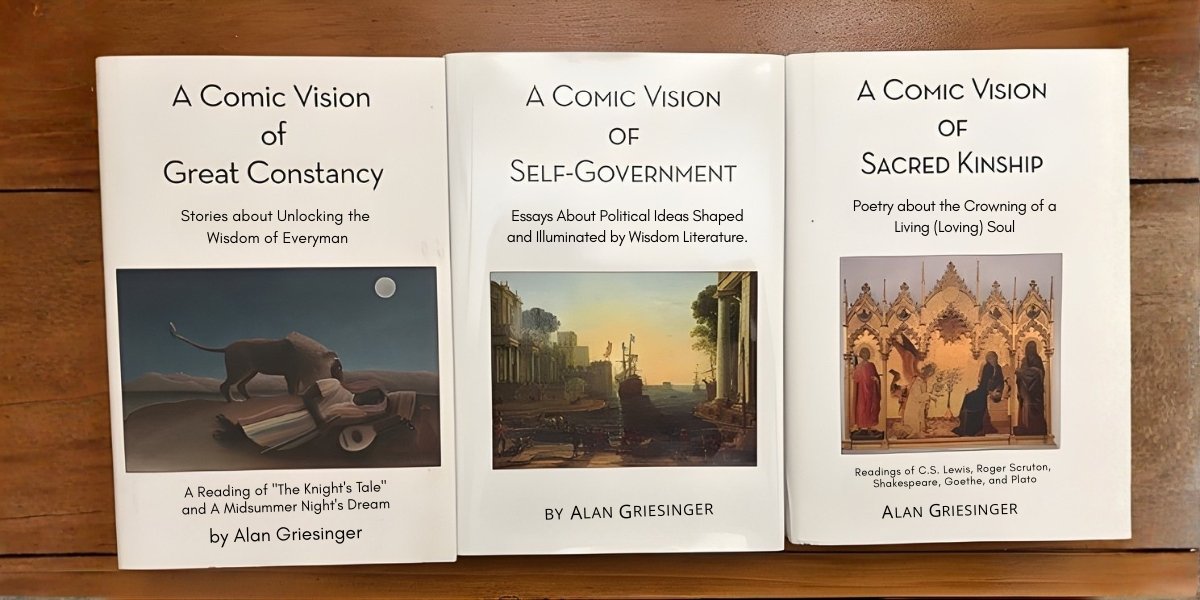
Alan Greisinger’s A Comic Vision of Great Constancy: Stories about Unlocking offers stories that mix insight, humor, and reflection in a way that stays with you.

Explore more and discover the book at: A Comic Vision