










Three young companies walk into the same conversation about card-based financing. All three are under a year old. One gets a small and pricey offer, one gets a substantial offer that might actually help, and one is turned away. The differences among them say more about this product than any definition could.
The businesses below are fictional, and the offers are illustrative. Real terms vary by provider and applicant.
Card processing financing is built around the flow of payments that you already accept. A provider reviews your processor statements, advances a sum, and collects through a portion of future card settlements, or through scheduled debits. Depending on the provider, it may be structured as a loan or as a purchase of future receivables, and that distinction affects both your contract and how the cost is stated.
A provider overview like Fundivi new-merchant card processing loan details can show what’s commonly requested. Usually, it’s months of processor statements, bank statements, ownership details, and a look at any existing advances.
Merchant A: Stillwater Pilates
Age: 4 months. Monthly card volume: $18,000. Card share of revenue: Nearly all. Need: $9,000 for reformers and studio flooring.
Stillwater’s revenue is almost entirely memberships billed by card, so its processor history is clean, if short. Four months is near the low end of what many providers will consider. An offer arrives:
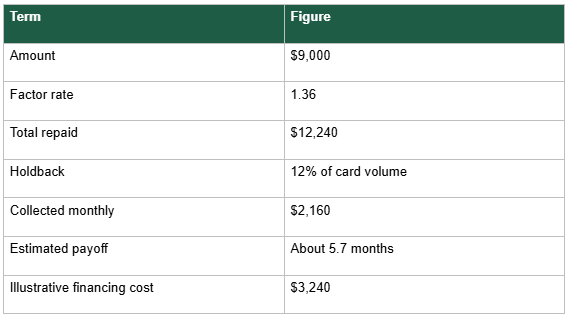
The result: A small offer with a substantial financing charge. The owner has to pay $3,240 for the use of $9,000 for less than six months.
What could go wrong: Studio memberships are recurring but can be cancelled. If several members leave at once, card volume drops, and repayment takes longer. A true percentage holdback softens that blow, but it doesn’t remove the debt.
What makes sense here: New equipment can support extra classes, and the added revenue can be estimated. If two more classes each week bring in $1,500 a month, the owner would still need to compare the additional operating costs and actual cash flow against the $3,240 financing charge. The owner also asks the equipment seller about a payment plan, since that could be a better match for an asset that lasts for years.
Merchant B: Ridgeline Outfitters
Age: 9 months. Monthly card volume: $55,000. Card share of revenue: About 95%, online and in-store. Need: $45,000 for inventory before a busy season.
Ridgeline’s larger volume and longer history get a better reception. Margins are healthy, and the owner carries no other financing. Its offer:
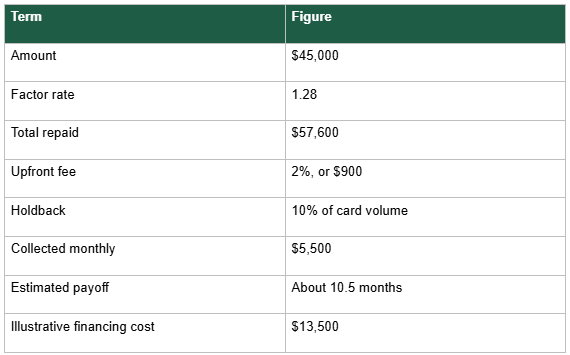
The result: More money and a lower factor rate than Merchant A, although the upfront fee adds to the total financing cost. Its total cost is $13,500.
Why the offer looked better: With three times the card volume and five more months of statements, Ridgeline gives the provider a much larger sample. A $45,000 advance is also still less than one month of its card receipts, which keeps the request in proportion.
The test it had to pass: Ridgeline ran a downturn scenario. If card sales were to fall 40% to $33,000, the holdback would drop to $3,300 a month, and payoff would stretch to about 17.5 months. Because the collection is a true percentage, the payment falls along with sales. That’s the main reason a seasonal or ramping business would pick this form over a fixed weekly payment.
Ridgeline’s owner then did one more check, against seasonal alternatives. This overview of loans for seasonal businesses helped frame what else to ask about, because an inventory purchase that sells through in four months doesn’t fit neatly with a repayment that lasts ten.
Merchant C: Oakline Auto Detailing
Age: 11 months. Monthly card volume: $6,000. Total monthly revenue: $30,000, largely cash, checks, and fleet invoices. Need: $20,000 for a second van.
Oakline is the oldest of the three and has the highest total revenue after Ridgeline. It’s still the weakest candidate for this particular product, because just 20% of its income passes through a card terminal. At a 10% holdback, a provider would collect only $600 a month. At that pace, collecting $20,000 alone would take more than 33 months, before accounting for financing charges.
The result: No suitable card-based offer.
What makes sense here: Oakline’s money flows elsewhere, so it needs a product that looks elsewhere. Vehicle financing is a natural fit for a van, since the van serves as collateral. Its fleet invoices could also be suited to factoring. A bank-deposit advance might be possible too, though that would carry its own costs.
Oakline’s lesson is simple: the right product depends on how your money arrives, not on how much of it there is.
Independent research can add context as you shop. BestWorkingCapitalLoans.com card merchant resources is one place to learn how card-based financing compares with other working capital products, before you commit to any single approach. For Oakline, reading about those other products took one evening and spared it from chasing offers that never could have worked. Its owner also decided to offer a card option to fleet customers, which would slowly raise the share of revenue a future card-based offer could rely on, while cutting the wait for payment.
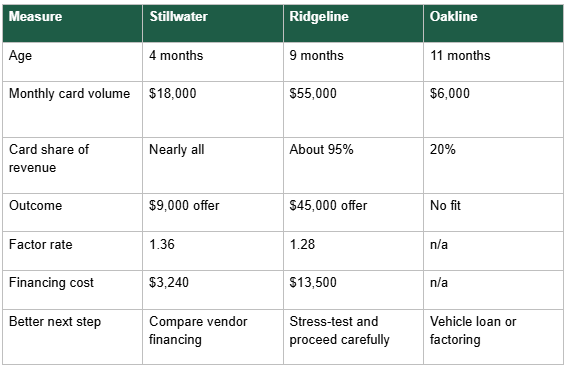
The Three Results Side by Side
What Separated Them
Volume. Offers are typically sized to monthly card receipts. More volume supports more funding.
Card concentration. A provider collecting from card settlements needs those settlements to exist.
Age. A longer processing history may affect an offer, although the fictional examples do not establish how a real provider would price an application.
Margin. A holdback comes straight out of revenue. If Stillwater’s net margin were 8%, then a 12% holdback would mean spending more than it earns from those sales until the balance clears.
Chargebacks and processor stability. Providers often look at disputes and recent processor changes. Switching processors just before you apply may complicate the review.
Before You Pick Your Own Column
Find the merchant you most resemble, and then rebuild its table with your own numbers. Start with your lowest card-volume month rather than your average. Multiply that month by the holdback, divide the total repayment by the result, and see how long payoff would take. If the answer alarms you, ask for a smaller amount or wait for a few more months of history.
Questions for Your Own Comparison
New products in this category are appearing, and it can be helpful to see how they’re introduced. A Benzinga release about card-processing loans announces one such offering for small businesses. Reading any launch announcement should lead you to the following questions:
☐ Is this a loan or a purchase of future receipts?
☐ Is the holdback a true percentage, or a fixed debit?
☐ Must I change processors? If so, what are the new rates and any early-termination charges?
☐ What fees come out before I receive the money?
☐ Is there a discount for paying early?
☐ Who guarantees repayment, and is there a lien?
Run those questions against every quote. A term that looks minor on Stillwater’s scale, such as a $25 monthly admin fee, is a much larger share of a $9,000 deal than it would be of Ridgeline’s $45,000.
Frequently Asked Questions
How long must I process cards before I can apply?
Requirements vary. Several months is a common minimum, and some providers want six or more.
Is a processing loan the same as a merchant cash advance?
They’re closely related, and some products are advances in all but name. The contract shows whether it’s a loan or a purchase of receivables.
Do I have to switch payment processors?
Sometimes. Certain providers work directly with your current processor, while others require a change.
What if most of my sales are cash?
Card-based financing probably isn’t a fit. Consider products that look at total deposits, invoices, or equipment.
Does seasonality hurt my application?
It may, particularly with a short history. Be ready to explain the pattern and show the months you have.
How much might I qualify for?
Offers are commonly related to monthly card volume, adjusted for risk, age, and any existing obligations.
Are holdback rates negotiable?
Sometimes. A lower percentage extends repayment, which could help cash flow without changing total repayment.
Disclaimer: This article is for general informational purposes only and does not constitute financial, lending, legal, tax, or investment advice. The businesses, figures, offers, rates, and scenarios presented are fictional and illustrative only and do not represent actual financing offers or guaranteed terms. Requirements, pricing, repayment structures, fees, and approval decisions vary by provider and applicant. Readers should carefully review the terms of any financing agreement and consult a qualified professional before making financing decisions.


