











By: Shawn Mars
Santa Monica has been named a finalist for the Los Angeles County Economic Development Corporation’s 2026 Most Business-Friendly City award for the second consecutive year, the city announced Oct. 6. The recognition comes as the city prepares to award grants meant to keep storefront businesses open. For Santa Monica small businesses and their peers along the coast, that push has a quieter side effect: local search competition keeps building, while the few spots a nearby customer sees when searching for a service stay the same size.
Key Takeaways
- Santa Monica is a 2026 Most Business-Friendly City finalist and is offering $5,000 grants to storefront businesses.
- Local search competition tends to build in dense coastal markets with many similar businesses.
- Google says local results weigh relevance, distance, and prominence, and you can’t buy a ranking.
- Specific service details, a complete profile and steady reviews tend to set businesses apart.
- Progress typically takes months, and no position is guaranteed.
Local Search Competition Rises as Santa Monica Courts Small Businesses
Winners are scheduled to be announced Nov. 4 at the Rose Bowl in Pasadena. The recognition comes alongside the city’s $100,000 Small Business Relief Microgrant Program, which offers one-time $5,000 grants to existing brick-and-mortar businesses. The first round of applications closed Oct. 1, and the city expects to announce recipients by early November, according to the Santa Monica Lookout.
Neither effort is about search. But cities that keep businesses open and draw new ones also keep more of them competing in the same local results, where many customers start looking for a service.
Why Coastal Markets Feel the Squeeze First
Coastal California markets, from Santa Monica to San Francisco, tend to pack many similar service providers into small areas. The Los Angeles-Long Beach-Anaheim metro area, which includes Santa Monica, had about 1.8 million small businesses in 2022, or 99.8% of all businesses there, according to the Small Business Administration’s Office of Advocacy.
A local search, meanwhile, has a fixed shape. For most service queries, Google shows a short list of businesses on a map, followed by a handful of results. Each new dental office, contractor, or fitness studio competes for those same few spots, often against nearly identical listings, and the page doesn’t grow to make room.
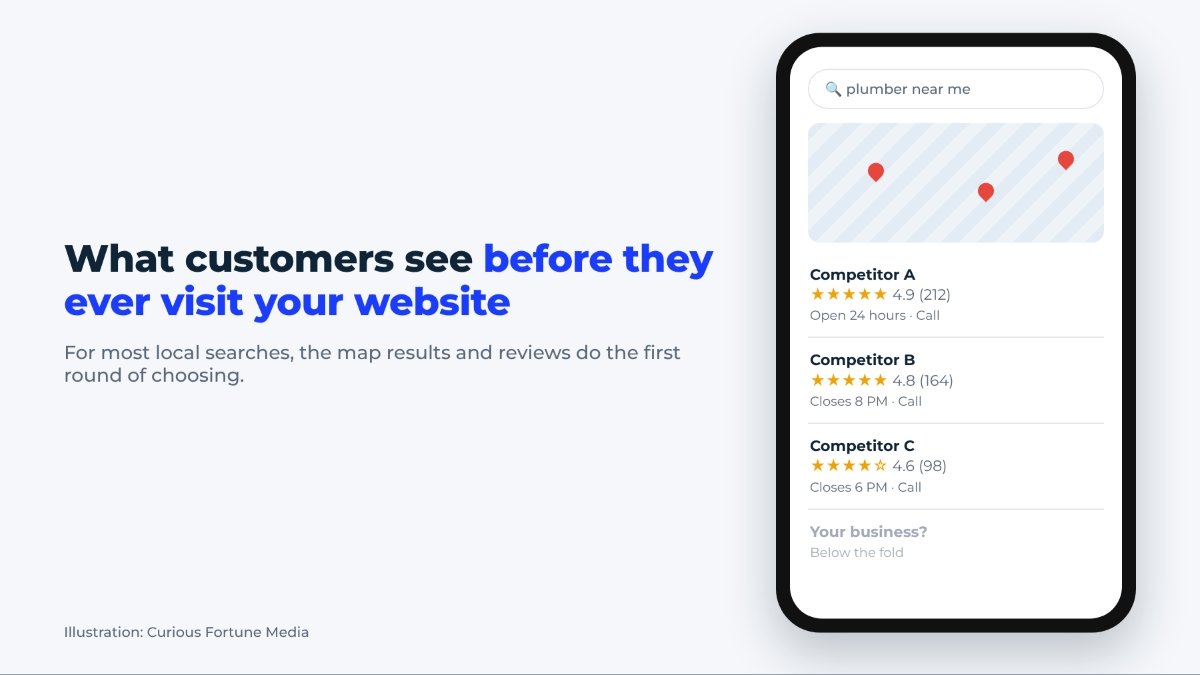
What Customers Compare When Listings Look Alike
Google’s guidance on local ranking says results depend mainly on three factors: relevance, how well a listing matches the search; distance from the person searching; and prominence, how well known a business is, based on reviews and links from other websites. The same guidance says you can’t request or pay for a better local ranking.
In Santa Monica, relevance often comes down to specifics. A business whose website and profile reflect the services it offers and the neighborhoods it covers, such as Main Street, Montana Avenue or Ocean Park, gives Google more to match than one that says only that it serves the Westside.
“In a neighborhood like this, a customer usually has three or four businesses on the screen that offer the same thing,” said Edmond Abramyan, founder of Curious Fortune Media, a marketing agency focused on local search that works with service businesses in Santa Monica. “Being on that list gets them in the room. What wins the call is being specific about what they do and where, and showing proof that’s recent.”
Proof Tends to Outweigh Presence
The habits that build prominence are familiar: a complete, accurate Google Business Profile with the right categories, hours, and service areas; a steady flow of genuine online reviews; and mentions in local press, neighborhood associations, and community organizations.
These pieces work best when the profile, website, and reviews all describe the same business in the same way. That consistency may matter more as AI-generated answers summarize a few local options, though how those answers choose sources is not fully transparent.
In crowded local markets like these, being found and being chosen are separate tests, which is how Abramyan structured the Authority Engine™ he developed at Curious Fortune Media: visibility to get a business onto the short list, authority to make it the credible option, and conversion to turn that credibility into a call.
Competition Without Shortcuts or Guarantees
The approach has limits. You can’t manufacture proximity, since Google requires a Business Profile to be tied to a real-world location, and P.O. boxes and virtual offices aren’t eligible. Broad searches still tend to favor large brands and national directories, AI-generated answers vary, and progress typically takes months.
“A grant or a crowded market doesn’t change the work,” Abramyan said. “Credibility gets built a month at a time, through real reviews and real information. Anyone promising a business a spot on the map is promising something nobody controls.”
In coastal markets, being listed no longer sets a business apart; customers and Google seem to weigh relevance and visible proof. Rather than trying to look bigger, owners may get more by being specific about the neighborhoods and services they cover and by building proof steadily, knowing progress takes months, AI answers vary, and no position is guaranteed. As coastal cities keep competing to attract and retain businesses, customers may choose the ones they can most easily verify and trust.
Frequently Asked Questions
Why is local search competition higher in coastal cities?
Dense coastal markets pack many similar service businesses into small areas, but local results still show only a few at the top.
How does Google local ranking work?
Google says local results are based mainly on relevance, distance, and prominence. Prominence includes reviews and links from other websites.
How long does it take a local business to stand out in search?
Progress typically takes several months, and no one can guarantee a position.
Do AI-generated answers change local search?
They can narrow a customer’s options to a few named businesses, making consistent business information and genuine reviews more important. Those answers can vary by search.


