








By: Natasha Johan
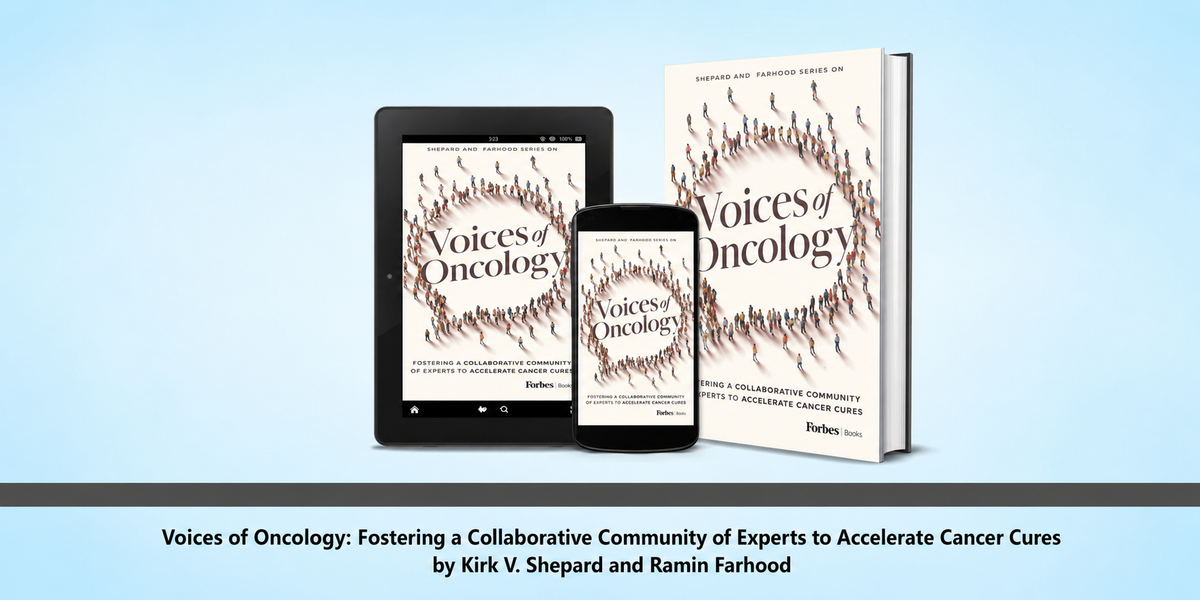
There is a structural problem at the heart of oncology that most people inside the field understand, and most people outside it have never been shown clearly enough to demand something different. The knowledge required to meaningfully accelerate the path to cancer cures exists, distributed among pharmaceutical executives, academic researchers, patient advocates, healthcare innovators, and clinical specialists who spend the majority of their professional lives in separate institutional ecosystems that were never designed to communicate with the urgency this disease demands. Kirk V. Shepard and Ramin Farhood have spent their combined careers watching that structural problem slow progress that should have been faster, and Voices of Oncology is their most complete and most publicly accessible argument for what needs to change and what it actually looks like when it does.
What makes the reading experience so compelling is the way Shepard and Farhood have constructed the book to demonstrate its own central argument. By assembling thirty-three distinct voices from across the full landscape of oncology rather than synthesizing everything into a single authoritative narrative, they create a living example of what genuine collaboration in this field can produce. You feel the difference in texture and depth as you move from chapter to chapter, each contributor adding a dimension to the picture that no single expert, however distinguished, could have supplied alone. That cumulative effect is not accidental. It is the deliberate result of two authors who understood that the message about collaboration would be most persuasive if it arrived collaboratively.
Shepard brings to the project the particular credibility of someone who has led pharmaceutical innovation across organizations including Boehringer Ingelheim, Takeda, and Eisai and who cofounded the Medical Affairs Professional Society, an organization whose existence reflects his longstanding conviction that the medical affairs function in oncology deserves both greater recognition and greater strategic integration than it has historically received. Farhood brings the perspective of someone who has spent more than twenty-five years building patient-centric medical strategies and who navigated the launch of the world’s first gene therapy for spinal muscular atrophy, an experience that gave him an unusually concrete understanding of what it actually takes to move a genuinely transformative therapy from development to the patients who need it.
The book’s treatment of diversity, inclusion, and the cultural dimensions of oncology is one of its most important and most underrepresented contributions to the field’s conversation about its own future. Shepard and Farhood make it explicit that the communities most affected by cancer have historically had the least influence over the strategies designed to address it, and they give real space in the book to the voices and perspectives working to change that dynamic. That explicitness gives the book a moral seriousness that purely scientific treatments of oncology consistently lack.
Voices of Oncology is a book that addresses the problem of cancer with the full complexity it deserves, not as a purely scientific challenge to be solved by sufficiently brilliant individuals, but as a human, institutional, and collaborative challenge that requires a different kind of effort than the field has historically been organized to produce. Shepard and Farhood have built something important here, and it deserves the widest possible readership, both within and beyond the oncology community.
If you have ever sensed that the pace of progress against cancer has been held back not by the absence of brilliant people but by the absence of genuine collaboration between them, Voices of Oncology by Kirk V. Shepard and Ramin Farhood is the book that makes that case compellingly and shows you what a different approach actually looks like in practice. The book is available on Amazon.


