










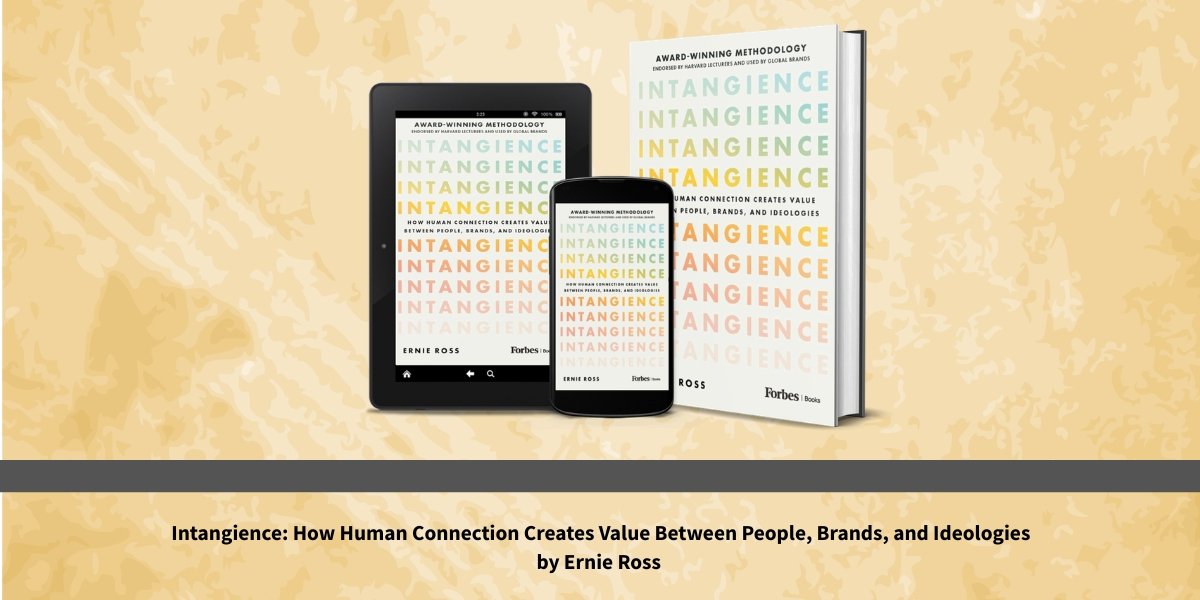
By: SM Harrison
Most books about branding and communication arrive with a confidence that outpaces their evidence, promising transformation through frameworks that have been stress-tested in a handful of case studies and extrapolated into universal principles. Ernie Ross takes the opposite approach in Intangience, and the restraint of that approach is one of the first things you notice and one of the things that makes the book so persuasive. He does not tell you that the Intangience methodology works and expect you to take his word for it. He shows you, through decades of accumulated real-world evidence drawn from some of the most challenging and unlikely contexts imaginable, what happens when you understand and activate the intangible values that actually drive human connection rather than the rational features and facts that most communication strategies are built around.
The reading experience this book provides is one of steady, accumulating recognition. Ross is describing something that most people in communication, leadership, and brand strategy have sensed intuitively but have never had a sufficiently rigorous language to articulate or a sufficiently structured methodology to act on. The Pillars of Purpose, the Currency of Conversation, the Science of Human Connection- these are not invented categories imposed on the world from outside. They are observed patterns pulled from the world as it actually operates, which is why they feel immediately recognizable even before Ross has finished explaining them.
The stories he tells to illustrate these patterns are the heart of the book and its most enduring contribution. The account of converting gang leaders through basketball, using the intangible values of respect and belonging and aspiration to reach people who had every reason to be unreachable, is one of the most striking demonstrations of applied Intangience methodology in the book. The story of rescuing a national brewery from foreign competition by reconnecting consumers to the cultural pride embedded in the brand is another. Each story does multiple things at once, illustrating a specific principle, demonstrating its practical application, and quietly making the larger argument that the methodology works not because Ross invented something new but because he identified something true.
What also comes through in the writing is the particular texture of a life lived across multiple cultures and contexts, from 1970s Guyana to Trinidad and Tobago to Costa Rica to Paris and beyond. Ross’s global perspective gives the book an authority that purely regional or industry-specific frameworks cannot claim, and the UN-established University for Peace certification of the methodology underlines that the principles he is articulating genuinely transcend the specific contexts in which they were developed.
This is a book that belongs on the desk of every leader, brand strategist, communicator, and human being who has ever wondered why some messages resonate and others disappear without a trace. Ross has given us both the answer and the framework for acting on it, and that combination is rarer and more valuable than most business books manage to offer.
If you have been building your communication strategy around features and facts and wondering why the results feel thinner than the effort deserves, Intangience by Ernie Ross is the book that explains exactly why and shows you what to do instead. Head over to Amazon and get your copy today. The language of genuine human connection has always been there, and this book teaches you how to speak it.


