









By: Elena Marquez
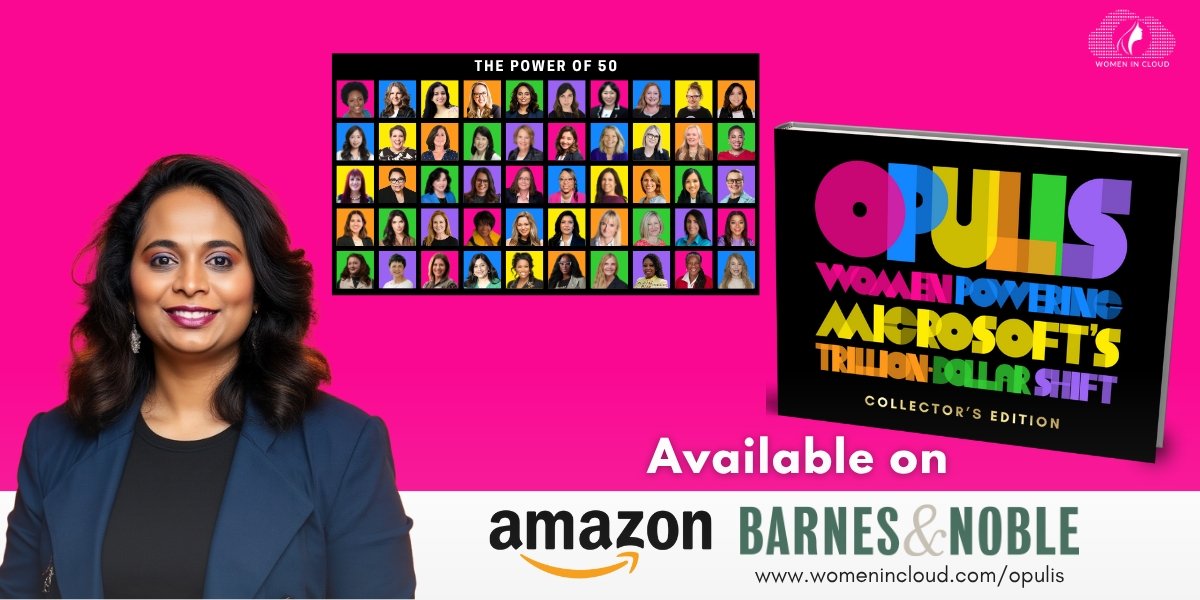
When Chaitra Vedullapalli first envisioned OPULIS: Women Powering Microsoft’s Trillion-Dollar Shift, it didn’t start with a marketing plan or a corporate directive. It began with a single, haunting question that wouldn’t let her sleep:
“How will history remember the women who built Microsoft’s future?”
As Microsoft approached its 50th anniversary, Vedullapalli, a tech leader, entrepreneur, and co-founder of Women in Cloud saw an opportunity to create something more than a tribute. She saw a responsibility. “Microsoft wasn’t just another corporate partner to us,” she explains. “It was the foundation sponsor that helped give birth to Women in Cloud, the platform that allowed us to dream in billions: billions in access, innovation, and possibility. They gave us the tools to build; now it was our turn to give something back.”
That vision evolved into OPULIS, a collector’s-quality publication that captures the untold stories of 50 pioneering women and their allies whose innovations, leadership, and quiet courage powered Microsoft’s most defining transformations. But beyond the beauty of its design and storytelling, OPULIS carries a deeper mission: to preserve legacy, fund opportunity, and ignite a new era of inclusive innovation.
The Spark That Started a Movement
The idea for OPULIS crystallized during early conversations with Microsoft leaders. Vedullapalli proposed a simple but profound concept:
“What if we honored the past, celebrated the present, and ignited the AI future?”
The idea resonated immediately. Yet, during the research phase, she uncovered something that shook her: many of the women who had shaped Microsoft’s breakthroughs engineers, strategists, and program architects were absent from the company’s archives. Their fingerprints were on billion-dollar innovations, yet their names had quietly faded from the record.
“I knew we needed to create something lasting,” Vedullapalli recalls. “A book that didn’t just celebrate women, but honored the allies, mentors, and champions who stood beside them. True progress has always been a shared endeavor, and I wanted that truth at the heart of OPULIS.”
She began calling these stories “leadership codes of innovation.” The women featured in OPULIS weren’t following a playbook they were writing it. They built systems from scratch, redefined leadership norms, and shaped Microsoft’s evolution long before terms like “inclusive innovation” became corporate buzzwords.
More Than a Book: A Living Framework
To Vedullapalli, OPULIS is far more than a retrospective. “It’s a leadership accelerator,” she says. “Everyone who contributes to or engages with it grows as a leader—because they’re learning how inclusion, innovation, and impact intersect in real time.”
The project is anchored by three commitments:
- Celebrate significance – honoring the hidden figures and allies whose contributions powered Microsoft’s trillion-dollar shift.
- Ignite 1,000 AI careers – through the Books-to-Scholarships model, where every ten copies purchased fund one AI certification scholarship for under-represented talent.
- Archive legacy – ensuring these stories become a permanent part of Microsoft’s official history and a blueprint for inclusive leadership for the next 50 years.
“When we think of artifacts preserved in museums,” Business Insider noted, “we imagine ancient manuscripts or political documents. Rarely do we think of the stories of women in technology. Yet these stories are every bit as foundational to understanding our world today.”
OPULIS is determined to make sure they’re never forgotten again.
The Humanity Behind the Headlines
As Vedullapalli began contacting the women selected for inclusion, she noticed something striking. “Their first reaction wasn’t excitement—it was disbelief,” she recalls. “They’d say, ‘Why me? I wasn’t an executive.’ These were women whose fingerprints were all over Microsoft’s greatest transformations building the cloud, expanding global markets, advancing accessibility—but they didn’t see themselves as chosen.”
That humility, she says, revealed something powerful about women’s leadership. “They weren’t chasing visibility; they were creating value. They weren’t leading from titles—they were leading through contribution.”
For Vedullapalli, it was also a reminder that recognition doesn’t happen in silence. “If someone wasn’t included, it wasn’t because they didn’t deserve it—it was because no one nominated them. Recognition requires advocacy. We must speak up for one another.”
The Blueprint of ICONIC Leadership™
Across the dozens of interviews and stories, Vedullapalli began to see recurring themes. The women in OPULIS weren’t just excelling in the system—they were redesigning it. Their behaviors reflected what she now calls ICONIC Leadership™—a model grounded in:
- Intention – Leading with purpose and clarity.
- Courage – Challenging systems that exclude.
- Optimism – Believing in what’s possible before proof exists.
- Nurture – Building others as they climb.
- Innovation – Turning imagination into impact.
- Connection – Forging communities that multiply success.
These women embodied six “activations” of democratized leadership: inclusive foundations, collaborative partnerships, open access, navigational agility, innovative solutions, and collective action.
“They didn’t wait for permission,” Vedullapalli says. “They built pathways so others could follow. They turned leadership into architecture—one designed not for exclusivity, but for access and shared impact.”
A Defining Moment of Bravery
Among the many stories that shaped OPULIS, one conversation stood out. Vedullapalli recalls speaking with Karen Fassio, a visionary leader who looked beyond profits toward global impact. “Karen wanted to connect Microsoft’s work to the UN’s Sustainable Development Goals,” Vedullapalli explains. “At the time, there was no internal mechanism to recognize or elevate innovators aligned with those goals—so we built one.”
That initiative became BUILD for 2030, a Microsoft partner program uniting innovators across industries to advance sustainability, accessibility, and inclusion. “That’s what bravery looks like in leadership,” Vedullapalli says. “It’s not always about personal risk—it’s about daring to rewire systems for the collective good.”
Legacy in Motion
For Vedullapalli, OPULIS is both a tribute and a transformation engine. It honors the past, empowers the present, and safeguards the wisdom that will shape the future.
“The women in this book are the modern architects of progress,” she reflects. “Their courage, intellect, and resilience built the foundation that allows us to innovate in this new era of AI. When women decades from now go searching for history, I want them to find truth—not just data.”
In the end, OPULIS isn’t just preserving stories—it’s preserving possibility. It’s a reminder that the future is always written by those who dare to remember, record, and rebuild.
Get your copy of OPULIS: Women Powering Microsoft’s Trillion-Dollar Shift and be part of the movement to celebrate legacy, ignite opportunity, and democratize access in the AI economy.


