









By: Nathaniel Cross
The husband-and-wife duo channels the emotional honesty, musical freedom, and timeless spirit that once made the Bay Area a rock and roll revolution.
San Francisco has always had a complicated relationship with rock and roll. This is, after all, the city that helped turn popular music into something bigger than entertainment. In the late 1960s, bands like Jefferson Airplane, Big Brother and the Holding Company, and the Grateful Dead transformed the Bay Area into a laboratory of sound, where blues, folk, psychedelia, and raw emotion collided without much concern for commercial expectations. The music wasn’t always polished, but it was frequently honest. It sounded like people discovering themselves in real time.
Nearly six decades later, Ohio-based husband-and-wife duo Eleyet McConnell arrive with The Journey, an album that would have made perfect sense in the philosophical atmosphere of that earlier San Francisco scene. Not because Angie and Chris McConnell are trying to recreate the Summer of Love, but because they share one of its most enduring principles: music means more when the people making it have something real to say.
And these two have plenty to say.
The Journey moves between muscular classic rock, blues-inflected storytelling, and intimate balladry with the confidence of musicians who understand that authenticity cannot be manufactured. There’s no desperate attempt to chase streaming trends, no fashionable electronic distractions, and little interest in disguising the duo’s musical influences. Instead, Eleyet McConnell embraces the familiar language of guitars, bass, piano, drums, and a voice capable of commanding attention without asking permission.
That voice belongs to Angie McConnell.
She is the album’s unmistakable emotional center, a singer whose power recalls the great female vocalists who helped establish rock as a vehicle for personal expression. There’s something of Grace Slick’s fearless authority in her delivery, the blues-soaked intensity of Janis Joplin in her willingness to expose emotional scars, and the commanding presence of Ann Wilson when a song demands something approaching thunder.
Yet Angie is more than the sum of those comparisons. Her greatest asset is an ability to make even the most familiar musical territory feel personally inhabited.
Consider “The Ledge,” one of the album’s most forceful statements.
A song about escaping manipulation and reclaiming personal independence, it arrives with the attitude of someone who has finally decided that enough is enough. The track’s defiant spirit recalls the kind of rock that once echoed through the Fillmore Auditorium, when performers treated emotional confrontation as an essential part of the musical experience.
But “The Ledge” isn’t simply about anger. It’s about what happens after anger becomes clarity. Angie sings with the conviction of someone who understands that freedom sometimes requires walking away from people who have convinced us we cannot survive without them.
It’s a powerful message, delivered without unnecessary subtlety.
“King of Glass” continues the album’s exploration of fragile power and complicated relationships. Its imagery suggests the instability beneath appearances of strength, an idea that fits naturally into a record concerned with the distance between who people pretend to be and who they actually are.
Meanwhile, “The Horizon” reflects the duo’s determination to keep moving forward. Its title alone feels appropriate for a record called The Journey. In San Francisco, where the Pacific Ocean stretches beyond the western edge of the continent, the horizon has always carried a particular symbolism: possibility, uncertainty, and the promise of something beyond the familiar.
Chris McConnell understands that symbolism better than most.
With more than 56 years of bass playing behind him, Chris has experienced the less glamorous realities of a musician’s life. Financial hardship, broken relationships, personal setbacks, and the responsibility of supporting a family have all contributed to his story.
That experience informs his musicianship. His bass playing represents the kind of grounded musical foundation that made players like Jack Casady and Phil Lesh so essential to the Bay Area’s rock revolution. He understands that the instrument can do more than support a rhythm. It can help define a song’s personality.
The McConnells’ partnership also gives the album its distinctive emotional chemistry.
They aren’t simply two musicians collaborating on a project. They are spouses whose creative relationship reflects years of shared experiences, disagreements, reconciliation, and mutual understanding.
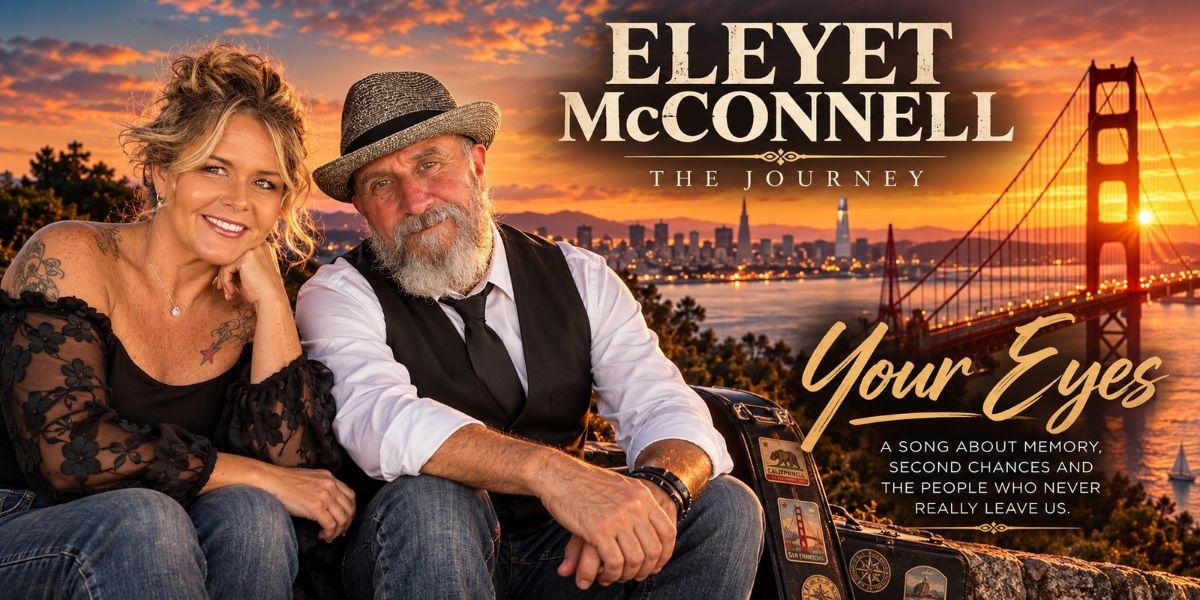
Nowhere is that more apparent than on “Your Eyes,” the album’s most emotionally revealing composition.
Built around piano and delicate strings supplied by Kimmi Samson, the song trades electric intensity for vulnerability. Producer Patrick Himes allows the arrangement to unfold without excessive decoration, giving Angie the space to deliver one of her most affecting performances.
The inspiration is almost disarmingly ordinary.
Chris unexpectedly spotted an old high-school heartbreak while shopping at Walmart. Rather than approaching her, he began wondering whether two people separated by decades could simply resume a conversation as though no time had passed.
That passing thought became “Your Eyes.”
He brought the composition home to Angie, who added the bridge.
The result is a remarkable meditation on memory, love, and the relationships that continue shaping us long after they’ve ended.
There’s something distinctly San Franciscan about its emotional openness. The city’s musical heritage has always valued the willingness to examine love beyond conventional boundaries, and “Your Eyes” approaches its subject with uncommon generosity.
Rather than portraying an old romance as a threat to an existing marriage, the song recognizes that our past experiences remain part of who we become.
Angie’s performance is especially impressive because she resists the temptation to overwhelm the material. She allows tenderness to carry the emotional weight, proving that a powerful singer doesn’t always need to sing powerfully.
Elsewhere, “Without You” and “Dreamy” reinforce the album’s interest in romantic connection, longing, and emotional reflection. Together, these songs create a balance between the record’s harder-edged moments and its more introspective passages.
That variety is both a strength and a reminder of the album’s traditional instincts. The Journey doesn’t always venture far beyond established classic-rock structures, and listeners expecting the experimental unpredictability of San Francisco’s psychedelic pioneers may find its arrangements comparatively conventional.
But Eleyet McConnell isn’t attempting to rewrite the rules of rock.
They’re reminding listeners why those rules worked in the first place.
The album’s greatest achievement is its sense of lived experience. These songs don’t sound like exercises in nostalgia. They sound like conversations between people who have endured enough heartbreak, disappointment, and unexpected happiness to recognize the difference between manufactured drama and genuine emotion.
And perhaps that’s where the strongest connection to San Francisco’s musical heritage ultimately resides.
The Grateful Dead built a career around the idea that music was a journey rather than a destination. Janis Joplin demonstrated that emotional honesty could be more compelling than technical perfection. Jefferson Airplane challenged audiences to question expectations and embrace individuality.
Eleyet McConnell carries pieces of that philosophy into a different era.
The Journey is an album about surviving, remembering, forgiving, and continuing forward. Its musical language may be familiar, but its emotional convictions feel entirely contemporary.
Imagine these songs drifting from a North Beach club on a foggy evening, or playing through a car stereo as the Golden Gate Bridge disappears into the marine layer. Their themes would feel right at home: love complicated by time, freedom earned through struggle, and the determination to keep believing in something better.
Angie and Chris McConnell may come from Ohio, but their music speaks a language that San Francisco helped teach the world.
And on The Journey, they prove that rock and roll’s greatest destination has never been a particular city, chart position, or moment in history.
It’s the place where experience becomes truth, and truth becomes a song.


