









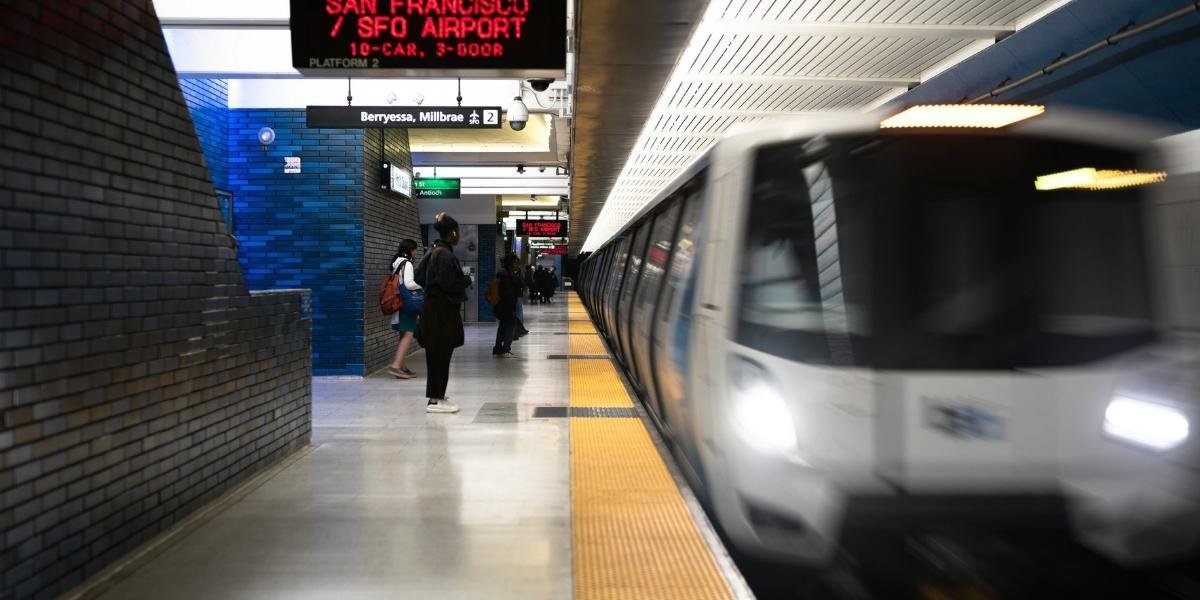
New AI fare fates piloted across Bay Area Rapid Transit stations are being tested across select locations as officials introduce faster-closing, sensor-driven barriers aimed at reducing fare evasion caused by piggybacking. The pilot program began in early May 2026, with testing underway at Antioch Station and along a central bank of gates at Concord Station ahead of a planned broader rollout on May 18.
The updated fare gates are designed to close in approximately 500 milliseconds, a significant improvement from the previous 800-millisecond closure time. According to BART infrastructure officials, the faster response reduces the gap that allows riders to slip in behind paying passengers, a common form of fare evasion that has persisted despite earlier system upgrades.
Faster-Closing Gates Engineered to Prevent Piggybacking
The redesigned system incorporates a combination of physical adjustments and software enhancements to improve gate performance. Engineers shortened the sensor detection zone along the gate panels, limiting the distance at which motion can keep the gates open. They also modified the behavior of overhead AI-assisted cameras to reduce unnecessary delays in closure timing.
Joy Sharma, assistant general manager of infrastructure delivery at BART, demonstrated the upgraded model inside a testing laboratory at Lake Merritt Station, where engineers have been refining the system. The mock setup replicates real station conditions, complete with Plexiglass barriers and motion-tracking sensors. During testing, the gates consistently closed before a second individual could pass through immediately behind a paying rider.
The faster closure speed is supported by new motor components and recalibrated software that synchronize sensor input with mechanical movement. Engineers worked to ensure that the system allows one authorized rider through while minimizing the risk of accidental contact with closing panels.
Pilot Testing Expands Across Select BART Locations
Field testing is currently limited to a small number of stations, allowing BART to observe performance under real commuting conditions. Antioch and Concord were selected due to their ridership patterns and station layouts, which provide a controlled environment for measuring gate efficiency and user interaction.
Riders passing through these stations may notice only subtle differences, as the upgraded gates maintain a similar appearance to existing installations. The primary change is the speed and timing of the panel movement, which now closes more abruptly after a single entry. Early observations suggest that the adjustment has reduced visible instances of piggybacking, although BART has not yet released formal data from the pilot phase.
Officials have confirmed that the systemwide rollout of the upgraded design is expected to begin on May 18, marking the next phase of deployment across the network.
Fare Evasion Remains a Longstanding Operational Challenge
The initiative is part of BART’s ongoing effort to address fare evasion, which has posed financial and operational challenges for the transit system. Agency estimates have previously placed annual losses from unpaid fares at up to $25 million, prompting multiple rounds of infrastructure redesign over the past decade.
Earlier fare gate models, including the low-profile “pie-wedge” barriers installed in the 1970s, proved easy to bypass. Riders could jump over or slip through the gaps, contributing to a perception that enforcement was inconsistent. In response, BART introduced taller Plexiglass gates equipped with sensors and cameras as part of its modernization program.
These newer gates improved station security and reduced incidents such as vandalism and unauthorized access. Internal reports presented to the agency’s board indicated that the upgraded infrastructure helped decrease maintenance demands and generated an estimated $10 million in additional annual revenue. However, piggybacking remained a persistent issue even after these improvements.
Engineering Adjustments Refine Existing Gate Technology
Rather than replacing the entire system, BART engineers focused on refining existing gate designs to address specific vulnerabilities. The adjustments introduced during the current pilot represent targeted modifications based on observed rider behavior and system performance.
One key change involved recalibrating how sensors detect movement within the gate threshold. By narrowing the active detection zone, the system reduces the likelihood that a trailing rider can trigger the gate to remain open. Additionally, partial deactivation of certain AI camera functions allows the gate to prioritize speed over extended monitoring in specific scenarios.
According to engineering staff working at the Lake Merritt lab, achieving the balance between responsiveness and safety required months of testing and iteration. The goal was to ensure that the gates close quickly enough to prevent piggybacking without creating hazards for passengers carrying bags, bicycles, or mobility devices.
The laboratory environment includes full-scale mockups of station equipment, enabling engineers to simulate real-world conditions and troubleshoot potential issues before deployment.
Rider Experience and System Impact Under Evaluation
Initial rider reactions have varied, with some commuters reporting fewer instances of fare evasion while others noted minimal visible change. At Concord Station, at least one rider observed a decline in piggybacking activity, though he did not immediately attribute the difference to the upgraded gates.
The changes are designed to be largely unobtrusive, with most passengers experiencing only a quicker closure after entry. Audible and visual cues remain consistent with previous gate models, helping maintain familiarity during the transition.
BART has not yet released detailed metrics on piggybacking detection or enforcement outcomes, though the system is capable of logging such events. Officials are expected to use this data to assess the effectiveness of the pilot and determine whether further adjustments are necessary as the May 18 rollout expands across the system.
As testing continues, the agency is focusing on maintaining efficient passenger flow while improving fare compliance. The introduction of faster, AI-assisted gates reflects a targeted infrastructure upgrade aimed at addressing a specific operational challenge within the Bay Area transit network.


