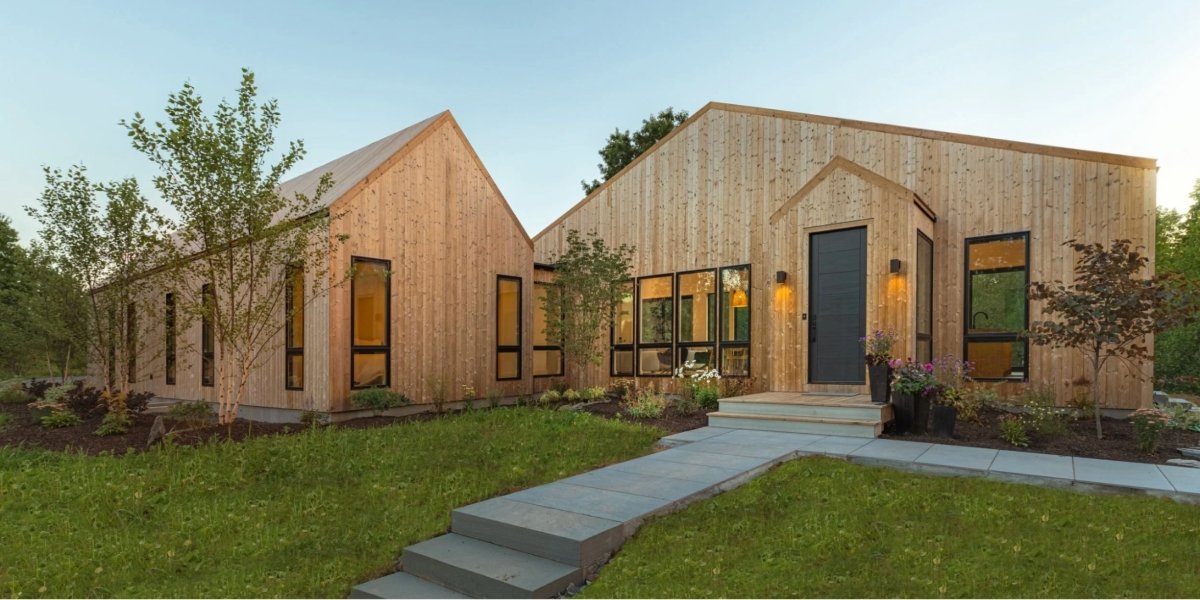
Outdoor Living 2.0 and How Hudson Valley Modern Homes Are Redefining Exterior Spaces

By: Kattie Muniz

For many homeowners, the idea of outdoor living used to begin after the house was finished. There was the home itself, and then there was the deck, the patio, the pool, or whatever came next. In the Hudson Valley, where some buyers seek larger properties and a closer relationship with the landscape, that way of thinking about exterior space is changing.

At Upstate Modernist, the outdoors is considered much earlier.

The Rhinebeck-based design-build firm approaches each property by first looking at the land itself: its topography, mature trees, sun path, prevailing winds, and long views. From there, the position of the house, its windows, rooflines, and floor plan begin to take shape. Exterior living spaces are part of that conversation as well, which means a covered terrace, pool, courtyard, or outdoor dining area can be considered alongside the kitchen and living room instead of being added once construction is nearly complete. Upstate Modernist describes its work as site-specific, with each residence designed in response to the property rather than beginning with a predetermined house plan.

“We always start with the land,” co-founder and managing partner Doug Maxwell says. “A home in the Catskills should not be approached in the same way as a home in Dutchess County, just as a house sitting in a meadow calls for different decisions than one surrounded by woods.”

That philosophy has become especially relevant as outdoor spaces take on a larger role in Hudson Valley modern homes for Upstate Modernist.

The Landscape Comes First

Upstate Modernist was founded by Maxwell and registered architect Christopher Dierig, who moved from New York City to Rhinebeck in 2015 and began developing a version of modern architecture they felt was better suited to the region. They call the aesthetic “Upstate Modern,” combining modernist forms with natural materials, warmer textures, and references to the agricultural and rural architecture already found throughout the Hudson Valley.

That same context-sensitive approach extends beyond the exterior walls.

A house on open acreage may be positioned to preserve a view of the Catskill Mountains, while one on a heavily wooded property may use the trees to create privacy around a deck or pool. Existing stone walls, changes in elevation, and even the direction of afternoon sunlight can influence where outdoor spaces belong.

“People come to the Hudson Valley because they want space and they want the landscape,” says Maxwell. “It would be strange for us to design the house without thinking just as carefully about how they are going to live outside of it.”

Upstate Modernist’s Spruce residence offers one example. The home uses multiple volumes and a covered porch to create an outdoor living area between the house and the surrounding woods. In discussing the project, Maxwell has also emphasized that clients are increasingly thinking about everyday life rather than treating an upstate house primarily as a weekend escape. Storage, circulation, and durability have all become more important as homeowners spend more time in these properties.

Outdoor areas are evolving for much the same reason. A terrace that looks beautiful but is uncomfortable in the afternoon sun has limited value. An outdoor kitchen located too far from the indoor kitchen quickly becomes inconvenient. A pool may be an important feature of a property, but its position can affect privacy, circulation, and the view from inside the house.

The details begin to matter once the property is expected to work as a full-time home.

Beyond the Patio

The outdoor living areas being designed today also tend to be more specific than the traditional backyard patio. A property may have a covered seating area close to the great room, an outdoor kitchen and dining area, a pool terrace, and another, quieter space farther from the main house. Rather than asking for a single patio to accommodate every activity, the exterior begins to develop its own loose floor plan.

Materials help connect those spaces to the architecture. Stone used on the house can continue onto an exterior wall or terrace. Wood can bring warmth to a covered porch. Large glass doors and floor-to-ceiling windows allow the living room and the property outside it to remain visually connected even during the colder months.

That indoor and outdoor relationship is already visible throughout Upstate Modernist’s portfolio. At Meadowlark, a three-bedroom residence positioned on preserved meadowland, open living areas and large windows take advantage of broad views across the property. Salisbury House, meanwhile, sits along the edge of a wooded parcel with western red cedar siding, a wrapped metal roof, a covered porch, an expansive deck, and an in-ground pool.

These exterior features do not read as separate amenities added to increase a listing’s appeal. Their position makes sense because of the architecture around them.

“A good outdoor space should feel inevitable,” Maxwell shares. “You shouldn’t walk outside and feel like someone found an empty corner of the property and decided to put a patio there. It should make sense with the house, the view, and the way people are actually going to use it.”

Designing for a Hudson Valley Climate

Of course, outdoor living in upstate New York comes with conditions that do not exist in warmer climates. The Hudson Valley moves through four very distinct seasons, and an exterior space that works beautifully in July may behave completely differently in November.

That affects everything from roof coverage to building materials. A covered porch can provide summer shade and protection during rainy weather while allowing homeowners to use the space farther into fall. Exterior stone and paving have to tolerate freeze-and-thaw cycles. Trees that provide almost complete privacy in summer may reveal neighboring properties once the leaves fall.

The view changes too.

A wooded property can feel enclosed during the warmer months, then open dramatically in winter. The path of the sun shifts. A distant hill that disappears behind foliage in July may become one of the strongest views from the living room in January.

Upstate Modernist’s emphasis on studying the site before designing the house gives those seasonal conditions more influence over the architecture. The firm says its floor plans, window placement, roof pitches, and material palettes all grow from an analysis of the individual property.

Sustainability is part of the equation as well. Upstate Modernist has shifted its homes to all-electric systems and uses strategies including heat pumps, geothermal technology, energy recovery ventilation, and tightly sealed building envelopes. Those performance decisions may be largely invisible, but they reflect the same idea driving the exterior design: the home has to respond to the place where it is being built.

The Exterior Becomes Part of the Home

Attention to exterior spaces can reflect changing expectations for a modern country home. Homebuyers may still consider the kitchen, number of bedrooms, baths, primary suite, and the architectural details that traditionally shape a real estate listing. Exterior features can be part of that consideration as well.

A pool has a different value when it feels integrated with the house. A covered terrace gets used differently when it is positioned directly off the living space. Several acres become more meaningful when the architecture gives homeowners places from which to experience them.

“The landscape is part of the experience of the house,” notes Maxwell, “Sometimes you experience it through a wall of glass, and sometimes you’re sitting in the middle of it.”

For Upstate Modernist, that relationship has been present from the beginning. The firm’s preservation-focused plans maintain natural spaces and sight lines, while each residence responds to the characteristics of its individual property. As exterior living becomes more sophisticated, the same philosophy naturally extends to the spaces around the house.

The backyard may still have a pool, a grill, and somewhere to sit. It just happens that now someone has thought carefully about exactly where all of it belongs.

The Twenty-Year Journey Behind the Novel A Thousand More

By: Guillermo Goods

There is a particular kind of story that arrives fully formed in the imagination and then waits, patient and insistent, for the person carrying it to be ready to write it down. K.S. Lynn had the dream that became A Thousand More in 2005. She set it aside. She returned to it in 2019 when, as she describes it, her desire to write returned. And the debut novel that emerged from that two-decade gestation, the Literary Titan Book Award winner, the International Impact Book Awards Romance Saga Fiction winner, the Global Book Awards Bronze Medalist in Contemporary Romance, and a book that has accumulated first-place wins across multiple award competitions, is one that earns every moment of the waiting that preceded it. Some stories need time to find the form that does them justice, and A Thousand More found its form.

The premise is one of those setups that contains enormous emotional potential in its most compressed statement: identical twins separated at birth by a devastating choice, raised in worlds apart, unaware that the other exists. One grows up in privilege, haunted by a sense of loss she cannot name. The other, adopted by a loving nurse, finds strength in overcoming tragedy and forging her own path. The mother at the center of this separation, Ann Carrington, made her choice in 1982 under circumstances that the novel traces with the generosity of a writer who is genuinely interested in why people make impossible decisions rather than simply in their consequences. That generosity, extended to characters who have done things that are difficult to forgive, is one of the qualities that distinguishes A Thousand More from more formulaic treatments of the separated siblings premise.

Literary Titan praised A Thousand More as a tender and twist-laden novel about the families we lose, the families we make, and the love that keeps arriving after we think our hearts are already full. The review also highlighted Lynn’s ability to build the story across decades, allowing childhood friendships, first loves, parental devotion, and old wounds to accumulate real weight. That accumulation of weight is what gives the novel its particular emotional power, because Lynn understands that the revelation of a decades-long secret does not arrive in a vacuum. It arrives into the specific lives that the people involved have been living, the relationships they have built and the identities they have formed, and the disruption it produces is inseparable from the specific texture of what it disrupts.

The novel is a multigenerational family saga romance spanning over thirty years, exploring love, loss, forgiveness, and the enduring bonds of family, both chosen and biological, and ultimately celebrating the resilience of the human spirit. That breadth of scope gives the book a richness that shorter treatments of the same material could not achieve, because Lynn allows the reader to understand who Michelle and Shelby have become before she asks them to understand what it means for each of them to discover who they are to each other.

A Thousand More is a family saga of heartbreaks and betrayals eventually leading to newly found chances at love and hope. The narrative retains the reader’s attention through its tear-jerking portrayal of grief, death, loneliness and love, and the ending does great service to readers of poignant and convoluted family drama, as well as seekers of the sweet, yet uplifting feeling that the triumph of love over loss always offers.

If you love multigenerational family sagas with the emotional depth to earn the revelations they build toward and the generosity to treat even the most flawed characters as fully human, A Thousand More by K.S. Lynn is the book that delivers all of that and then some. Grab your copy on Amazon today and meet the family that secrets kept apart and love is slowly, painfully, beautifully putting back together.

Bay Area Safeway Closures Include San Jose Store, Richmond Plant

Bay Area Safeway closures will end a 57-year run at a San Jose supermarket and shut down a Richmond bread plant affecting 92 workers. The two facilities have different employee arrangements, while reports differ on the Richmond closing date. The announcements also leave questions about the future of a major San Jose retail property.

Key Takeaways

  • Safeway plans to close its 6150 Bollinger Road supermarket in San Jose on or around November 13, 2026
  • A Richmond bread plant that opened in 1965 is scheduled to close in December, affecting 92 employees
  • Safeway says all San Jose store employees will retain their jobs through reassignment to nearby locations
  • The Orchard Farms Shopping Center property is being marketed for occupancy beginning January 1, 2027
  • Publicly reported Richmond closure dates differ, with December 20 and December 30 both appearing in available accounts

Safeway is preparing to close two longtime Bay Area operations, with a San Jose supermarket scheduled to shut its doors in November and a Richmond commercial bakery facing closure in December.

The announcements affect separate parts of the grocery chain’s operations. San Jose customers will lose a neighborhood supermarket, while the Richmond shutdown involves food production and a workforce of 92 employees identified in a state labor notice.

Safeway has not publicly explained the specific reasons for either closure. Its parent company, Albertsons Companies, has confirmed different employment arrangements for workers at the two facilities.

San Jose Safeway Closure Ends 57 Years at Orchard Farms

The Safeway at 6150 Bollinger Road, near the Cupertino border, is expected to close on or around November 13, 2026. The store has operated for 57 years and serves as an anchor tenant at Orchard Farms Shopping Center.

A notice posted outside the supermarket confirms the planned closing date, according to NBC Bay Area.

Safeway has said employees at the location will retain their jobs rather than face layoffs.

“All associates will keep their jobs and be assigned to another store in the geographic area, consistent with the collective bargaining agreements,” a Safeway spokesperson told KRON4.

The company has not disclosed how many employees work at the Bollinger Road store or which nearby locations will receive them.

San Jose has 13 other Safeway supermarkets, according to KRON4. One of the closest is at 5146 Stevens Creek Boulevard, less than a mile from the closing location.

The Bollinger Road supermarket has also served nearby students. SFGATE reported that middle and high school students have used the location as a gathering place and that alternative diploma programs have incorporated grocery shopping into practical life-skills instruction.

The closure will also leave a substantial commercial property without its longtime grocery tenant.

Commercial brokerage Colliers is advertising the Orchard Farms space for lease, with occupancy available beginning January 1, 2027. The building measures approximately 35,578 square feet, according to the San Francisco Chronicle.

The listing identifies the property as a former Safeway but does not announce a replacement tenant.

Other Bay Area commercial districts, including San Francisco’s Mid-Market corridor, have also faced questions about the reuse of vacant retail spaces. No comparable plans have been announced for Orchard Farms.

The property’s next use remains undetermined in the publicly available leasing information.

Richmond Bread Plant Closure Affects 92 Employees

Safeway also plans to permanently close its commercial bread plant at 905 South 34th Street in Richmond, ending operations at a facility that opened in 1965.

The plant has produced bakery products for Safeway for decades. Its closure involves a different employment situation from the announced San Jose store shutdown.

An October 20 Worker Adjustment and Retraining Notification identifies 92 affected employees at the Richmond location.

State WARN-based listings identify December 20, 2026, as the effective date. SFGATE, which reviewed the October 20 notice, reported December 30 instead. The difference between those dates remains unresolved in the available reporting.

Albertsons Companies senior director of external communications Sarah Holland confirmed to SFGATE that a limited number of Richmond employees would be offered positions elsewhere.

The company did not specify how many workers would receive offers, what positions might be available or where those employees could be transferred.

The 92-worker figure reflects the workforce affected by the planned shutdown. It does not establish how many employees will ultimately be separated from the company after any transfers.

Unlike the San Jose supermarket, where Safeway has pledged reassignment for all associates, the Richmond announcement does not include a comparable commitment for the entire workforce.

The company has also not disclosed where its Bay Area stores will obtain the branded bread previously produced at the Richmond facility.

Safeway has not publicly identified a specific reason for shutting down the plant.

Earlier Bay Area Safeway Closures Add Context

The latest announcements follow several other Safeway store closures across the Bay Area during 2025 and 2026.

The chain closed its supermarket in San Francisco’s Fillmore District in February 2025, followed by locations in Pinole and Vallejo that spring. Another store at 231 West Jackson Street in Hayward closed in February 2026.

The circumstances surrounding those departures have varied.

In Hayward, Safeway cited the expiration of its lease. A state employment notice identified 76 affected employees, with the company planning to transfer them to other stores rather than eliminate their positions.

The Fillmore closure also removed a longstanding full-service supermarket from its neighborhood. Across San Francisco, vacant former grocery properties have prompted separate discussions about commercial reuse and access to food retailers.

Those earlier developments do not establish the reasons for the newly announced San Jose and Richmond closures.

The announcements also follow a quarterly financial report from Albertsons Companies.

On October 13, Albertsons reported that identical-store sales declined 0.8% during its fiscal second quarter, which ended September 12, 2026. Total net sales and other revenue decreased 0.1% to approximately $18.9 billion.

Digital sales increased 11% during the same period.

Chief Executive Officer Susan Morris announced a comprehensive review of the company’s operations and costs, citing the need to improve performance and simplify its organization.

The financial results provide companywide context but do not identify the factors behind the two Bay Area shutdowns.

For the Bay Area Safeway closures, the immediate developments remain the approaching November 13 supermarket closing, the December Richmond plant shutdown and the separate arrangements announced for affected employees.

Frequently Asked Questions

When will the San Jose Safeway store close?

The Safeway at 6150 Bollinger Road in San Jose is scheduled to close on or around November 13, 2026. The supermarket has served the Orchard Farms Shopping Center area for 57 years.

How many employees are affected by the Richmond plant closure?

The Bay Area Safeway closures include a Richmond bread plant shutdown affecting 92 employees, according to an October 20 labor notice. Albertsons Companies has indicated that a limited number of workers will be offered other positions, although the exact number remains undisclosed.

Will employees at the San Jose Safeway lose their jobs?

Safeway says all employees at the Bollinger Road store will retain their jobs and be assigned to other locations in the geographic area. The company has not announced individual transfer destinations.

When is the Richmond Safeway bread plant closing?

State WARN-based listings identify December 20, 2026, while SFGATE reported December 30 after reviewing the notice. Both accounts place the shutdown in December, but the conflicting dates have not been publicly reconciled.