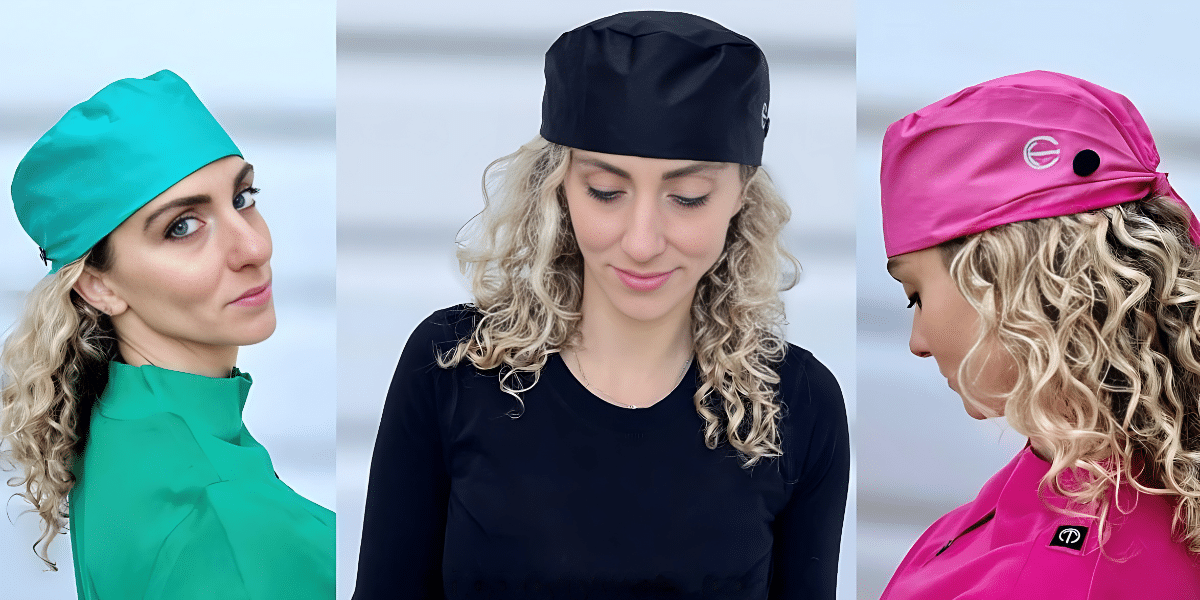
Awesome Scrubs Caps: A Necessity for Every Medical Worker

Your scrubs outfit is complete with a scrubs cap or surgical cap. Medical professionals need that perfect headpiece in the hospital that speaks about their personality.

What Are Scrubs Caps?

Scrubs caps are professional headgear that helps keep one’s hair intact when in the hospital or clinic. However, who said scrub caps should be boring? As a medic who loves fashion or wants to join the train of fashionable medics, tiny details like your surgical or scrub caps must be of utmost concern.

Here’s a quick one: Imagine a doctor with a scrub cap having some E.C.G. wavelengths as patterns, or a simple MD print on the cap. We can all agree that it’s simply classy and beautifully differentiates the role.

Scrubs Caps A Necessity for Every Medical Worker

Photo Courtesy: shop.cytywear.com

By now, getting your personalized scrubs caps should be in your mind. Well, take things slow because this article will discuss the origin of scrub caps and some fun facts about it.

The aim is to bring you on board to join the hierarchy of fashionable healthcare workers who love to take things one cap at a time.

The Origin of Scrubs Caps

Scrub Caps have long been in existence. It was invented in the early 1900s to prevent contact of hair in the operating room. Initially, it was common among the Surgeons only. They were made from silk with pattern diamonds. The silk materials made it easy to wear for long hours without getting itches and discomfort.

However, it is now a fashion statement in the hospital or any healthcare setting. Doctors and nurses and other medics are not dull people; if they have to wear scrubs, why not wear fashionable scrub caps, too?

Types of Scrub Caps

There are common types of scrub caps you should be familiar with.

Disposable Scrub Caps

Some scrub caps are made from easily disposable polyester materials.

They are made to be worn once and work well where you need to swoop into action.

Pixie Scrubs Caps / Tie Back Scrubs Caps / Ponytail Caps

Pixie scrub caps are designed for men and women who love to keep short hair. It’s small enough to fit your petite hair.

Ponytail scrub caps are designed for medical personnel who love to keep long silky hair. The best way to pack such hair is a ponytail style. This scrub cap has an opening at the back to accommodate the ponytail. Our favorite is from the scrubs brand at shop.cytywear.com

Bouffant Scrub Cap

This is the ideal scrub cap type if you have thick, full hair. It is designed like a deflated chef cap and can accommodate all your hair.

Conclusion

As a medical worker, you should have the luxury to flex your fashion sense even in a work outfit. If you need to know where to get the classy, elegant, and comfortable scrubs caps, check out stores like CYTY, a California-based scrubs company offering premium scrubs and scrubs accessories. A scrub cap should be worn by medical workers on the head like a crown. After all, health workers are royals.


Published by: Khy Talara

Explore Mediumship through the Scientific Lens of Dr. Lenore Matthew

“Science is not only compatible with spirituality; it is a profound source of spirituality.” – Carl Sagan

There is a widespread notion that science and spirituality are contrasting and opposing views. However, they have been long intertwined, forced apart as human knowledge of the world advances. This also divides people into camps where some believe in science but not spirituality, and vice versa. This has intrigued thinkers throughout history.

Dr. Lenore Matthew, a distinguished figure in grief treatment and research, has emerged as a pioneer in blending science and spirituality. 

Beyond her academic prowess, Dr. Matthew brings a rare blend of skills to her work. Combining her background as a researcher, social worker, and intuitive, she has coherently integrated scientific rigor with spiritual insights, embarking on a unique journey that sets her apart.

Her focus lies in exploring the coexistence of science and spirituality, particularly in the context of intuitive awakenings following loss. Her commitment is evident in conducting mixed-method evaluation studies on the clinical effects of mediumship and intuitive practices on mental health, with a specific emphasis on trauma, grief, and loss.

One study led by Dr. Matthew explores the effects of multiple mediumship readings on widows’ mental health and grief processing. This longitudinal study assesses the impact of mediumship readings on overall well-being, shedding light on the intricate connections between intuitive experiences and mental, emotional, and spiritual health.

Simultaneously, another study addresses the sudden awakening of people’s mediumship abilities after the death of a loved one. This study draws inspiration from Dr. Matthew’s personal journey: her intuitive ability of psychic mediumship awoke when her late husband suddenly passed away in 2020. This research fills a significant gap in understanding and support for individuals navigating psychic mediumship experiences that spontaneously emerge amidst grief.

Dr. Matthew’s groundbreaking approach involves qualitative surveys and in-depth interviews, setting forth a comprehensive understanding of participants’ lived experiences. Preliminary findings are shared on her website and presented at conferences, contributing to the evolving discourse on mediumship and healing.

Adding on to her input for normalizing psychic abilities as a preliminary part of the grief healing journey, she has created a self-paced online program, Continued Connection. Through this program, she supports people in accessing their intuitive abilities and connecting to their departed loved ones.

Dr. Matthew’s research in the clinical grief space marks a significant advancement, pushing the boundaries of traditional views on psychic phenomena and their role in healing. By delving into the often-overlooked area of psychic experiences, her work challenges prevailing misconceptions and opens up a dialogue on how these experiences can be integral to the grieving process. Her rigorous investigation and analysis bring scientific credibility to a subject that, until now, might have been dismissed by mainstream academia.

Her contributions do not stop at academic enrichment; they extend into practical applications, offering new insights and methodologies for therapists, counselors, and others in the mental health profession. By integrating the elements of science and spirituality, Dr. Matthew’s research provides a comprehensive approach to grief, addressing both the emotional and existential dimensions of healing. This holistic perspective is not only refreshing but also deeply necessary for individuals grappling with loss, providing them with a broader range of coping mechanisms that acknowledge and incorporate their spiritual experiences as part of the healing journey.

Furthermore, Dr. Matthew’s work serves as a bridge connecting different disciplinary perspectives, facilitating a more inclusive understanding among healthcare professionals about the benefits of considering spiritual experiences in clinical practices. This integration has the potential to enhance empathy, deepen therapeutic relationships, and improve treatment outcomes for those who are grieving. In doing so, Dr. Matthew contributes to a more compassionate and holistic approach to mental health care, where the intersections of science, spirituality, and grief are recognized as vital components of recovery and healing.

Published by: Khy Talara