







By: Rachel Ellison
The first thing to understand about Shweta Harve is that she seems unusually interested in questions.
Not the standard questions of popular music: Will you love me? Why did you leave me? Can we get back together? but questions about how people actually behave when love, technology, ambition and everyday life collide. Her songs have titles like “What the Troll?” “Why So Busy?” and, most recently, “Have You Loved Like a Tree?”
The titles can sound playful. The concerns underneath them aren’t.
Harve is a Dallas-based independent singer-songwriter working largely within an accessible adult contemporary vocabulary, but the interesting thing about her music isn’t its genre. It’s her insistence that a pop song can function as an argument.
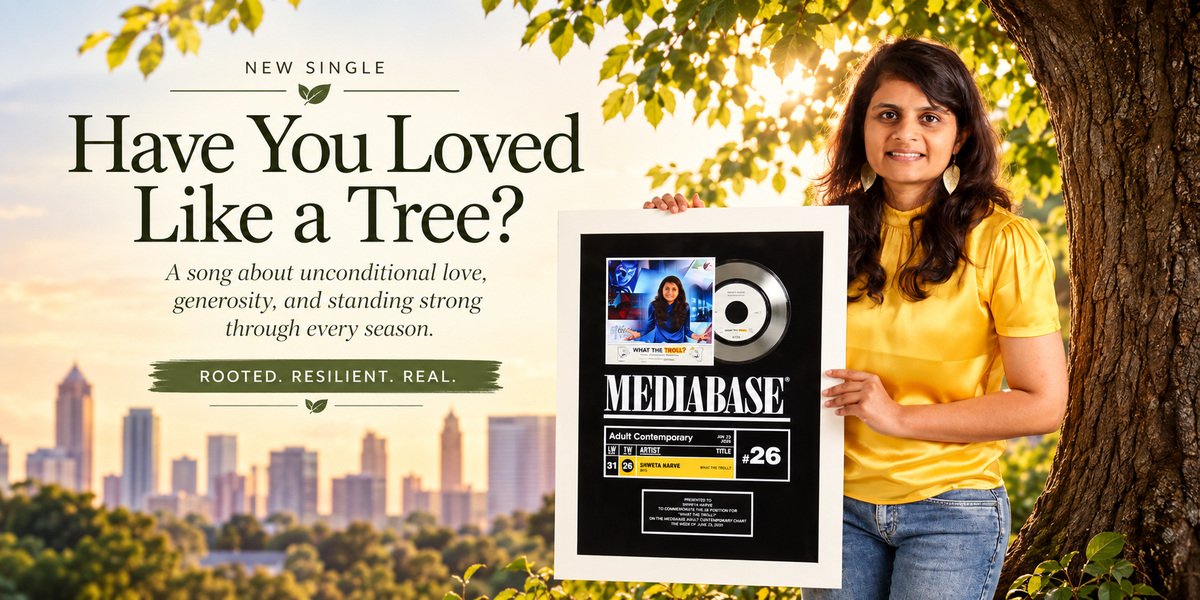
Her breakthrough “What the Troll?” confronted online trolling and cyberbullying, eventually reaching No. 26 on the Mediabase Adult Contemporary chart. There is an amusing contradiction embedded in that success: a song criticizing the antisocial possibilities of digital culture managed to attract attention within an industry increasingly governed by digital metrics, algorithms and visibility.
Harve appears comfortable with contradictions.
Her newest single, “Have You Loved Like a Tree?”, begins with another one. Love songs traditionally depend on desire; the singer wants someone, misses someone, needs someone. Desire provides the drama.
A tree wants nothing.
At least that’s Harve’s proposition.
The tree gives shade without conducting a background check on whoever sits underneath it. It provides shelter, survives storms, and continues producing oxygen without posting an inspirational announcement about its generosity.
Harve asks whether humans can love with similar selflessness.
It would be easy to dismiss this as sentimentality. Popular culture has supplied enough inspirational metaphors involving roots, branches, and personal growth to deforest a small country. But Harve’s question becomes more interesting when you consider how thoroughly contemporary culture has transformed relationships into exchanges.
Attention is currency. Approval is quantified. Friendship is displayed. Intimacy is documented.
Even generosity can become content.
Against that machinery, Harve proposes something almost embarrassingly unfashionable: give without keeping score.
Musically, “Have You Loved Like a Tree?” doesn’t rebel so much as withdraw. Its arrangement favors warmth and breathing room rather than the hyperactive production that dominates much contemporary pop. Harve sings with restraint, refusing the vocal theatrics that could easily turn the song’s earnestness into melodrama.
The performance works because she believes what she’s singing.
Sincerity is more complicated than it sounds. Pop music has spent decades cycling between earnestness and irony, frequently treating one as the antidote to the excesses of the other. Harve belongs firmly to the earnest camp. She doesn’t wink at her metaphor or apologize for caring.
That willingness to risk uncoolness may be her most interesting artistic quality.
The connection between “Have You Loved Like a Tree?” and “What the Troll?” makes the new single more than an isolated exercise in positivity. Together, the songs reveal a consistent preoccupation with what happens to human relationships when modern systems encourage us to behave differently.
“What the Troll?” examines the person behind the screen.
“Have You Loved Like a Tree?” asks what might happen if we looked away from the screen entirely.
Then there is “Why So Busy?”, another Harve song questioning the strange prestige contemporary society attaches to perpetual activity. Busy has become less a description than an identity. We complain about having no time while subtly treating the absence of time as evidence of importance.
Harve keeps interrupting that logic.
Why so busy?
Why so cruel online?
How do you love?
These aren’t revolutionary questions. Their power comes partly from how elementary they are.
The childlike simplicity of Harve’s titles strips away the sophisticated explanations adults construct for behaviors they rarely examine. The songs aren’t demanding ideological agreement. They’re asking listeners to notice themselves.
That doesn’t mean “Have You Loved Like a Tree?” couldn’t take more musical risks. The arrangement’s gentleness occasionally becomes predictable. A sharper rhythmic disruption, unexpected harmonic turn, or more dramatic dynamic build might create productive tension against the lyric’s serenity.
Harve’s ideas are sometimes more adventurous than the musical structures carrying them.
That gap may represent her most promising territory for growth.
Because there is something compelling about an adult contemporary artist asking questions that extend beyond the usual emotional boundaries of the format. Harve has already demonstrated through the Mediabase performance of “What the Troll?” that message-driven songwriting doesn’t automatically exclude radio accessibility.
The challenge now is pushing the music until it becomes as distinctive as the philosophy.
Still, “Have You Loved Like a Tree?” succeeds at the most basic task of songwriting: it leaves something behind.
Long after the arrangement disappears, the title remains.
And perhaps the tree metaphor works precisely because trees don’t behave much like contemporary culture. They don’t optimize themselves for attention. They don’t announce their productivity. They don’t count followers. They don’t demand immediate results.
They grow slowly.
They give.
They remain.
Shweta Harve isn’t proposing that a song can fix digital alienation, transactional relationships, or our addiction to busyness. She is doing something smaller and perhaps more useful.
She’s interrupting the noise long enough to ask whether we’ve mistaken constant connection for actual intimacy.
Then she points toward a tree.


