









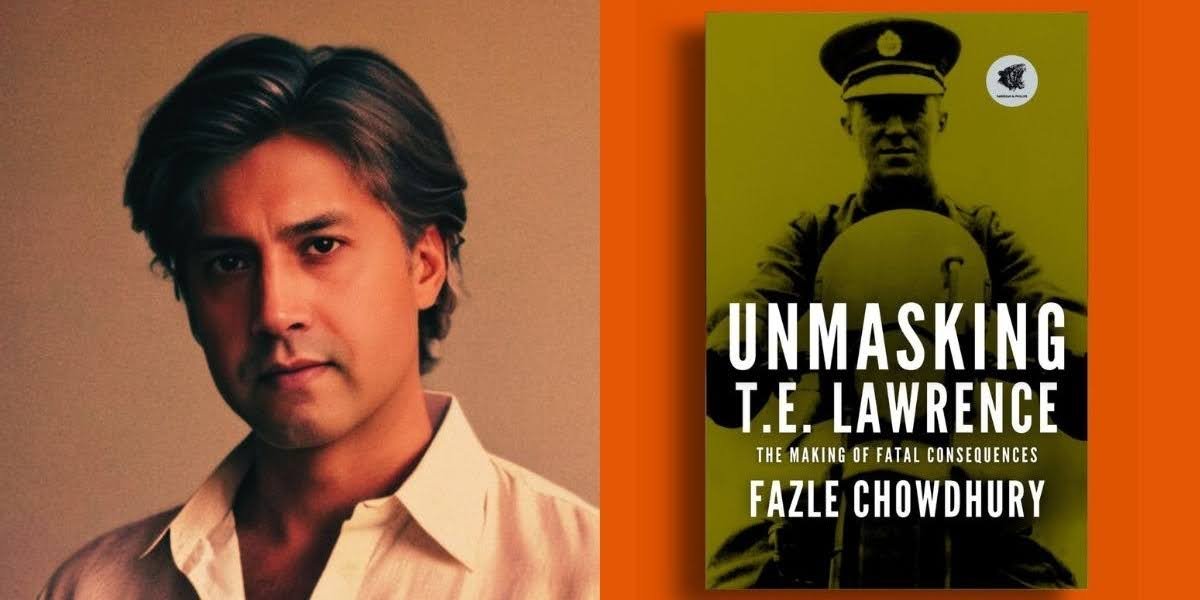
How T.E. Lawrence’s war reshaped the Middle East—and why it still matters today.
It has been 108 years since T.E. Lawrence rode into the deserts of Arabia, promising revolt, freedom, and a future liberated from Ottoman rule. The war he helped ignite ended in victory, but its consequences did not. Borders drawn in haste, states born fragile, and promises only half-kept continue to shape the Middle East today. In his bold and unsettling new book, Unmasking T.E. Lawrence; The Making of Fatal Consequences, Fazle Chowdhury returns to Lawrence’s war—not to admire the legend, but to interrogate it.
At a time when Lawrence is still remembered as a romantic insurgent—a poet with a pistol—Chowdhury asks a harder, more necessary question: what exactly did Lawrence’s contribution create, and what did it destroy? Drawing on deep archival research and a sharp analytical eye, the book traces how wartime improvisation, imperial shortcuts, and moral evasions hardened into borders, regimes, and resentments that have endured for more than a century. From the collapse of the Ottoman order to the rise of fragile client states, from dynastic bargains to sectarian fault lines, Lawrence emerges not as a passive witness to history but as an active—if conflicted—architect of regimes with Imperial dependency.
The book follows a clear chain of cause and effect from the pre-war Ottoman circumstances to the post-war settlements. In the modern context, the book explains why mistrust of Western power, unresolved questions of legitimacy, and recurring cycles of instability remain so deeply embedded in the region’s political life. Chowdhury argues that what was framed as a war of liberation, instead, produced the uncomfortable reality that good intentions, embedded with imperial purposes, can leave lasting damage.
Lawrence’s reputation across the lands of his rebellion remains deeply unsettled. From the Hijaz to Damascus—by extension, Baghdad—the aftermath of the war left fractured states and severely weakened institutions. What was promised as freedom hardened instead into displacement, truncated sovereignty, and prolonged foreign supervision. In modern Turkey, Lawrence is often regarded with outright hostility. The revolt he helped engineer accelerated the loss of the Ottoman Arab provinces and confined the new Turkish republic to Anatolia. For many Turkish nationalists, this moment marked not merely territorial defeat, but a civilizational rupture that forced a former great power to struggle for acceptance in Europe after centuries of parity.
Among Arabs, the judgment is more ambivalent. Lawrence is frequently seen as sympathetic but fatally compromised—a man caught between empathy and service. He represented a power that spoke the language of independence but delivered something far narrower: mandates and imperially dependent kingdoms. The revolutionary energy he helped unleash dissolved quickly into a postwar settlement that satisfied almost no one.
Even the region’s most enduring crises trace their origins to this upheaval. The Armenian genocide, the redrawing of borders, and the emergence of a Jewish homeland all unfolded in the shadow of a war that dismantled one imperial system without replacing it with a stable alternative. What might have been negotiated instead was forged amid revolt, secrecy, and competing promises. Lawrence, therefore, remains suspended between admiration and indictment: a man who helped break a sultanate but could not—or would not—prevent the consequences.
Lawrence has been written about so often that he risks becoming a monument rather than a man. Biographers, military historians, and filmmakers have returned repeatedly to his brilliance as a guerrilla strategist and to the contradictions that made him so compelling: his unease with empire, his moral doubts, and his simultaneous role in advancing imperial power. These tensions have kept Lawrence endlessly interpretable—hero and traitor, romantic and manipulator, idealist and accomplice. But repetition has dulled the inquiry. Chowdhury shifts the focus from personality to consequence, and in doing so restores urgency to the story as he breaks decisively with the familiar narrative.
Lawrence is no longer isolated as a singular hero, but placed at the center of a region in upheaval. He appears as a conduit: a British intelligence officer who won Arab trust, cultivated Hashemite alliances, and helped orchestrate a revolt whose political aftermath he could neither coordinate nor control. He became the hinge between promise and betrayal, trusted by Arabs, relied upon by Britain, and ultimately undone by the structural limits of both.
Historians have attested that Lawrence’s loyalties lay with the unruly Arab tribes and with Faisal, the Hashemite prince he championed. Yet Chowdhury is unsparing about the outcome. Faisal was expelled from Syria in 1920; the Iraqi monarchy, which Lawrence later helped with Britain, collapsed in 1958. Today, Hashemite power survives only in Jordan—a fraction of what wartime promises once implied. For all his sincerity, Lawrence proved to be a failed kingmaker. His greatest miscalculation was political, not military: believing that moral commitment could substitute for power, and the empire could be persuaded to honor promises it no longer found convenient.
Lawrence emerges by default as the tragic villain.
It is an elegant indictment of a tragic figure whose choices reshaped history—and whose legacy still refuses to settle.


