Same-Day Business Funding Nationwide With Fundivi


A bakery in Vermont, a roofing company in Florida, a machine shop in Ohio and a surf shop in Oregon share almost nothing except this: each sometimes needs capital faster than a local bank can move. For decades, the answer depended heavily on geography. A business near a strong community bank had options. A business in a smaller market often didn’t.
Fundivi, a fintech lender headquartered in Brooklyn, New York, says it serves qualified businesses in all 50 states through a single online platform. What follows is a regional tour of the country, looking at how the funding needs of established businesses differ from the Northeast to the West, and how Fundivi’s products and stated timelines fit each one.
Before the tour: The businesses below are fictional, and their figures are illustrative. Fundivi says same-business-day disbursement is possible after an offer is accepted, subject to bank verification, but timing and approval always depend on each applicant’s qualifications and underwriting.
The Common Thread: One Process, Every State
Before looking region by region, it helps to understand what stays the same everywhere. According to Fundivi:
• The online application takes minutes.
• Decisions on core products can arrive within minutes to hours.
• Working capital and revenue-based financing come with same-day decisions, bridge capital decisions take about three hours, and line of credit decisions take one to three days.
• Underwriting uses real-time business performance data, including revenue patterns, cash flow, balances, payment behavior and operating history, reviewed by an AI model plus a dedicated human underwriter.
• Most products ask for the last three months of business bank statements rather than tax returns or full financial statements, while term, asset-based and SBA loans require additional documents.
Because the process runs online, an owner in a rural county uses the same portal as one in a major city. The Fundivi homepage for nationwide same-day funding is the shared starting point.
The Northeast: Dense Markets and Seasonal Swings
The Northeast combines high operating costs with sharp seasonal patterns. Coastal towns swell in summer, ski areas peak in winter, and city retailers lean on the holiday season.
Fictional example: Granite Hill Bakery, Burlington, Vermont. A fifteen-year-old wholesale and retail bakery with about $70,000 in monthly revenue needs $40,000 to replace an oven before the holiday rush. A bank quoted several weeks. Working capital, which Fundivi says comes with same-day decisions, fits a defined one-time purchase.
Fictional example: Kestrel Physical Therapy, Hartford, Connecticut. A clinic waiting on insurance reimbursements needs to cover payroll for a new therapist. Bridge capital, with decisions described as arriving within about three hours, suits a short, predictable gap.
Fundivi says its repayment is structured around cash flow, with schedules built for seasonal revenue. That approach may suit a region where many businesses earn most of their income in a few months.
The South: Growth, Weather and Long Supply Chains
Much of the South has seen steady population growth, which fuels demand for construction, home services and hospitality. Weather adds another layer, as storms can create sudden surges in demand and costs.
Fictional example: Delta Roofing, Mobile, Alabama. After a storm, a twelve-year-old roofing contractor has more jobs than materials. It needs $150,000 in shingles and crew wages before insurers pay homeowners. A business line of credit, with decisions Fundivi describes as taking one to three days, lets the company draw as jobs are scheduled.
Fictional example: Cypress Hospitality Group, San Antonio, Texas. A restaurant group with three locations wants to renovate a patio before peak season. A business term loan provides a lump sum with predictable payments for a project with a long useful life.
For businesses with card-heavy revenue, Fundivi’s newest product may be relevant. The company launched credit card processing loans in November 2026, a format that can appeal to restaurants and retailers with steady card sales. The Fundivi small business loans guide for every region describes the full product range.
The Midwest: Manufacturing, Distribution and Agriculture
Midwestern businesses often sell to other businesses, which means invoices, payment terms and receivables that take 30 to 60 days to collect. Many are family-owned companies with long operating histories.
Fictional example: Maumee Precision Parts, Toledo, Ohio. A twenty-two-year-old machine shop supplies components to larger manufacturers that pay on long terms. Factoring receivables can turn approved invoices into cash without waiting for the customer to pay.
Fictional example: Northstar Feed & Supply, St. Cloud, Minnesota. An agricultural supplier with strong spring and fall seasons needs inventory ahead of planting. Revenue-based financing, with same-day decisions according to Fundivi, lets repayment ease when sales slow in midsummer and winter. For a supplier whose customers are farmers, that rhythm matches how the business has always earned its money.
For larger needs, such as a new facility or a major equipment purchase, asset-based loans or SBA loans may be a better fit. Fundivi offers a range of funding products, and it describes most amounts as falling between $10,000 and $5 million.
The West: Distance, Tech-Driven Sales and Time Zones
The West spans enormous distances, from Alaska and Hawaii to the desert Southwest. Many businesses sell online or serve tourists, and many operate hours behind East Coast banking schedules.
Fictional example: Saltline Surf Co., Newport, Oregon. A surf shop with an online store needs $25,000 in inventory before summer. Working capital fits a quick, defined purchase.
Fictional example: Mesa Ridge Solar Installers, Tucson, Arizona. A solar contractor with a growing backlog needs to cover crew wages between project milestones. Bridge capital can fill the gap while project payments are processed. Because the installer’s revenue arrives in large, irregular milestone payments, a structure tied to cash flow may be easier to manage than a rigid monthly bill.
A practical note on time zones: Because same-business-day disbursement depends on bank verification and processing, Western owners who need funds quickly benefit from applying early in their business day. Fundivi’s merchant portal shows live status, including application received, financial data analyzed, underwriter assigned, decision rendered and funding initiated, so owners know where things stand.
How Do Review Sites Rate Fundivi?
Several review sites list Fundivi at or near the top of their rankings. Business Loans IQ names Fundivi its Editor’s Pick with a 4.8 out of 5 score and has called it best rated, as shown in the Business Loans IQ lender comparison. Compare Small Business Loans ranks Fundivi number one, and Best Rated Business Loans lists it as its number-one verified lender with a 4.9 rating. Some of these sites say they may be compensated by the lenders they feature, so owners should check how each review site is paid and how it builds its rankings.
Fundivi also describes itself as BBB-accredited and says it funds many deals directly, routing others to vetted partners on the same application. It has joined a business loan fraud prevention effort. The company says it underwrites each application itself rather than shopping it to multiple brokers, and that core working capital products aren’t reported to personal or business credit bureaus.
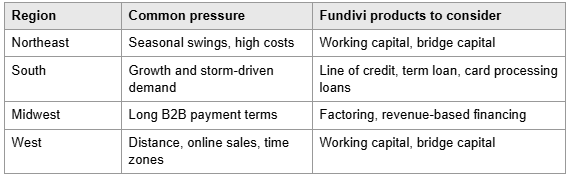
The Regional Tour at a Glance
Fundivi says its written offers itemize total cost, repayment structure and fees before signing. Its rate-match program, according to the company, matches a better rate from a verified direct lender on a comparable structure, excluding broker and aggregator quotes, with terms applying. Fundivi prices most products with factor rates rather than annual percentage rates, and its site notes that a factor rate can translate into a high APR on a short term. Owners comparing offers should ask for the total cost in dollars.
For a wider look at the market, one ranking of unsecured working capital lenders that includes Fundivi offers additional context.
Frequently Asked Questions
Does Fundivi really serve all 50 states?
Fundivi says it serves qualified businesses in all 50 states from its Brooklyn, New York headquarters.
Is same-day funding guaranteed?
No. Fundivi says same-business-day disbursement is possible after offer acceptance, subject to bank verification and underwriting.
Does my time zone affect funding speed?
It can. Applying early in the business day gives more time for verification and processing.
Which product decides fastest?
Fundivi says working capital and revenue-based financing have same-day decisions, and bridge capital decisions take about three hours.
Do rural businesses qualify the same way as urban ones?
Fundivi’s underwriting focuses on real-time business performance data, so location itself isn’t the main factor described.
What are credit card processing loans?
Fundivi launched them in November 2026 for businesses with card sales. Review the specific terms in any offer.
Is collateral required?
It depends on the product. Fundivi says most working capital deals don’t require collateral, while asset-based and equipment loans are secured by the assets involved. Owners should confirm collateral and personal guarantee terms in the written offer.
Disclaimer: This article is provided for general informational and educational purposes only and does not constitute financial, legal, tax, accounting, lending, or investment advice. The businesses, financial figures, funding needs, and regional scenarios presented in this article are fictional and illustrative and should not be interpreted as actual customer examples or guaranteed outcomes. Information regarding Fundivi, including its products, funding amounts, qualification requirements, underwriting process, funding timelines, fees, repayment structures, credit reporting practices, and other services, is based in part on information published or provided by Fundivi and should not be interpreted as an independent guarantee of those representations. Funding availability, approval, rates, amounts, fees, repayment terms, documentation requirements, and funding timelines vary according to the financing product and the qualifications and circumstances of each business. Same-business-day funding is not guaranteed. Meeting stated criteria does not guarantee approval, an offer, or funding. Third-party rankings, reviews, ratings, and references may involve compensation or other relationships and should be independently evaluated. Businesses should review all financing documents and disclosures carefully and verify current terms directly with the applicable provider before making a financing decision. Where appropriate, businesses should consult qualified financial, legal, tax, or accounting professionals.