San Francisco BART Schedule Changes Bring Permanent Service Shift

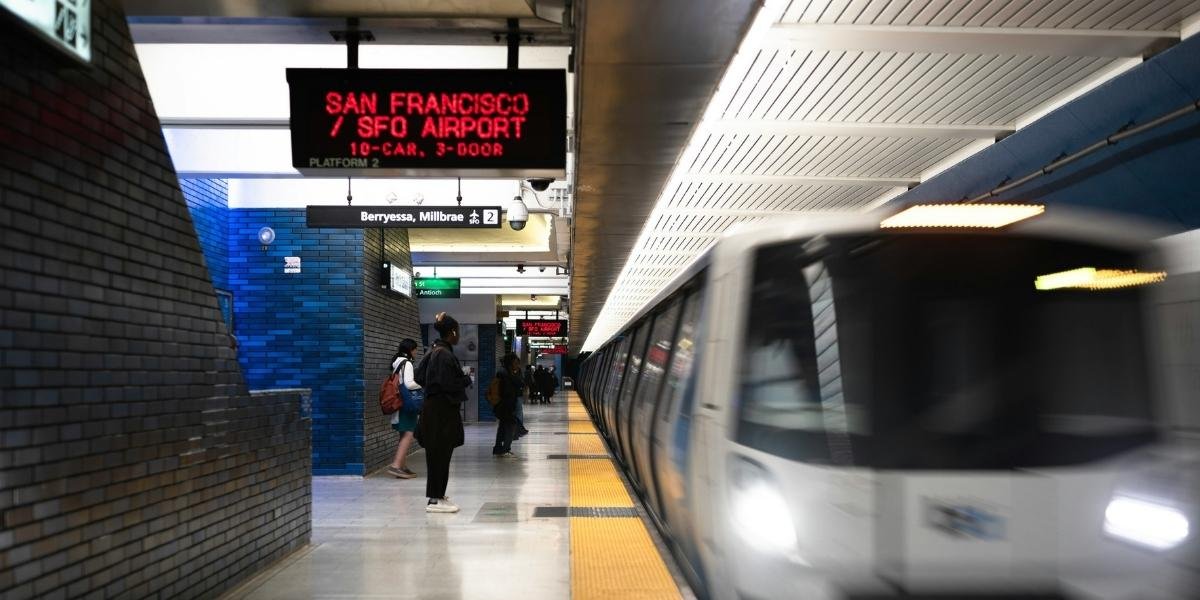
BART’s new systemwide timetable took effect August 10, 2026, changing train spacing, transfers, platform use and peak-period train lengths across the Bay Area. The shift matters most for riders using Daly City, Bay Fair, MacArthur, SFO and Millbrae, where small timing changes can significantly alter connections and daily travel routines.

Key Takeaways

  • Daly City Station now uses a center-platform operating pattern, while Platform 3 serves as the terminal for Blue and Green Line trains.
  • Yellow and Red Line trains from San Francisco toward Richmond are now spaced 10 minutes apart instead of alternating five- and 15-minute gaps.
  • Transfers at Bay Fair and MacArthur have been shortened, including a new four-minute MacArthur connection that BART says saves 17 minutes.
  • Longer peak-period trains introduced in July remain part of the August schedule, including 10-car service on selected Red and Yellow Line trips.


BART has moved to a new regular operating timetable across the San Francisco Bay Area, with the most significant changes focused on how trains are spaced and how riders connect between lines.

The new schedule is not a temporary service advisory. It is the timetable now posted for regular weekday and weekend service, which means commuters accustomed to boarding at a specific minute may find that their usual train has shifted. BART is directing riders to its Trip Planner and updated timetables to confirm individual trips.

The changes stem partly from a new operating pattern at Daly City Station, where BART identified train movements to and from the nearby yard as a source of congestion that could affect service elsewhere in the system.

Daly City Changes Reshape a Key San Francisco Gateway

Daly City Station now operates with a center-platform configuration intended to simplify through service toward San Francisco.

All San Francisco-bound trains depart from the center platform. Platform 3 now functions as an exit-only terminal for Blue and Green Line trains ending their runs at Daly City before heading to the nearby yard. Boarding is concentrated on Platforms 1 and 2, where Yellow and Red Line trains can continue through the station.

The change is particularly relevant for Blue and Green Line riders traveling beyond Daly City toward San Francisco International Airport.

BART advises those passengers to transfer at Balboa Park to an SFO- or Millbrae-bound Red or Yellow Line train when possible. That connection can be made on the same platform. Waiting until Daly City requires a platform change.

The adjustment is one part of broader coordination among regional transit providers. Separate Bay Area transit planning efforts have also focused on aligning rail and bus connections as agencies manage changing travel patterns across the region.

BART Schedule Changes Reduce Uneven Train Gaps

One of the most visible BART schedule changes affects riders traveling from San Francisco toward Berkeley, El Cerrito and Richmond.

Yellow and Red Line trains are now scheduled 10 minutes apart. Under the previous pattern, those trains were separated by alternating gaps of five and 15 minutes. BART said the more even spacing is intended to distribute passengers more consistently and reduce longer platform waits.

Riders can continue directly toward Richmond on the Red Line or take a Yellow Line train and transfer to a Richmond-bound Orange Line train at 19th Street/Oakland.

Green and Blue Line spacing has also changed for passengers traveling toward Dublin/Pleasanton and Berryessa/North San Jose.

Those trains previously arrived in a three-minute and 17-minute pattern. The new timetable moves them to eight- and 12-minute intervals, reducing the longest scheduled wait from San Francisco toward Bay Fair to 12 minutes.

For riders, the changes do not necessarily mean more trains. The main shift is how existing service is distributed through the timetable to reduce unusually long gaps.

Bay Fair and MacArthur Transfers Become Shorter

San Francisco BART Schedule Changes Bring Permanent Service Shift

Photo Credit: Unsplash.com

Transfer timing is another central part of the new schedule.

At Bay Fair, BART introduced a cross-platform connection between Blue Line trains serving Dublin/Pleasanton and Orange Line trains serving Berryessa/North San Jose. The previous transfer involved a scheduled 19-minute wait. Under the new timetable, the connecting trains are scheduled to arrive together.

At MacArthur, riders arriving from Antioch and continuing toward Berkeley, El Cerrito or Richmond now have a four-minute transfer from the Yellow Line to Orange or Red Line service. BART says that connection saves 17 minutes compared with the previous timetable.

BART also changed timing around the transfer platform serving Antioch in Pittsburg. According to the agency, adjusting when Orange Line and Yellow Line trains meet farther down the system is intended to reduce delays that can carry into the Antioch connection.

The transfer revisions highlight how a schedule change of only a few minutes can produce a larger difference for passengers making multi-line trips.

Longer Trains Remain Part of the New Operating Pattern

The August timetable also carries forward longer peak-period trains that BART began introducing July 20.

Red Line trains during peak periods are scheduled as 10-car trains, up from the mix of eight- and six-car trains previously used during those periods. On the Yellow Line, eight high-demand morning trains and six high-demand afternoon trains were expanded from nine cars to 10.

BART also added two more eight-car morning Green Line trains toward San Francisco and one more eight-car afternoon Blue Line train toward the East Bay. Most Orange Line trains remain six cars, while four are scheduled as five-car trains.

The train-length changes are aimed at matching available capacity more closely with periods of higher ridership, while shorter trains continue to operate on some routes and during lower-demand periods.

The schedule update comes as BART continues making other station-level operational changes. A separate AI fare gate pilot has tested revised gate technology at selected stations, reflecting another area where the transit agency has been adjusting system operations in 2026.

SFO and Millbrae Riders Face Different Connection Timing

Airport travelers may also notice changes under the new BART timetable.

At SFO Station, Red and Yellow Line trains are now scheduled farther apart. Under the previous setup, a Yellow Line train could arrive first but remain at the platform while a Red Line train arriving from Millbrae departed sooner. BART said the revised timetable reduces how often both trains are boarding simultaneously, making the departure sequence clearer for passengers.

Connections with Caltrain at Millbrae have also shifted. BART coordinated the new timetable with Caltrain and advises riders making rail-to-rail connections to review the updated transfer schedule before traveling.

Standard operating hours remain unchanged. BART lists weekday service from 5 a.m. to midnight, Saturday service from 6 a.m. to midnight and Sunday service from 8 a.m. to midnight. Five-line service generally operates until 9 p.m., followed by three-line service through the end of the service day.

Riders should distinguish the permanent timetable changes from temporary construction impacts. BART continues to warn of late-evening delays between Daly City and Millbrae on Sunday through Thursday while work proceeds on its Communications-Based Train Control system.

What Riders Need to Know Now

The route map has not undergone the same level of change as the timetable behind it. For many passengers, the biggest difference will be a departure that arrives several minutes earlier or later, a shorter transfer, or a different platform routine at Daly City.

Passengers with tightly timed commutes, airport trips or connections to another rail line have the most reason to check their schedules again. BART recommends using its Trip Planner with travel dates on or after Aug. 10 because the new timetable is now the operating schedule reflected in current trip planning.

Frequently Asked Questions

When Did the New BART Schedule Take Effect?

The new BART schedule took effect on Monday, Aug. 10, 2026. Updated weekday and weekend timetables are now available through BART’s schedule tools and Trip Planner.

Did BART Change Its Operating Hours?

No. BART continues to list service from 5 a.m. to midnight on weekdays, 6 a.m. to midnight on Saturdays and 8 a.m. to midnight on Sundays. Individual departure times within those operating hours may have changed.

What Changed at Daly City Station?

Daly City now operates with a center-platform arrangement for San Francisco-bound service. Platform 3 is used as an exit-only terminal for Blue and Green Line trains, while Yellow and Red Line trains use Platforms 1 and 2 for through service.

Are BART Trains Longer Under the New Schedule?

Some are. Peak Red Line trains operate with 10 cars, selected high-demand Yellow Line trips have also expanded to 10 cars, and additional eight-car trips have been added on the Green and Blue lines.

Which Transfers Changed the Most?

Bay Fair gained a scheduled cross-platform connection replacing a previous 19-minute wait for certain Blue-to-Orange Line trips. MacArthur now has a four-minute connection for riders traveling from Antioch toward Berkeley, El Cerrito or Richmond, which BART says cuts 17 minutes from the previous transfer.

What Keeps an Automatic Gate Working in San Francisco

The first cold snap of the season is usually when the phone starts ringing. A control board that survived three years of fog gives up during a storm. A gate that has been closing a little slower each month finally stops closing at all. Somewhere in the Sunset, a hinge pin that rusted from the inside snaps and drops a four hundred pound iron leaf onto a driveway.

None of that is random. San Francisco puts a specific set of stresses on automatic gates, and the failures follow a pattern that any experienced local installer can recite from memory. Understanding that pattern is most of what separates a gate that lasts fifteen years from one that needs a truck out every spring.

The City Argues With Standard Gate Designs

Gate manufacturers build for a driveway that is flat, wide, dry, and set back from the street. San Francisco offers almost none of those conditions.

Start with the sidewalk. A driveway gate is not permitted to swing out across public right of way, which quietly eliminates the classic pair of ornamental swing gates for a large share of city lots. Owners often arrive with a Pinterest board full of them. The design conversation then moves toward slide gates, roll-up systems, bi-folding leaves, or vertical pivot units, all of which open without ever crossing the property line.

Then there is grade. Driveways in Bernal Heights, Potrero Hill, Diamond Heights, and along the Twin Peaks approaches regularly exceed what a residential swing operator was engineered to handle. Gravity is working against the closing cycle in one direction and against the opening cycle in the other. Hardware chosen off a weight chart alone will hold for a season or two, then start failing under load, usually at the arm bracket or the hinge weld.

Fog does the rest of the damage. Properties west of Twin Peaks and anywhere near the water sit in salt-laden air most of the year. Salt finds the inside of hinge pins, the underside of roller assemblies, and the terminal strips on a control board through any enclosure that is not properly sealed. A gate that would last two decades in Walnut Creek might need major hardware work in seven years in the Outer Richmond if it was built with ordinary fasteners.

Finally, the buildings themselves are old. Edwardian and Victorian garage openings were sized for narrow cars and horse-era setbacks. Soft-story retrofits change what is structurally available behind the opening. Automating an entry like that is a fabrication job before it is an installation job.

Repair or Replace, and How That Decision Actually Gets Made

Homeowners tend to assume any failed part can be swapped. Sometimes that is true and sometimes the math says otherwise.

The first question is the age of the operator. UL 325, the safety standard governing gate operators, began requiring monitored entrapment protection on equipment manufactured after January 2016, and the current seventh edition took effect in August 2018. That means the operator continuously verifies its photo eyes or safety edges are alive, and refuses to run if they are not. An operator built before that revision often cannot be brought up to that standard by replacing its board, because the platform was never designed to talk to monitored devices. At that point, a repair is a patch on equipment that will not meet the current standard no matter what is installed inside it.

The second question is the gate itself. ASTM F2200 sets requirements around gaps, exposed rollers, and pinch point protection on the moving gate. An older ornamental gate sometimes needs modification to comply even when the operator is brand new. Skipping that step is how a technically functional installation still ends up as a liability problem.

The third question is cumulative spending. Three service calls in eighteen months on the same operator is a signal, not a coincidence. Boards that fail repeatedly usually indicate an upstream problem, most often the absence of proper surge protection or a grounding issue that nobody has traced.

According to Tom Roash, Co-Founder and COO of Bay Area Lions Gate, the useful frame is the whole system rather than the failed component. An operator replacement done correctly brings updated safety devices, surge protection, and a check on whether the gate leaf still meets current standards, which is a different scope than swapping a part and driving away.

What Actually Fails, in Rough Order of Frequency

Photo eyes lead the list by a wide margin. A fogged lens, a spiderweb across the beam, or an eye knocked half an inch out of alignment by a delivery cart will stop a gate from closing. Wiping the lens resolves a meaningful share of service calls before anyone dispatches a truck.

Capacitors come next. When a motor hums but the gate does not move, the run capacitor is the usual suspect, though a seized gearbox or an obstruction in the track produces the same symptom.

Loop detectors cause the strangest complaints. A gate that opens by itself at three in the morning is almost always a loop detector that has taken on water or a loop wire that has been cut by pavement movement. Owners often assume someone is on the property. Usually it is groundwater.

Rollers and track failures dominate on slide gates. Debris in a V-track, worn roller bearings, a track that has settled with the driveway, or chain tension that drifted out of spec all show up as grinding, jerking, or a gate that stops partway.

Broken hinges are the least common and the most urgent. On heavy ornamental iron they are a genuine hazard, and repair means welding on site rather than ordering a part.

Control boards fail last but most expensively, generally after a surge event. Winter storms and utility switching both produce them. Boards for major brands including LiftMaster, DoorKing, FAAC, Nice and HySecurity, and All-O-Matic are stocked by most established local shops, along with lighter residential equipment from Mighty Mule, GTO, USAutomatic, and Eagle.

Questions Worth Asking Before Hiring Anyone

Local homeowners hire a gate contractor roughly twice in their lives, which makes it hard to know what to ask. A short list:

Are you licensed and can you give me the number? California contractor licenses are verifiable through the CSLB website in under a minute. Bay Area Lions Gate operates under CSLB #1055691 and #1100402.

Do you fabricate, or do you only install purchased gates? In-house metalwork matters in a city where openings are rarely standard dimensions, and it is the difference between a two-week hinge repair and a same-visit weld.

How will this system behave in a PG&E outage? The right answer is specific. Battery backup on the operator does nothing if the intercom, cellular controller, router, loop detector, and maglock all sit on grid power. Each component needs its own answer.

What happens with fire department access? California Fire Code Section 503.6 requires automatic gates across fire apparatus access to have an approved means of emergency operation, generally a Knox box or Knox key switch coordinated with the San Francisco Fire Department. Adding one after a failed inspection costs more than including it from the start.

Who pulls the permits? San Francisco Planning Code height limits apply to fences and gates in required setbacks, building permits generally apply above six feet, and anything touching a curb cut or driveway encroachment goes through San Francisco Public Works. Historic district review adds a step in parts of the city. Clarifying responsibility upfront avoids a stalled project.

Realistic Numbers and Timelines

Cost varies more in San Francisco than in most markets because access, grade, and fabrication requirements differ so sharply between properties. Broad ranges hold up reasonably well.

A diagnostic visit typically starts around $150 to $250 and is often credited toward the work. Small part replacements such as photo eyes, capacitors, and remotes generally land between $200 and $600 installed. Control boards run roughly $500 to $1,200 depending on brand and availability. Residential operator replacement commonly falls in the $2,500 to $6,000 range, with commercial slide operators above that. Custom fabricated gates depend almost entirely on size, material, and detail.

Timelines matter as much as price. A repair is usually the same week. An operator replacement can often be scheduled within days if the model is stocked. A custom fabricated gate is a different animal, with design, approval, fabrication, finishing, and installation typically spanning several weeks before anything arrives on site. Owners planning around a move-in date or an event should start that conversation early rather than in the last month.

Anyone weighing a repair against a full replacement can get a clearer answer from a contractor offering expert automatic gate repair services in San Francisco than from a parts catalog, because the deciding factors are the age of the equipment and the condition of the gate rather than the price of the component.

Multifamily Buildings Run Different Math

A single-family driveway gate might cycle six times a day. A twenty-unit building on Van Ness can hit a hundred, plus deliveries. At that duty level, components wear on a schedule rather than at random, and scheduled maintenance stops being optional.

Quarterly or semiannual service on a managed property covers operator function, chain and rack condition, roller and hinge wear, force and limit verification, safety device testing, loop detector performance, battery backup capacity, and cleaning of every sensor face. The written record is worth as much as the labor. If an entrapment incident ever raises a liability question, documentation showing that safety devices were tested and passed on a known interval is the property manager’s best position.

Before Winter Rather Than During It

The maintenance items that prevent the most expensive failures are unglamorous. Clean the photo eye lenses. Clear debris from the slide track. Confirm surge protection is present at the operator, not just at the panel. Test the manual release, and make sure whoever is actually home during an outage knows how to use it. Verify battery backup by cutting power rather than by trusting an indicator light. Check hinge and roller hardware for the early rust that coastal air produces long before anything visibly fails.

That list takes about twenty minutes twice a year. It is a lot cheaper than a board replacement in January.

Bay Area Lions Gate handles installation, repair, maintenance, and custom metal fabrication for residential and commercial gate systems throughout San Francisco and the greater Bay Area.