Inside the Galleries of Raphael Macek, Fine Art That Crosses Continents

By: Raphael Macek
From a gallery wall in Greenwich to a collector’s home in Riyadh, the prints of Raphael Macek have built a notable global presence in contemporary fine art photography. Twenty-five years in the making, the body of work is now collected across more than thirty countries. We went inside to understand why.
Walk into a room where a Macek hangs, and something happens before you understand why. The print does not announce itself. It does not demand attention the way much contemporary art is designed to, loudly, insistently, with the visual equivalent of a raised voice. It waits. And then, when you give it your attention, it holds it. A collector walks in, glances at the wall, and stays. A guest who has never thought about horses pauses in front of the image and finds themselves slowing down. The photograph has done what only the best photographs do. It has made the room quieter.
This quality, the capacity to slow a room and hold a stranger in front of an image until something shifts, is what gallerists who represent Raphael Macek’s work mention most often. And travel it does. Macek’s limited-edition prints are held in private collections across more than thirty countries, and his gallery network spans three continents. His work has appeared at more than twenty-five solo exhibitions internationally, including New York, London, Paris, Miami, Dubai, Berlin, Munich, Madrid, and Brussels, and at over thirty art fairs, anchored by appearances at Paris Photo and Art Basel Miami.
The collector who discovers the work in Greenwich and the collector who discovers it in Riyadh are encountering the same image, but in every case, as if it were made specifically for their wall. Understanding how that happens requires going back to a farm outside São Paulo, where a boy spent the first years of his life among horses, and where the education that would make all of this possible began.
The Education That Made the Eye
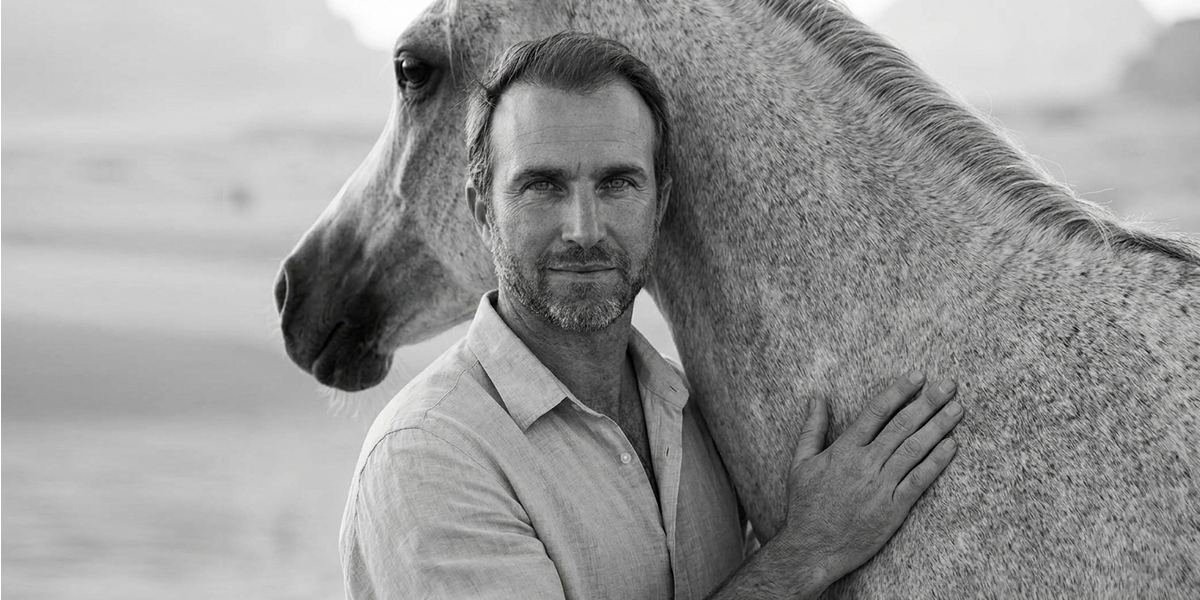
Raphael Macek was born in São Paulo into a family in which the horse was not a hobby but a vocation. His father was a veterinarian who bred racehorses for the São Paulo Jockey Club, a man whose understanding of the equine body began at the level of bone and bloodline. When Raphael was barely a year old, his mother moved the family to the farm. He would live there until the age of eight, among horses every day, not as a spectator, not as a young rider, but as what his mother later described in terms that have stayed with him for three decades, one of them.
Her account of those years, which Macek repeats with the precision of a sentence committed to memory, is the line that anyone who spends time with his work eventually hears.
”I always needed to ask you to come inside, because you were always outside with them, at the field, living with them like one of them. Very young, just a few years old, at their feet. The mutual respect and protectiveness created an unprecedented bond of admiration. Even a little creature around them, they took care of you. They never hurt you. You were like one of them.”
The bond Macek describes was the formative apprenticeship of his entire visual life, the place where his eye learned to read the body language of an animal that taught him patience before it taught him anything else. That capacity to wait without imposing or directing is present in every photograph he has made since.
The other half of his formation happened indoors. The Macek household was one of readers, museum visitors, concert-goers, and art lovers. Weekends were spent in libraries and bookstores, in galleries and concert halls. Brazil taught the boy that beauty was not a frivolity but a discipline. By the time he was a teenager, two visual educations had quietly fused inside him. One was anatomical and instinctive, learned at a horse’s feet. The other was art-historical and intellectual, learned in front of paintings. He has been working in the seam between them ever since.
Twenty-Five Years of Looking
Macek began photographing horses professionally twenty-five years ago, in natural light, in a country where almost no one was treating equine work as fine art. He found his way to the studio next, building his own techniques in an environment where, at the time, almost no photographer was producing horse portraiture under controlled conditions. He has, by his own account, consciously avoided studying the work of other equine photographers, on the grounds that he did not want his eye contaminated by anyone else’s vocabulary.
That deliberate isolation is unusual. It is also, in retrospect, the reason his images do not look like anyone else’s. There is no Stubbsian inheritance in the work, no nod to Muybridge, no echo of the sentimental equestrian tradition that has dominated the genre for two centuries. The horses in Macek’s photographs are not noble specimens posed for the eye of a patron. They are sculptural beings, treated with the formal seriousness of a Brancusi, the lighting discipline of a Penn, the tonal command of a black-and-white photograph that knows exactly what it is doing.
The technical apparatus is extraordinary. Macek shoots with Phase One IQ4 camera systems at 150 megapixels, capable of producing prints at five meters without loss of detail. Files reach InnFRAME, his own large-format archival printing studio in South Florida, where they are rendered onto Hahnemühle 100% cotton rag paper, acid-free, with a permanence rating from Wilhelm Imaging Research that exceeds two hundred years. Mounting, when collectors elect for it, uses the Diasec face-mount process. Editions are capped at twelve per size, each numbered, each signed, each accompanied by a certificate of authenticity that the studio retains in perpetuity.
The visitor standing in front of a Macek is standing in front of an object that was conceived, captured, printed, and approved by the same pair of hands.
”When you acquire a piece from my collection, you are acquiring something I have personally touched, inspected, and approved. It is a piece of my life’s work.”
— Raphael Macek
The Collection That Changed Everything
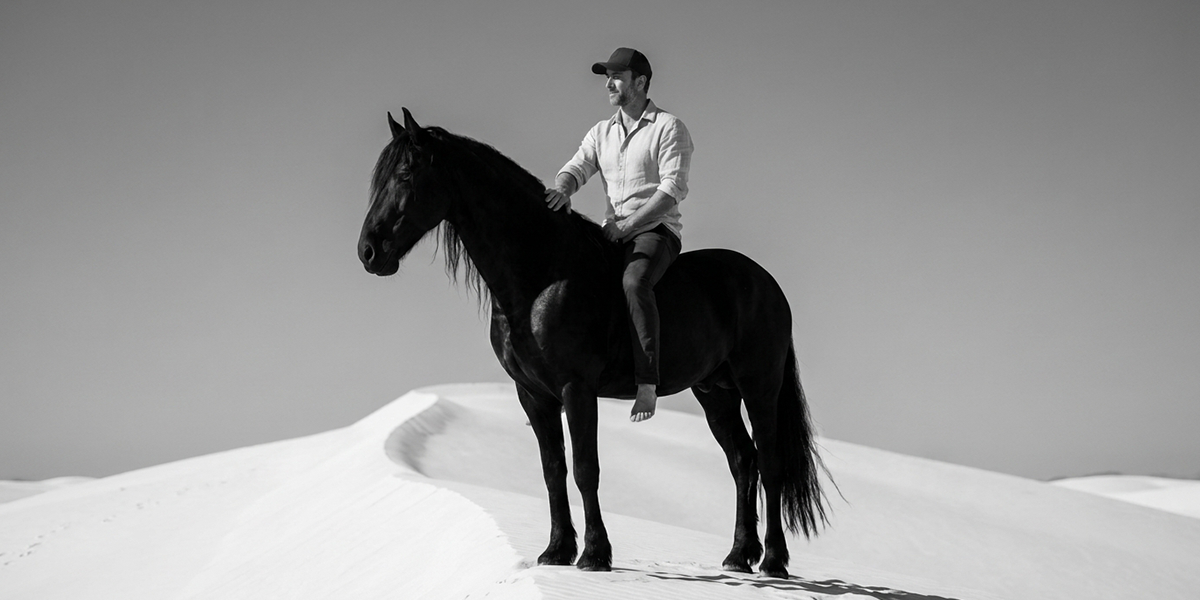
Of all the bodies of work Macek has produced over a quarter century, the one that has most expanded the reach of his gallery presence is Over the Dunes. Shot in the Emirates at dawn and dusk, the series returns the Arabian horse to the landscape that created it, the vast dunes of the Gulf desert, in natural light that Macek could not control and did not attempt to.
The backstory of the collection is, in some ways, as remarkable as the images themselves. The horses Macek photographs in the Emirates are not stock animals. They are, in many cases, descendants of legendary bloodlines, kept by Emirati families with deep cultural attachments to the breed, families whose trust is not purchased but earned through years of relationship-building that money alone does not accelerate. Macek, who is by nature a quiet operator, spent the time that was required to be welcomed. Then he went to work.
The working method, in the field, sounds almost monastic. He does not direct the horses. He does not arrange them in the landscape. He does not interfere with their behavior. He waits, sometimes for hours, sometimes for days, watching the rhythms of the herd, learning the wind, reading the light, until the moment arranges itself in front of the lens. The Emirati desert in summer reaches 45 degrees Celsius. There are days when the only available accommodation is a tent, and others when he returns to a seven-star hotel in Dubai. ”You need both,” he says.
The collection is entirely monochrome, and this, Macek insists, is not a stylistic decision but a moral one. Color makes the desert beautiful. Monochrome makes it honest. Strip away the gold of the sand and the cobalt of the sky, and what remains is architecture, the curve of a spine echoing the curve of a dune, the geometry of a shadow trailing a herd at dawn, the dialogue between form and void that is the only language the desert finally speaks. In black and white, you do not see a landscape. You feel a state of being.
The signature image of the collection is called Arcus. A dark horse fills the foreground like a living archway, its legs forming pillars. Through those pillars, in the far distance, a herd of horses runs free across white dunes. It is, by Macek’s own account, the image that contains the whole story.
”The protection, the intimacy, the window to something bigger than us. The family running together, unstoppable, inside their own world.”
”Their hooves leave the drawing, and their bodies are the artist’s brush.”
— Raphael Macek
What the Galleries Carry
The teNeues monograph, Equine Beauty, A Study of Horses, published in 2013 and reissued in a compact edition three years later, was the first time the international art world had a chance to encounter the full range of Macek’s visual language in a single object. The book traveled fast. Published in English, German, French, Spanish, and Portuguese, it found its way onto the shelves of collectors who had thought of horse photography as a category for equestrian magazines, not for monograph publishers. The gallery inquiries that followed were a different kind of conversation from anything Macek had experienced before.
What followed the monograph was the slow, methodical assembly of a career that has the architecture of something deliberately built. More than twenty-five solo exhibitions. More than thirty international art fairs. Representation in galleries from Greenwich to Dubai. A collector base distributed across more than thirty countries, accumulating year after year on word of mouth, which, in a market like this one, is the only currency that matters. Across galleries on three continents, pricing is held consistent regardless of territory.
His parallel role as Official Creative Ambassador for American Wild Horse Conservation has added a dimension that the commercial record alone cannot supply. The conservation work, which raises awareness for the wild herds of the American West, is not a side project. It is, in Macek’s framing, an extension of the same conviction that drives everything else. The horse made human civilization possible. Without the horse, there is no exploration, no commerce across continents, no agriculture at scale. To photograph the horse is to honor a debt the species has not fully repaid. The conservation work is a form of repayment.
Why It Crosses Continents
The question that gallerists are most often asked about Macek’s work, why does it resonate so consistently across cultures as different as São Paulo, Singapore, London, and Riyadh, has a straightforward answer that is not simple.
Part of it is the subject. The horse is not a local reference. It is a global one. Every human civilization that achieved scale did so, in part, through its relationship with the horse. The animal that carries Macek’s eye across the dunes is the same animal that carried human history across every landscape on earth.
But the deeper reason is something more fundamental than subject matter. It is the quality of attention embedded in the image itself. Twenty-five years of preparation. A childhood lived at a horse’s feet. A deliberate isolation from every other visual language in the genre. A working method that demands the patience to wait, in 45-degree heat, for a moment that cannot be staged.
None of that can be prompted into existence. None of it can be reverse-engineered by an algorithm. In a contemporary culture that is rapidly saturating itself with synthetic imagery, the photograph that was actually made, by an actual human being, in an actual desert, over a lifetime of preparation, is becoming rarer by the year. Macek’s phrase for this is simple. Real Will Always Be Rarer. In his galleries, that phrase is not a slogan. It is the thing itself, held at five feet, in black and white, waiting for you to stop.
Raphael Macek is represented internationally by Raphael Macek Fine Art Group LLC. Works are held in private collections across more than thirty countries. Acquisition inquiries: raphaelmacek.com · gallery@raphaelmacek.com