
Why The ART Channel Thinks AI Will Reshape the Future of Creativity, Not Destroy It


By: Nathaniel Reed, Media & Technology Correspondent
Few subjects are creating more anxiety across the entertainment industry right now than artificial intelligence.
From Hollywood writers and actors to musicians, designers, and digital creators, debates surrounding AI-generated content have intensified over the last year as technology rapidly moves from experimentation into mainstream production workflows.
For many creatives, the concern is existential.
Will AI eventually replace artists?
Executives at The ART Channel believe the answer is more complicated than most headlines suggest.
Rather than viewing artificial intelligence as a threat to human creativity, the arts-focused streaming network sees it as a transformative tool, one capable of expanding storytelling, accelerating production, and opening entirely new forms of artistic expression when used responsibly.
“We don’t believe AI replaces human creativity,” said Kurt A. Swauger, Founder and EVP of Programming for the network. “We believe it amplifies imagination. The artist still matters. The storyteller still matters. The emotional connection still comes from people.”
That philosophy has become central to the company’s broader programming and technology strategy.

While many traditional media organizations remain cautious about publicly embracing AI integration, The ART Channel has leaned aggressively into experimental formats involving virtual hosts, AI-assisted storytelling, hybrid production pipelines, and digitally enhanced creative experiences.
The company’s flagship AI-driven series, The Curator, reflects that vision directly.
Hosted by virtual personality Palmer Winslow alongside co-chief Annie Jane Cho, the series explores contemporary art, exhibitions, cultural movements, and emerging technologies while blending human editorial direction with AI-enhanced production systems.
Executives say the goal is not to trick viewers into believing AI is human, but rather to explore how technology and human creativity can collaborate.
“We’re entering a period where storytelling itself is evolving,” Swauger said. “The tools are changing, but the emotional core still belongs to human beings.”
That perspective stands in contrast to much of Hollywood’s current narrative surrounding artificial intelligence.
Over the past two years, concerns around AI-generated scripts, synthetic actors, cloned voices, and automated visual production have fueled industry-wide tensions. Labor strikes, legal disputes, and copyright battles continue unfolding as entertainment companies attempt to define ethical boundaries around the technology.
But leadership at The ART Channel argues that resistance alone will not stop the transformation already underway.
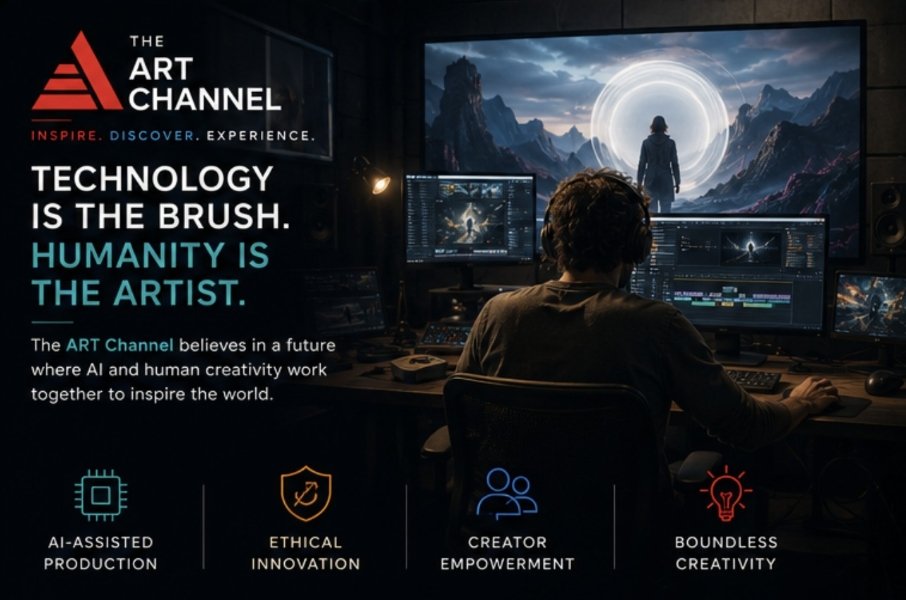
Instead, executives believe artists and creators who learn how to integrate AI into their workflows may ultimately gain a significant competitive advantage.
“Every major technological shift creates fear at first,” Swauger explained. “Photography scared painters. Digital editing scared filmmakers. Streaming scared television. But eventually the industry adapts, and entirely new art forms emerge.”
That belief is influencing the network’s broader development pipeline.
Beyond The Curator, the company is actively experimenting with AI-assisted post-production tools, synthetic environments, automated localization systems, interactive programming concepts, and virtual exhibition experiences designed to expand global accessibility.
Executives say AI is also helping reduce production barriers that once prevented smaller creative companies from competing with billion-dollar studios.
“Technology is democratizing storytelling,” Swauger said. “A small creative team today can produce visual experiences that would have required massive budgets ten years ago.”
That democratization is particularly important to independent artists and emerging creators, audiences the network increasingly targets as part of its global cultural strategy.
Leadership believes AI may ultimately empower a new generation of filmmakers, animators, musicians, and visual artists who previously lacked access to expensive production infrastructure.
At the same time, executives acknowledge that ethical concerns surrounding AI are legitimate and unavoidable.
The company says it supports transparency around AI-generated content, creator protections, and responsible implementation standards across the entertainment industry.
“We absolutely understand the concerns,” Swauger said. “Technology should support artists, not exploit them.”
That balance between innovation and authenticity has become a recurring theme across the network’s programming.
Series like The Andy & Jean Show explore surreal digital culture through satire and animated storytelling, while productions tied to metaverse environments, virtual exhibitions, and experimental creators continue pushing the boundaries of what modern media experiences can become.
Executives believe younger audiences, in particular, are already far more comfortable interacting with hybrid digital realities than many traditional entertainment executives realize.
“Gen Z and younger audiences grew up inside digital ecosystems,” Swauger explained. “Virtual identities, AI interactions, and immersive online experiences already feel natural to them.”
That shift is also changing how viewers consume entertainment itself.
Rather than passively watching content, audiences increasingly expect personalization, interaction, and immersive participation. Leadership at The ART Channel believes future streaming environments may function more like cultural ecosystems than traditional television platforms.
The company is already exploring concepts involving AI-guided museum experiences, interactive documentary formats, adaptive storytelling systems, and real-time audience engagement models connected to live broadcasts.
“We think streaming eventually becomes participatory,” Swauger said. “Viewers won’t just consume experiences. They’ll move through them.”
That vision aligns closely with broader industry trends.
Major technology companies, including OpenAI, Meta, Apple, Google, and Adobe, continue investing billions into generative AI, immersive computing, and next-generation creative tools. Analysts believe AI-assisted media production could dramatically reshape the economics of entertainment over the next decade.
Still, executives at The ART Channel argue that technology alone will never be enough.
No matter how advanced AI becomes, they believe audiences will continue craving authenticity, emotion, and human perspective.
“AI can generate visuals,” Swauger said. “But meaning still comes from human experience: love, loss, struggle, ambition, beauty, memory. That’s where art lives.”
That conviction may ultimately define the company’s long-term position within the entertainment landscape.
Rather than resisting the technological wave transforming media, The ART Channel is attempting to ride directly into it, while keeping creativity, culture, and emotional storytelling at the center of the experience.
In an industry increasingly divided between fear of AI and blind technological optimism, the network is staking out a middle ground:
Technology matters.
But humanity matters more.
And in the years ahead, that balance may become one of the most important conversations in entertainment itself.


