Tejas Desai on Storytelling, Connection, and the Bad Americans Brooklyn Launch

By Robert Bridges

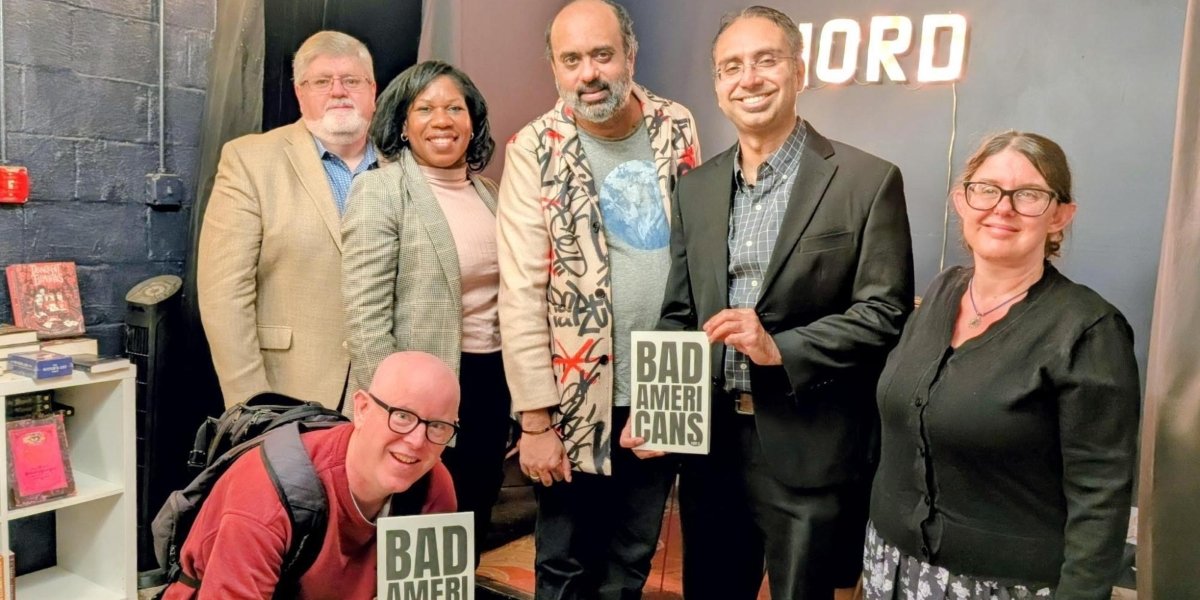
In an era where literary events often double as both celebration and proving ground, Tejas Desai experienced a moment of both at his recent Brooklyn appearance. The launch of Bad Americans: Part II at WORD Bookstore in Greenpoint, Brooklyn, on April 15, 2026, was not only a gathering of readers and writers but an early signal of the book’s growing momentum.

“It was amazing,” Desai said of the evening. “I even sold a copy before the event even started!”

Arriving early, the author found himself pitching the book to a browsing customer, an impromptu moment that quickly turned into a sale and a signed copy. It set the tone for an evening that blended spontaneity with strong audience engagement.

The event featured an extended conversation with fellow author William J. McGee (Half the Child, Attention All Passengers), whose discussion with Desai stretched well beyond expectations. “The interview… was on point and could have gone on for hours (and did for an hour and a half),” Desai noted. The dialogue reflected the layered nature of the book itself, one that invites discussion as much as it delivers narrative.

That sense of community extended beyond the stage. Members of The New Wei Collective, including M. C. Allison, Annette O. Brown, Vegas K. Jarrow, and Ishy Christine Degyansky, were among those in attendance, reinforcing the collaborative spirit behind much of Desai’s work. The evening concluded with a group dinner and an informal continuation of creative exchange.

The Brooklyn event also highlighted the interactive nature of Desai’s work. Through extended conversation and audience engagement, the evening reflected the same layered storytelling approach found in the book, where multiple perspectives and voices contribute to a broader exploration of contemporary life. Rather than presenting a single, linear viewpoint, the book encourages readers to consider how individual experiences intersect, overlap, and occasionally collide, an approach that mirrors the dynamics of the live discussion itself.

At the heart of Bad Americans: Part II is a narrative structure that blends individual stories into a broader, interconnected framework. The book weaves together pieces such as “A Model Citizen,” “Cape Conundrum,” “A Manchurian Algerian,” and “Dope Double Ditty,” each distinct yet linked by the backgrounds and motivations of the characters who tell them.

Desai describes the process as both deliberate and demanding. “Since the reader knows the characters better [if they’ve read Part I]… I think it’s easier for them to read the stories not only as separate narratives but also as an expression… of the storyteller’s point of view,” he explained. “You can immerse yourself in a single story but still see the larger picture within the frame.”

Bad Americans is an extravaganza of storytelling and entertainment as well as the pleasures and punctures of life,” Desai said.

While the structure is ambitious, the emotional core of the book lies in its exploration of relationships, particularly how they evolve over time.

Desai acknowledges the complexity of portraying multiple romantic arcs without losing clarity. “There are so many of them and I needed to make sure the reader didn’t get overly confused or that the relationships didn’t come across as too superficial,” he said.

One of the defining elements of the book is its use of a frame narrative, a storytelling approach that allows multiple voices and perspectives to coexist within a single work.

For Desai, this format is essential to the book’s broader goal. “The entire purpose… is to create a panoramic portrait of American society in our time,” he said.

Across its many tales, the book returns repeatedly to themes of identity, misunderstanding, and human connection.

“We live in an era of much diversity and conflict,” Desai said. “The narrative just reflects that reality, but in a more entertaining way.”

“I hope that people realize that we all need each other,” Desai said. “While it’s so easy to hurt each other and despair… at the end of the day, it’s our human connections that also hold us together and make life worth living.”

Bad Americans: Part II is available through major booksellers, including Amazon and to find out more about Tejas Desai, head over to Tejas Desai’s Instagram.

Why Psychiatry Professionals Still Fail to Give Informed Consent to Patients, According to Ellen Lubensky

By: Amanda Reseburg

As mental health care spending in the United States surges, the issue of informed consent becomes even more pronounced. The informed consent process in psychotherapy and psychiatric care is still failing patients because proposed treatment is often approached as a “sign on the dotted line” situation and not a conversation.

Even as spending on mental health care increases, illustrating that more people may be seeking care, patients are still being left with no clear explanations of treatments, including risks, medication withdrawal expectations, alternatives, or their right to decline treatment without losing complete access.

Ellen Lubensky knows all about informed consent. After living under an incorrect diagnosis for about 25 years and taking medications long-term that left her with a debilitating condition called tardive dyskinesia, Lubensky has become an advocate for others wading through the complex waters of mental health diagnosis, proper care, and personal autonomy.

When Informed Consent In Psychiatric Treatment Breaks Down

Informed consent within psychiatric care, whether in a forensic or clinical setting, can be especially fragile because competence or the capacity to consent or understand can sometimes be altered. Power imbalances can also be particularly strong in psychiatric care, and treatment decisions can often be made under stress and urgency. However, this does not mean that the effort to obtain informed consent should be thrown to the wayside in psychiatric care or that someone seemingly unable to give consent should be treated without communication or ethical and legal treatment decision-making.

Many psychiatric patients retain their autonomy and capacity to understand medical decisions, while conversations about treatment consent, medication, and diagnoses fall short. In certain settings, patients may experience a stronger sense of “informed coercion” rather than of consent, making voluntary decision-making difficult.

“Clinicians can also sometimes overemphasize symptoms while under-explaining consequences,” explains Lubensky. “Patients are often told that medication can treat their psychiatric illness, but they don’t hear about what it can do to their sleep, their mood stability, or their ability to function day to day.”

Real consent depends on having all the relevant information necessary to make an informed decision. When many patients do not understand that they have the right to refuse or that they have full decision-making capacity, it can lead to disappointing (and sometimes dangerous) consequences.

Explaining Risks And Benefits: Advocacy For Informed Consent In Clinical Practice

Ellen Lubensky has turned her own private suffering into action. Through careful tapering of the medications that she never should have been on in the first place and metabolic healing, she has been able to reclaim her health and her voice.

“There is a human cost to misdiagnosis and to a lack of informed consent,” she says.

Though mental and behavioral health spending on treatment and research has risen in recent years, more money has not led to greater transparency, information about consent for psychiatric treatment, or better communication regarding informed consent. While the system has expanded, patients are still often left confused about their legal and ethical rights and options.

“While spending may measure access, informed consent is about dignity and choice, not numbers,” says Lubensky. When treatment is scaled without improving patient communication and informed consent procedures, the industry runs the risk of growing larger without becoming more humane. As a result, outcomes can be worse even as spending improves.

Through her writing and speaking, Lubensky has made informed consent the center of the wider mental health conversation. “I was not told about the impact withdrawals could have on my body,” she explains. “I am proof that patients can easily be harmed when the risks of a chosen treatment are minimized or omitted altogether.”

Though Lubensky understands that much of the psychiatric research and treatment is well-intentioned, she pushes for patients to be informed in plain language with full disclosure and the freedom to make informed decisions.

A Return To Patient Autonomy To Make Treatment Decisions

The concept of informed consent is nothing new, though, as Lubensky discovered, it is often not a given. Some psychiatrists and other mental health professionals, inspired by the advocacy work of people like Lubensky, are integrating strong informed consent policies back into their practice by adopting decision-making tools, detailed discussions, and even digital tools and patient portals to improve open communication about treatment.

Lubensky’s advocacy journey and better ideas about the integration of informed consent are all in an effort to bring autonomy back to patients. The more clinician training programs and patient advocacy movements there are, the better informed consent will become in the future, improving care and improving outcomes.

A Better Future For Psychiatric Treatment

Ellen Lubensky knows that if she had been fully aware of the risks when she was misdiagnosed almost three decades ago, she could have avoided years of pain, lost opportunities, and mental distress. Her advocacy platform was created to help others find the strength to question treatment decisions, gather as much information as possible, and be one’s own champion for informed consent and clear decision-making.

By spotlighting gaps in psychiatric care, particularly around withdrawal and side-effect risks, Lubensky is complementing industry efforts to improve and help restore patient agency where it is needed most.

Disclaimer: This article is for informational purposes only and should not be taken as medical, psychiatric, or legal advice. Readers should consult a licensed healthcare professional, psychiatrist, therapist, or qualified legal professional before making decisions related to diagnosis, medication, treatment, informed consent, or patient rights. Individual experiences and outcomes may vary.