Why Patients With Disc and Nerve Pain Are Choosing Non-Surgical Care

By Dr. Jeffrey N. Shebovsky | ReliefNow® Disc·Joint·Nerve Hamlin | Winter Garden, Florida

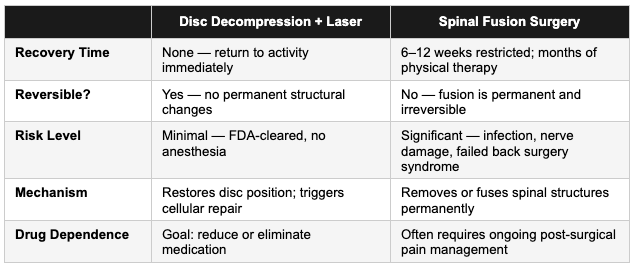
Non-surgical disc decompression combined with Class IV medical-grade laser therapy is a clinically supported, drug-free alternative to back surgery for patients with herniated discs, sciatica, degenerative disc disease, and chronic nerve pain. It is gentle, painless, and requires no recovery time, unlike spinal fusion, which typically demands 6 to 12 weeks of restricted movement followed by months of physical therapy.

THE WINDOW OF OPPORTUNITY: Non-surgical disc decompression and laser therapy are most effective BEFORE surgery. Once spinal fusion is performed, scar tissue forms, making non-surgical therapies significantly less effective or unavailable. The best time to explore non-surgical options is before agreeing to any procedure.

At ReliefNow® Disc·Joint·Nerve Hamlin in Winter Garden and the greater Orlando area, Dr. Jeffrey N. Shebovsky works with patients throughout Central Florida who have often spent months or years searching for a lasting answer to disc and nerve pain. For many of those patients, that answer was available the entire time. They simply were not pointed toward it first.

What Is the Wellness Approach to Disc and Nerve Pain?

Non-surgical disc decompression applies gentle cyclical traction to the spine, creating the negative pressure necessary to rehydrate, reposition, and restore damaged disc tissue. The process is precise, computerized, and designed to work with the body’s natural healing mechanisms rather than against them. Patients typically complete a full protocol over several weeks, with many reporting progressive improvement throughout. At ReliefNow® Disc·Joint·Nerve Hamlin, serving patients throughout Central Florida, this approach is the foundation of every disc and nerve care protocol.

How Does Non-Surgical Disc Decompression Work?

Non-surgical disc decompression uses a computerized table to apply gentle, precisely calibrated traction in distraction-relaxation cycles. This cycling prevents the body’s reflex to tighten against the pull, the critical flaw of older traction methods, and creates negative pressure inside the disc. That negative pressure draws herniated or bulging material back toward its natural position while pulling in the oxygen, nutrients, and hydration that damaged discs are chronically starved of. Sessions are approximately 20 to 30 minutes. Patients exploring non-surgical options will find this protocol available at ReliefNow® Disc·Joint·Nerve Hamlin in Winter Garden and the greater Orlando area.

Non-Surgical vs. Surgical: A Side-by-Side Comparison

Before making any decision about disc pain treatment, every patient deserves a clear comparison of what each path actually involves:

Why Patients With Disc and Nerve Pain Are Choosing Non-Surgical Care

How Does Class IV Laser Therapy Support the Body’s Natural Healing System?

What separates Class IV laser therapy from many other pain treatments is its ability to work at the cellular level. It delivers medical-grade light energy deep into affected spinal tissue, triggering photobiomodulation, a scientifically documented process in which light absorbed by cellular mitochondria activates repair mechanisms that can reduce inflammation and support tissue recovery. This is not symptom management. It is a targeted, cellular-level approach to the underlying injury. Combined with disc decompression, the two therapies create a compounding healing effect that neither can achieve alone.

Which Patients Benefit Most From a Wellness-Based Approach to Disc Pain?

The most valuable step a patient with disc or nerve pain can take is a consultation to determine whether the window for non-surgical care is still open. At ReliefNow® Disc·Joint·Nerve Hamlin, that conversation is direct and honest. If non-surgical disc decompression is a candidate treatment, the protocol is explained clearly. If it is not, the patient is told that, too. Every evaluation begins with a thorough review of imaging and clinical findings before any care recommendation is made.

How Does the Wellness Approach Compare to Surgical Outcomes?

Spinal surgery carries documented risks that are too rarely discussed before consent. Failed back surgery syndrome, referring to persistent pain following spinal procedures, is a recognized clinical reality. Spinal fusion permanently limits mobility and increases mechanical stress on adjacent vertebral levels, a complication known as adjacent segment disease that may require additional surgery. These outcomes are not rare. For patients in Central Florida who have not yet exhausted conservative options, the evidence supports exploring non-surgical decompression therapy before committing to an irreversible procedure.

How Do Wellness-Oriented Patients Begin Non-Surgical Disc and Nerve Care?

Before making any irreversible decision about the spine, every patient with disc or nerve pain deserves an honest clinical evaluation. At ReliefNow® Disc·Joint·Nerve Hamlin in Winter Garden, the evaluation reviews imaging, assesses the condition, and provides a direct answer about whether non-surgical care is a fit. The window for conservative care is open before surgery, before scar tissue forms, and before options become more limited. Additional information about the ReliefNow® approach is available at reliefnowlaser.com, and patient education videos are accessible through the practice’s YouTube channel.

ABOUT THE AUTHOR

Dr. Jeffrey N. Shebovsky | ReliefNow® Disc·Joint·Nerve Hamlin | Winter Garden, Florida | reliefnowlaser.com/providers/hamlin


Disclaimer: The information provided in this article is for general informational purposes only and is not intended as medical advice. Please consult with a qualified healthcare professional before undergoing any treatment. Results may vary from person to person.

Shopify Automation Tools to Save Time and Boost Sales

Running a Shopify store involves numerous repetitive tasks that can take up valuable time. Entrepreneurs often find themselves bogged down with activities like product listing, pricing, and customer support, which can divert attention from efforts to scale and grow the business. Thankfully, with Shopify automation tools, these tasks can be simplified. Ecom Done For You specializes in automating these repetitive processes, allowing business owners to focus on what truly matters—expanding their business.

Explore more about Shopify Automation Tools

Product Design Automation: Let the Store Shine

When building an online store, design plays a pivotal role. A visually appealing Shopify store can make a significant impact on attracting customers. However, creating the perfect design manually can be a time-consuming process. Ecom Done For You’s Shopify automation tools alleviate this burden by automating product design. This ensures precise, goal-aligned designs that elevate the overall look and feel of the store.

Product Listing Automation: Save Time and Effort

For many Shopify store owners, product listing is one of the most time-consuming tasks. Uploading each product with its descriptions, pricing, variants, and images requires a lot of manual effort. Ecom Done For You’s Shopify automation tools can streamline this process by allowing store owners to upload products in bulk. This automation saves hours each week and enables business owners to focus more on scaling their operations.

Learn more about how to automate product listings

Mockup Generation: Visuals That Sell

High-quality visuals are essential in e-commerce. Mockups help customers visualize how products will look in real life. Manually creating mockups can be time-consuming and tedious. With the mockup generation tool offered by Ecom Done For You, Shopify store owners can generate premium-quality mockups automatically. These automated visuals contribute to a more professional and engaging shopping experience for customers, helping to boost conversions.

Competitive Pricing: Stay Ahead in the Market

In the competitive world of e-commerce, pricing plays a crucial role in attracting customers. Given the large number of sellers in the market, it’s important to adjust pricing strategies to remain competitive. Ecom Done For You’s automated pricing tool helps store owners maintain an edge by analyzing market trends and adjusting product prices accordingly. This tool ensures that products stay competitive while maintaining profit margins.

Automated Store Design: Enhance User Experience

An attractive, user-friendly store design is key to converting visitors into buyers. Customers are more likely to make purchases on a well-designed site, which leads to higher conversion rates. Ecom Done For You’s Shopify automation tools create layouts that are not only visually appealing but also optimized for a smooth user experience. By automating store design, store owners can build an engaging, easy-to-navigate Shopify store that encourages sales.

These are just a few examples of the many services offered by Ecom Done For You. The team is committed to simplifying Shopify store operations, enabling store owners to focus on growth and success.

Get in touch to explore how automation can benefit your Shopify store

Ecom Done For You helps entrepreneurs reclaim their time by automating the complex and time-consuming tasks of running an online store. From product listing and inventory syncing to customer support, Ecom Done For You’s Shopify automation services allow business owners to scale their operations with ease. By handling the backend details, Ecom Done For You empowers business owners to focus on achieving success.

East Bay’s Golden Gate Fields Could Become Public Park with $175M Deal

Golden Gate Fields, a historic horse racing venue situated along the East Bay shoreline, is set for a major transformation. The site, which closed its doors in 2024, is under a $175 million option agreement that will likely result in the property being developed into a public park. This deal, brokered by Trust for Public Land, marks a shift from its racing heritage to a broader environmental and community focus, with plans to open the 161-acre site for recreational use and ecological restoration.

The agreement allows Trust for Public Land to secure the property for public use, pending a series of financial and environmental reviews. The ultimate goal is to hand the land over to the East Bay Regional Park District (EBRPD), which will manage the space as part of a broader strategy to expand public access to the waterfront. The acquisition plan signals the beginning of a new chapter for the property that has long been a fixture of the East Bay landscape.

Historical Background and Transition of Golden Gate Fields

Golden Gate Fields has been an iconic location in the Bay Area for over 80 years, offering thoroughbred horse racing from its opening in 1941 until its closure in 2024. As one of the last remaining major horse racing venues in the region, its closure marked the end of an era. The decision to close the track came after decades of declining attendance and industry contraction, which rendered the venue economically unsustainable.

For years, advocates and local government officials have speculated on how the property could be repurposed to serve the public good. After the site ceased operations, Trust for Public Land stepped forward with a plan to purchase the property, using it to expand the region’s shoreline parks and offer new green spaces to the public.

Details of the $175M Agreement and Funding Sources

The $175 million agreement secured by Trust for Public Land provides the organization with an exclusive option to purchase the property. The funds for the purchase are expected to come from a combination of public sources, including state funds, as well as private contributions. The sale price reflects the site’s prime location along the San Francisco Bay, and its potential for redevelopment into a public park, further bolstered by its proximity to other regional parks and trail systems.

Over the next year, Trust for Public Land will conduct a series of environmental reviews, secure necessary funding, and raise support for the project. This process will be followed by a transfer of ownership to the East Bay Regional Park District, which will be tasked with developing and maintaining the park.

Planned Features of the New Public Park

Once acquired, Golden Gate Fields will undergo a comprehensive redevelopment process aimed at enhancing public access to the waterfront while preserving the natural beauty of the area. The envisioned park will likely include recreational areas, walking trails, and wetlands restoration projects. These features are expected to align with the broader goals of ecological conservation and public engagement, creating a sustainable, multi-use space for the community to enjoy.

The property will also serve as a hub for habitat restoration efforts, as environmental groups have long advocated for the return of native plants and animals to the region. By revitalizing coastal wetlands and other environmentally sensitive areas, the park will enhance habitat resilience and provide valuable ecosystem services. This project complements broader initiatives aimed at improving the region’s climate adaptability, making it a key part of the Bay Area’s ecological future.

Economic and Cultural Impact of the Redevelopment

Golden Gate Fields has long been an economic driver for the area, contributing both to local employment and to the cultural fabric of the East Bay. However, as the horse racing industry has seen significant declines, the decision to transform the site into a park reflects a shift toward public green space and community-oriented development.

The new park will help to alleviate the shortage of publicly accessible open space in the area. It will also provide much-needed recreational options for residents, tourists, and wildlife alike. Public leaders have emphasized the potential of the park to be an economic asset, attracting visitors, providing jobs during the construction and development phases, and supporting local businesses by drawing increased foot traffic to nearby neighborhoods.

This cultural shift from a racing venue to a public park is also part of a broader trend in the Bay Area, where many former industrial sites are being repurposed for public use. The site’s transformation into a park will also create an opportunity for the community to take part in shaping the design of the park, ensuring that local residents’ needs and values are reflected in the final product.

Public Involvement and Approval Process

The deal’s success depends on approval from both local government officials and regional regulators. During the due diligence phase, the Trust for Public Land will coordinate with various stakeholders, including city councils and environmental groups, to finalize plans for the park. Community input will be central to the design process, ensuring that the park meets the needs of local residents while preserving the site’s natural resources.

Once the purchase is finalized, the East Bay Regional Park District will take over the land and begin designing and developing the park. A phased development approach will ensure that the park is built with input from the community at each step of the way.