Donna Lynch on Forgiveness, Betrayal, and the Quiet Power of Choosing Love

By: Lisa Patrick

In No Regrets – The Forgiving Heart, author Donna Lynch delivers an emotionally layered novel that explores the complexity of love, the pain of betrayal, and the courage it takes to make life-altering decisions. At the center of the story is Alison Porteus, a woman whose personal journey is shaped by passion, disappointment, and the gradual awakening that comes from lived experience. Rather than presenting a conventional romance, Lynch crafts a narrative that reflects the difficult emotional terrain many people face when love collides with trust and forgiveness.

A Love Story Rooted in Real Experience

The novel opens at an extravagant summer gala, where Alison meets Kyle Riker, a charismatic man whose charm and confidence quickly draw her into an affair. What begins as an intoxicating connection soon fractures when Kyle’s influential and wealthy wife discovers the betrayal and abruptly ends the relationship. Alison is left to confront the emotional fallout of choices made in the heat of desire.

As Alison begins a new friendship with real estate attorney Marc Kelsey, it gradually develops into something deeper. Despite this growing bond, Kyle attempts to win her back, and Alison finds herself unable to resist his pull. She dreams of a future with Kyle and their baby, imagining a family life together. Those hopes are shattered when Alison discovers her best friend, Felicia, in bed with Kyle—an act of betrayal that forces her to confront painful truths about trust, loyalty, and self-worth.

Lynch explains that the story was shaped by her own lived experiences. “The story was inspired by my own personal experiences, the ongoing struggles within my family related to love, betrayal, and difficult decisions,” she says. Observing others navigate similar pain also informed the narrative. “Even an old friend of mine had to make a hard choice to divorce his wife. Despite loving her, he could not forgive her betrayal, showing that sometimes even love cannot overcome certain hurts.”

Forgiveness as an Emotional Journey

Forgiveness is not treated as a simple or immediate solution in No Regrets. Instead, it is portrayed as a deeply personal process that unfolds over time. “Forgiveness means letting go of what has caused pain,” Lynch explains. “It is a process that relieves the heart and allows for healing.”

For Alison, forgiveness does not require forgetting the harm she has experienced or minimizing betrayal. It requires acceptance and emotional honesty. Lynch adds, “We should accept people as they are—recognizing that not everyone shares the same thoughts or feelings—which is central to true forgiveness.”

The Tension Between Passion and Stability

Alison’s relationships with Kyle and Marc Kelsey offer a striking contrast. Kyle represents intense attraction and emotional volatility, while Marc embodies steadiness, patience, and long-term support. Writing these opposing dynamics required careful emotional insight. “Alison’s connection with Kyle was marked by intense chemistry and physical attraction,” Lynch notes.

As Alison matures and becomes a mother, her understanding of love evolves. “As she matured and became a mother, she realized the importance of stable, lasting love,” Lynch says. “The steady support offered by Marc represented the qualities Alison needed for herself and her son.”

Transforming Emotion Into Fiction

Although the story is fictional, its emotional core is grounded in real feeling. “Elements of Alison’s journey were drawn from my own life and real-world observations,” Lynch shares. “I can relate deeply to Alison’s feelings of abandonment and used my own empathic emotions to shape the characters and events in the story.”

This emotional authenticity allows readers to see themselves in Alison’s struggles, even when their personal circumstances differ.

What Lynch Hopes Readers Take Away

At its heart, No Regrets is about recognizing human imperfection and choosing compassion—both for others and oneself. “After finishing the book, I hope my readers feel satisfied and understand that everyone has flaws because we are all human,” Lynch says. “Above all, the story aims to highlight that true love—regardless of the type of relationship—is what truly matters.”

No Regrets – The Forgiving Heart is available on Amazon for readers drawn to emotionally driven stories that explore love, forgiveness, and difficult choices. Donna Lynch’s novel offers a reflective and resonant reading experience for anyone who has faced the challenge of letting go and moving forward.
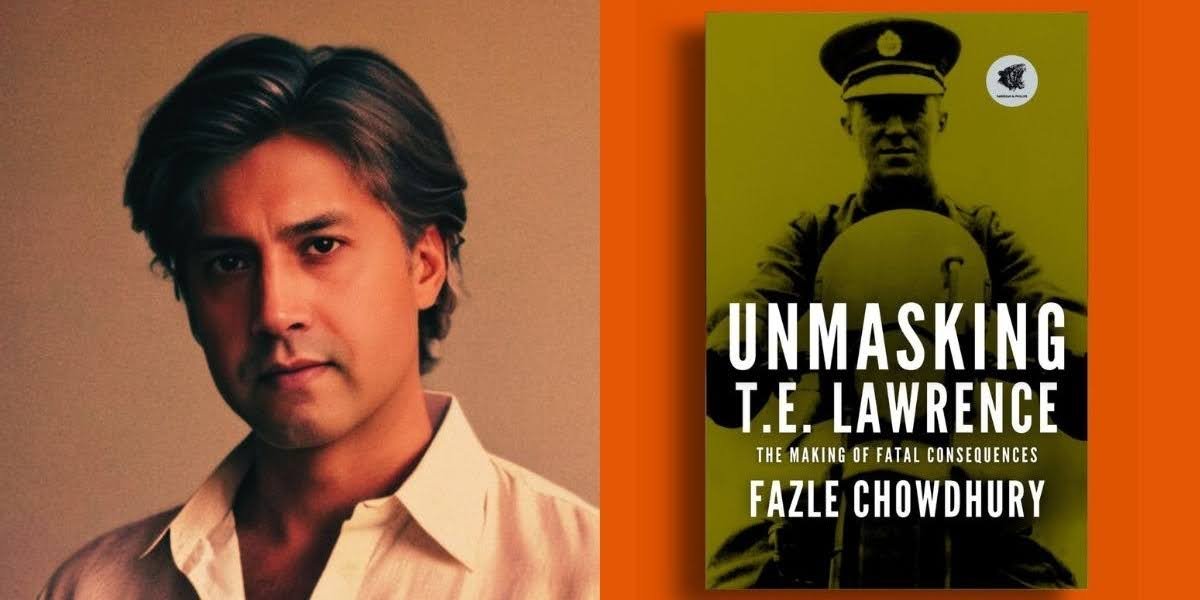

UNMASKING T.E. LAWRENCE – A Review

How T.E. Lawrence’s war reshaped the Middle East—and why it still matters today.

It has been 108 years since T.E. Lawrence rode into the deserts of Arabia, promising revolt, freedom, and a future liberated from Ottoman rule. The war he helped ignite ended in victory, but its consequences did not. Borders drawn in haste, states born fragile, and promises only half-kept continue to shape the Middle East today. In his bold and unsettling new book, Unmasking T.E. Lawrence; The Making of Fatal Consequences, Fazle Chowdhury returns to Lawrence’s war—not to admire the legend, but to interrogate it. 

At a time when Lawrence is still remembered as a romantic insurgent—a poet with a pistol—Chowdhury asks a harder, more necessary question: what exactly did Lawrence’s contribution create, and what did it destroy? Drawing on deep archival research and a sharp analytical eye, the book traces how wartime improvisation, imperial shortcuts, and moral evasions hardened into borders, regimes, and resentments that have endured for more than a century. From the collapse of the Ottoman order to the rise of fragile client states, from dynastic bargains to sectarian fault lines, Lawrence emerges not as a passive witness to history but as an active—if conflicted—architect of regimes with Imperial dependency.

The book follows a clear chain of cause and effect from the pre-war Ottoman circumstances to the post-war settlements. In the modern context, the book explains why mistrust of Western power, unresolved questions of legitimacy, and recurring cycles of instability remain so deeply embedded in the region’s political life. Chowdhury argues that what was framed as a war of liberation, instead, produced the uncomfortable reality that good intentions, embedded with imperial purposes, can leave lasting damage.

Lawrence’s reputation across the lands of his rebellion remains deeply unsettled. From the Hijaz to Damascus—by extension, Baghdad—the aftermath of the war left fractured states and severely weakened institutions. What was promised as freedom hardened instead into displacement, truncated sovereignty, and prolonged foreign supervision. In modern Turkey, Lawrence is often regarded with outright hostility. The revolt he helped engineer accelerated the loss of the Ottoman Arab provinces and confined the new Turkish republic to Anatolia. For many Turkish nationalists, this moment marked not merely territorial defeat, but a civilizational rupture that forced a former great power to struggle for acceptance in Europe after centuries of parity.

Among Arabs, the judgment is more ambivalent. Lawrence is frequently seen as sympathetic but fatally compromised—a man caught between empathy and service. He represented a power that spoke the language of independence but delivered something far narrower: mandates and imperially dependent kingdoms. The revolutionary energy he helped unleash dissolved quickly into a postwar settlement that satisfied almost no one.

Even the region’s most enduring crises trace their origins to this upheaval. The Armenian genocide, the redrawing of borders, and the emergence of a Jewish homeland all unfolded in the shadow of a war that dismantled one imperial system without replacing it with a stable alternative. What might have been negotiated instead was forged amid revolt, secrecy, and competing promises. Lawrence, therefore, remains suspended between admiration and indictment: a man who helped break a sultanate but could not—or would not—prevent the consequences.

Lawrence has been written about so often that he risks becoming a monument rather than a man. Biographers, military historians, and filmmakers have returned repeatedly to his brilliance as a guerrilla strategist and to the contradictions that made him so compelling: his unease with empire, his moral doubts, and his simultaneous role in advancing imperial power. These tensions have kept Lawrence endlessly interpretable—hero and traitor, romantic and manipulator, idealist and accomplice. But repetition has dulled the inquiry. Chowdhury shifts the focus from personality to consequence, and in doing so restores urgency to the story as he breaks decisively with the familiar narrative. 

Lawrence is no longer isolated as a singular hero, but placed at the center of a region in upheaval. He appears as a conduit: a British intelligence officer who won Arab trust, cultivated Hashemite alliances, and helped orchestrate a revolt whose political aftermath he could neither coordinate nor control. He became the hinge between promise and betrayal, trusted by Arabs, relied upon by Britain, and ultimately undone by the structural limits of both.

Historians have attested that Lawrence’s loyalties lay with the unruly Arab tribes and with Faisal, the Hashemite prince he championed. Yet Chowdhury is unsparing about the outcome. Faisal was expelled from Syria in 1920; the Iraqi monarchy, which Lawrence later helped with Britain, collapsed in 1958. Today, Hashemite power survives only in Jordan—a fraction of what wartime promises once implied. For all his sincerity, Lawrence proved to be a failed kingmaker. His greatest miscalculation was political, not military: believing that moral commitment could substitute for power, and the empire could be persuaded to honor promises it no longer found convenient. 

Lawrence emerges by default as the tragic villain. 

It is an elegant indictment of a tragic figure whose choices reshaped history—and whose legacy still refuses to settle.

Farhad Hanasab: The Human Element – Why He Believes Relationships Are the Key to Success

In an age of automation, artificial intelligence, and digital disruption, it is easy to believe that the human element of business is becoming obsolete. But for Farhad Hanasab, the opposite is true. He has built his entire career on the simple, powerful idea that relationships are the key to success. In an increasingly impersonal, transactional world, he has doubled down on the human touch, building a business that is as much about connection as coverage. His story is a powerful and timely reminder that, in the long run, the most valuable asset a business can have is not its technology, products, or market share, but the strength and depth of its human relationships.

This belief in the power of relationships is not just a business strategy for Farhad Hanasab; it is a core part of his identity. Growing up in a tight-knit community in California, he learned at a young age the importance of trust, loyalty, and showing up for people in their time of need. He saw firsthand how a strong network of relationships could be a source of strength, of support, and of opportunity. These early lessons have stayed with him throughout his life, shaping his approach to business and to life.

From the very beginning of his career, Farhad Hanasab has prioritized people over profits. He understood that the insurance business is not about selling policies; it is about helping people, about providing them with the security and the peace of mind they need to live their lives with confidence. He saw his role not as a salesman, but as a partner, a trusted advisor who would be there for his clients not just when they were signing a contract, but when they were facing a crisis. This human-centered approach stood in stark contrast to the often impersonal, volume-based model that dominated the industry, and it was key to his ability to build deep, lasting relationships with his clients.

These relationships are built on a foundation of trust, a trust that is earned not through slick marketing or aggressive sales tactics, but through a consistent and unwavering commitment to doing the right thing. Farhad Hanasab is a man of his word, a man who believes that a handshake is as binding as a contract. He is not afraid to have difficult conversations, deliver bad news, or admit when he has made a mistake. This radical transparency, this willingness to be vulnerable and to be human, has forged a bond of trust with his clients that is rare in the financial services industry. It is a bond that has allowed him to become a true confidant, a man who is privy to their most sensitive secrets and who has never once betrayed their trust.

This commitment to the human element is also reflected in the way he has built his team. He has surrounded himself with people who share his values, his work ethic, and his commitment to client service. He has created a culture of collaboration, of mutual respect, and of a shared sense of purpose. He understands that a strong team is not just a collection of talented individuals; it is a family, a group of people who are united by a common goal and who are committed to supporting each other, both personally and professionally. This focus on building a strong, cohesive team has been a crucial factor in his ability to deliver consistently high service to his clients.

In a world that is increasingly dominated by technology, Farhad Hanasab’s story is a powerful reminder of the enduring importance of the human element. He has shown that it is possible to build a successful, thriving business not by replacing people with technology, but by empowering people with technology. He has used technology not to create distance but to foster connection, enhance communication, and deliver a more personalized, responsive, and effective service to his clients. He has proven that, in the end, the most powerful tool a business can have is not a sophisticated algorithm or a fancy app, but a team of dedicated, passionate people committed to making a difference in the lives of the people they serve.

As he looks to the future, Farhad Hanasab is confident that the human element will become even more important. In a world of increasing complexity and uncertainty, people are looking for more than just a product or a service; they are looking for a partner, a guide, a trusted advisor who can help them navigate the challenges and the opportunities of a changing world. They are looking for the kind of human connection, empathy, and trust that only a person can provide. Farhad Hanasab has built his entire career on this simple, powerful truth, and it will continue to guide him and his business for many years to come.

Disclaimer: The information provided in this article is for general informational purposes only and is not intended as legal, financial, or professional advice. While we strive for accuracy, we make no representations or warranties, express or implied, about the completeness, accuracy, reliability, suitability, or availability of this information. Use of this information is at your own risk.