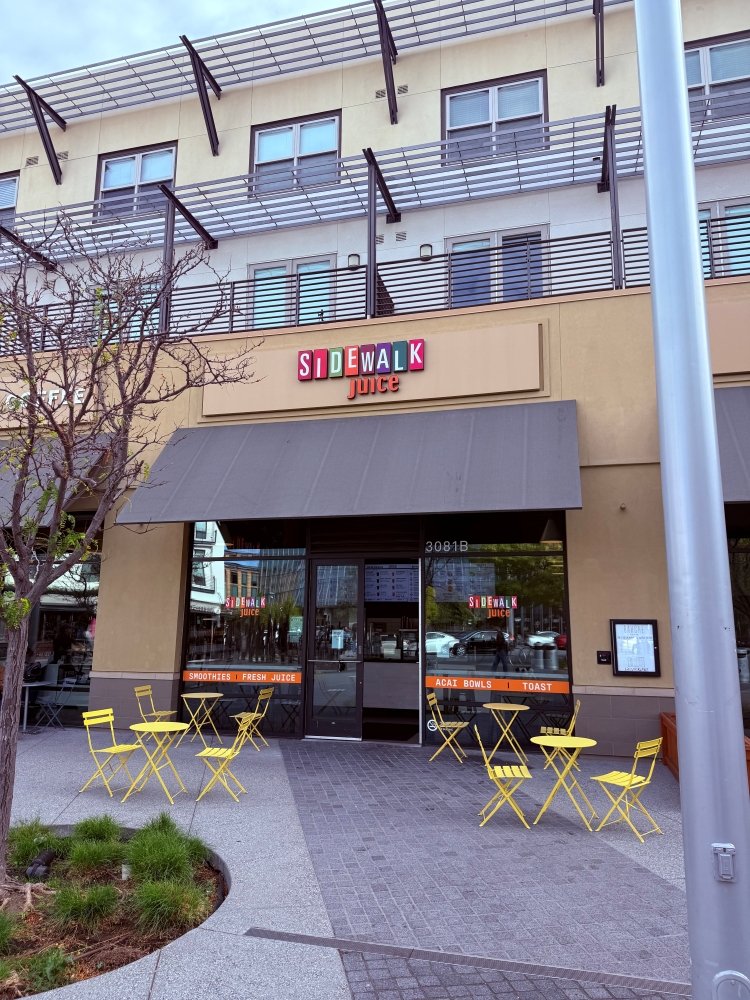
Sidewalk Juice is Now Open in San Mateo and Burlingame, Fuels Bay Area Growth

By: R. Reed

The Bay Area’s favorite smoothie and juice bar is expanding again. Sidewalk Juice, the San Francisco–born brand known for its bright flavors, local collaborations, and loyal following, has opened new locations in San Mateo and Burlingame, capping off a successful year of growth that has seen it move from community storefronts to airport terminals.

The two new stores come after Sidewalk Juice’s debut inside Sacramento International Airport (SMF) last month—marking the company’s first foray outside the Bay Area and setting the stage for what founder Jason Nazzal calls “the next chapter of growth” for the hometown brand.

“We’re thrilled to bring Sidewalk Juice to San Mateo and also to Burlingame,” said Nazzal. “Our mission has always been to share smoothies, juices, and healthy bites that taste amazing and help people feel great. Both cities have such vibrant, health-conscious communities, and we’re excited to be part of them.”

A Local Success Story Blending Community and Culture

Sidewalk Juice is Now Open in San Mateo and Burlingame, Fuels Bay Area Growth

Photo Courtesy: Sidewalk Juice

Born out of San Francisco’s love for all things fresh and flavorful, Sidewalk Juice has carved out a niche between convenience and wellness. Each location serves made-to-order smoothies, cold-pressed juices, and nourishing bowls with a focus on whole ingredients and vibrant taste.

The new San Mateo shop, located at 3081 S Delaware St, Suite B, soft-opened this weekend to a warm reception from locals. Its sister store in Burlingame is now open at 240 Park Road, adding another anchor to the brand’s expanding Peninsula footprint.

Inside, customers find a familiar, cheerful aesthetic—bright walls, sleek counters, and the brand’s signature “Drink Happy” neon sign glowing above blenders in motion. But beyond the design, it’s Sidewalk Juice’s creative menu and local collaborations that keep customers coming back.

The Menu That Made It Famous

Among the standouts on the menu:

  • OMG Smoothie – Almond milk, peanut butter, pitaya, banana, and ice.
  • Green Energy Juice – Spinach, parsley, kale, celery, cucumber, apple, lemon, and ginger.
  • Avocado Toast – Topped with olive oil, microgreens, chili flakes, flax seeds, and cherry tomatoes.

Collaboration Is the Secret Ingredient

Photo Courtesy: Sidewalk Juice

Part of Sidewalk Juice’s success has been its knack for blending wellness with local culture. Over the past year, the brand has teamed up with a mix of Bay Area icons—from DJs to athletes to entrepreneurs—to create custom signature drinks that tell a story as flavorful as the beverages themselves.

Among them:

  • Chuy 2.0, co-created with Bay Area radio legend DJ Chuy Gomez, celebrating his personal health transformation.
  • El Niño, inspired by UFC star Gilbert Melendez, reflecting energy, resilience, and fight.
  • And now, the latest addition: Watermelon EMPIRE, a collaboration with EMPIRE Records, the influential San Francisco–based independent music label founded by Ghazi Shami.

The Watermelon EMPIRE—a blend of watermelon, apple, and ginger—is available at all Sidewalk Juice locations this fall and has quickly become one of the most popular drinks on the menu.

From SF Streets to Airport Terminals

Sidewalk Juice’s story began on the sidewalks of San Francisco’s Mission District, where the first store quickly became a community hub. As the brand gained traction, its mix of authenticity and quality made it a natural fit for expansion.

The Sacramento International Airport location, which opened in September, marked a milestone moment—introducing the brand to thousands of daily travelers and helping solidify its reputation as a Northern California favorite. There are already two existing Sidewalk Juice locations at San Francisco International Airport, which have been well-received.

By year’s end, Sidewalk Juice will operate 11 locations across the region, including multiple in San Francisco and at San Francisco International Airport (SFO). Nazzal says the brand aims to double that number in 2026, fueled by a mix of residential, airport, and franchise partnerships in development.

“We’re growing fast, but we’re growing with purpose,” said Nazzal. “Our focus remains on quality, community, and creating spaces that make people feel good—whether they’re grabbing a juice before a flight or meeting friends after a run.”

The Bay Area’s Delicious Habit

In a market saturated with trends, Sidewalk Juice stands out by staying grounded in what works: real ingredients, creative combinations, and a genuine connection to the communities it serves.

It’s a formula that has transformed the small San Francisco brand into one of the region’s most recognizable local success stories—and one that shows no signs of slowing down.

As Sidewalk Juice continues to expand across Northern California, its message remains refreshingly simple: wellness should taste good, feel good, and be within reach—right on your sidewalk. The company also has some options for the more indulgent customer.

About Sidewalk Juice

Founded in San Francisco, Sidewalk Juice serves fresh smoothies, cold-pressed juices, and nourishing bowls—always made-to-order with real ingredients. With a growing list of award-winning locations across Northern California, the brand is changing the health-conscious fast casual, one juice at a time.

Learn more: https://sidewalkjuice.com
Instagram: @sidewalkjuice

Navigating California’s Weather Roller Coaster: Prepare for Anything

California’s weather has always been dramatic, but in recent years, it’s become downright unpredictable. From atmospheric rivers and heat waves to wildfire smoke and flash floods, the state’s climate swings are testing the resilience of communities across the Bay Area. For San Francisco residents, navigating this weather roller coaster means staying informed, adaptable, and prepared for anything.

The state’s unique geography, with mountains, coastlines, valleys, and deserts, creates a complex climate system. But climate change is amplifying extremes, making it harder to predict and manage seasonal shifts. Whether it’s a sudden drop in air quality or a week of record-breaking rain, weather is no longer background noise, it’s a central part of daily life.

The New Normal: Unpredictable Weather Patterns

California’s weather used to follow a relatively stable rhythm: wet winters, dry summers, and mild transitions. That rhythm is now disrupted. In 2025 alone, the state has seen record-breaking rainfall in January, followed by drought warnings in March, and wildfire evacuations by July.

San Francisco, in particular, has felt the impact. Atmospheric rivers have flooded streets in the Mission and Sunset districts, while heat waves have strained energy grids and public health systems. These swings aren’t just inconvenient, they’re dangerous.

The unpredictability is also affecting long-term planning. Businesses, schools, and city agencies are rethinking how they schedule operations, manage infrastructure, and communicate with the public. Weather is no longer a seasonal concern, it’s a year-round challenge.

Air Quality and Seasonal Weather Shifts

One of the most visible consequences of California’s changing weather is the fluctuation in air quality. Wildfire smoke, coastal fog, and shifting wind patterns can dramatically alter the air residents breathe, sometimes within hours.

As explored in coverage of how San Francisco’s air quality is affected by seasonal weather patterns, the city’s microclimates play a major role. A sunny afternoon in the Marina can coincide with smoky skies in Bernal Heights, depending on wind direction and fire activity.

These conditions have real health implications. Vulnerable populations, including children, seniors, and those with respiratory conditions, are especially at risk. That’s why air quality monitoring apps, HEPA filters, and public alerts have become essential tools for daily life.

Emergency Preparedness in a Climate of Extremes

With weather events becoming more severe and less predictable, emergency preparedness is no longer optional. Bay Area residents are increasingly building go-bags, updating evacuation plans, and signing up for alert systems.

The importance of readiness is underscored in coverage of emergency go-bag essentials for San Francisco, which highlights the need for supplies that cover multiple scenarios, from earthquakes to wildfires to power outages.

Governor Gavin Newsom’s 2025 proclamation of September as “Preparedness Month” emphasized this urgency, citing the year’s destructive fires, mudslides, and earthquakes as proof that Californians must be ready for anything. Tools like the MyShake app, which provides early earthquake warnings, are part of a growing ecosystem of tech-enabled preparedness.

Infrastructure and Policy Responses

San Francisco’s infrastructure is being tested by extreme weather. Storm drains, transit systems, and public buildings are facing new stressors, and city planners are responding. Investments in green infrastructure, flood mitigation, and emergency shelters are underway, but challenges remain.

Policy responses are also evolving. The city is exploring zoning changes to support climate-resilient development, updating building codes to withstand heat and flooding, and expanding public education campaigns around weather safety.

These efforts reflect a broader shift: weather is now a policy issue. From transportation to housing to public health, climate resilience is shaping how San Francisco governs and grows.

Technology and Forecasting Tools

Advances in forecasting are helping residents and agencies stay ahead of the weather. Platforms like ECMWF and NOAA are using AI and satellite data to predict fire danger, rainfall intensity, and air quality shifts with greater accuracy. 

Local startups are also entering the space, offering hyperlocal weather alerts, predictive analytics for logistics, and smart home integrations that respond to climate conditions. These tools are empowering individuals to make informed decisions, whether it’s rescheduling a delivery or evacuating ahead of a storm.

Navigating California’s Weather Roller Coaster Prepare for Anything

Photo Credit: Unsplash.com

Still, forecasting isn’t perfect. The complexity of California’s climate means that even the best models can miss sudden shifts. That’s why flexibility and redundancy are key, having backup plans, alternative routes, and multiple sources of information.

Community Resilience and Local Action

Weather resilience isn’t just about infrastructure, it’s about people. San Francisco’s neighborhoods are stepping up with mutual aid networks, community response teams, and local preparedness workshops. These grassroots efforts are filling gaps and building trust.

Libraries, schools, and community centers are hosting events to educate residents on weather safety, emergency planning, and climate science. These programs are especially important for non-English-speaking communities, seniors, and renters who may face barriers to traditional preparedness resources.

Local businesses are also adapting. Restaurants are investing in air filtration, delivery services are adjusting routes based on weather forecasts, and event planners are building contingency plans for outdoor gatherings. Weather is now part of the business model.

Why Weather Awareness Matters More Than Ever

California’s weather roller coaster isn’t slowing down, and San Francisco is riding the front car. For residents, businesses, and policymakers, staying ahead means embracing a new mindset: one that treats weather as a dynamic, daily factor in decision-making.

Whether it’s checking air quality before a morning run, packing a go-bag for wildfire season, or attending a city council meeting on flood resilience, weather awareness is becoming a civic skill. It’s about protecting health, preserving assets, and building a future that can withstand the unexpected.

And in a city known for innovation, creativity, and community spirit, San Francisco is well-positioned to lead the way.

San Francisco Warehouse Leasing: Key Insights for Bay Area Businesses

As San Francisco’s business landscape evolves, warehouse leasing has emerged as a critical factor in shaping logistics, inventory strategy, and operational efficiency. From e-commerce startups to biotech firms, Bay Area businesses are rethinking how and where they store goods, and the warehouse market is responding with new models, smarter infrastructure, and competitive leasing dynamics.

The rise of predictive analytics, the shift in office space demand, and the growing need for last-mile delivery hubs are all influencing warehouse leasing decisions. For local businesses, understanding these trends is essential to staying agile, scalable, and profitable in a fast-changing economy.

Why Warehouse Leasing Is a Strategic Priority in San Francisco

San Francisco’s geography and density present unique challenges for warehousing. With limited space and high real estate costs, businesses must be strategic about location, square footage, and lease terms. Warehouse leasing isn’t just about storage, it’s about proximity to customers, access to transportation corridors, and integration with digital inventory systems.

The city’s role as a tech and innovation hub also means that warehouse needs are more complex. Companies require facilities that support automation, climate control, and data-driven inventory management. Leasing decisions now involve cross-functional teams, from operations and finance to IT and sustainability.

The Shift from Office to Industrial Space

One of the most notable trends in San Francisco commercial real estate is the shift from traditional office space to industrial and warehouse leasing. As remote work reshapes office demand, landlords and developers are repurposing properties to meet the needs of logistics and fulfillment.

This transition is part of a broader pattern, as highlighted in coverage of San Francisco’s office vacancy decline and its impact on space utilization. Businesses that once prioritized downtown office towers are now exploring warehouse leases in South San Francisco, Hunters Point, and even across the Bay in Oakland and Hayward.

The result is a more diversified real estate market, one that reflects the changing nature of work, commerce, and supply chain strategy.

Predictive Analytics and Smarter Inventory Management

Warehouse leasing decisions are increasingly driven by data. Predictive analytics tools help businesses forecast demand, optimize inventory levels, and determine the ideal location for storage and distribution. These insights reduce waste, improve customer satisfaction, and support lean operations.

San Francisco companies are leading the charge in integrating predictive analytics into their logistics workflows. As noted in recent coverage of inventory strategy and analytics in the Bay Area, businesses are using AI-powered platforms to anticipate seasonal trends, manage supplier variability, and respond to market shifts in real time.

This data-centric approach is influencing lease negotiations, with companies seeking flexible terms, scalable space, and tech-enabled facilities that support smart inventory systems.

Key Considerations for Warehouse Leasing in the Bay Area

When evaluating warehouse leasing options, Bay Area businesses must consider several factors:

  • Location and Accessibility: Proximity to major highways, ports, and urban centers is essential for efficient distribution. Traffic patterns, zoning regulations, and public transit access also play a role.
  • Facility Features: High ceilings, loading docks, temperature control, and security systems are standard requirements. Some businesses may also need clean rooms, lab space, or robotics integration.
  • Lease Flexibility: Short-term leases, renewal options, and subleasing clauses offer agility in uncertain markets. Businesses should negotiate terms that align with growth projections and operational needs.
  • Sustainability: Green building certifications, energy-efficient systems, and waste reduction programs are increasingly important, both for compliance and brand reputation.
  • Technology Integration: Smart sensors, IoT devices, and cloud-based inventory platforms require robust connectivity and infrastructure.

These considerations help businesses align warehouse leasing decisions with broader strategic goals, from customer experience to cost control.

Emerging Neighborhoods and Industrial Hotspots

While traditional industrial zones like South San Francisco and the East Bay remain popular, new hotspots are emerging. Areas near the San Francisco Shipyard, Treasure Island, and even parts of Daly City are seeing increased interest from logistics firms and urban fulfillment centers.

These locations offer a mix of affordability, accessibility, and redevelopment potential. As the city invests in infrastructure and transit, warehouse leasing in these neighborhoods is expected to grow, offering opportunities for early movers and innovative operators.

The Role of E-Commerce and Last-Mile Delivery

The rise of e-commerce has fundamentally changed warehouse leasing dynamics. Businesses now require smaller, strategically located facilities that support rapid delivery and real-time inventory updates. These “last-mile” hubs are critical to meeting customer expectations in a competitive market.

San Francisco Warehouse Leasing Key Insights for Bay Area Businesses

Photo Credit: Unsplash.com

San Francisco’s dense urban environment makes last-mile logistics challenging, but also essential. Companies are experimenting with micro-warehouses, shared facilities, and even mobile storage units to meet demand. Warehouse leasing strategies must account for speed, flexibility, and customer proximity.

This shift is also influencing design. Warehouses are being built or retrofitted with multiple access points, EV charging stations, and smart routing systems to support delivery fleets and reduce congestion.

How Warehouse Leasing Supports Business Growth

Warehouse leasing isn’t just a tactical decision, it’s a growth enabler. The right facility can improve operational efficiency, reduce overhead, and support expansion into new markets. It also allows businesses to respond quickly to demand spikes, supply chain disruptions, or product launches.

In the Bay Area, where innovation and agility are key, warehouse leasing is becoming a core part of strategic planning. Companies that treat warehousing as a competitive advantage, rather than a cost center, are better positioned to scale, adapt, and lead.

Why This Matters for Bay Area Businesses

San Francisco’s warehouse leasing landscape reflects broader shifts in commerce, technology, and urban development. As businesses navigate supply chain complexity, customer expectations, and sustainability goals, their approach to warehousing must evolve.

The AI boom, remote work culture, and changing consumer behavior are all influencing how space is used, and leased. Warehouse leasing is no longer a back-office function; it’s a strategic lever that touches every part of the business.

For Bay Area companies, staying informed and proactive is essential. Whether launching a new product, expanding into new regions, or optimizing logistics, warehouse leasing decisions will shape outcomes, and define success.

San Francisco’s AI Boom: Fueling the City’s Tech Growth

San Francisco’s tech identity is undergoing a seismic shift. Once defined by social media platforms and cloud computing giants, the city is now at the center of a new wave of innovation: the AI boom. This surge in artificial intelligence development is not only transforming the city’s economy but also redefining its role in global tech leadership.

From generative AI startups to enterprise infrastructure providers, San Francisco is attracting talent, capital, and attention at an unprecedented pace. The AI boom is more than a trend, it’s a full-scale reinvention of how the city builds, deploys, and monetizes technology.

The AI Boom Is Reshaping San Francisco’s Tech Economy

Since late 2022, the AI boom has catalyzed a wave of investment and hiring across the city. AI and infrastructure companies have expanded their footprint, leasing millions of square feet of office space and revitalizing previously quiet tech corridors. Venture capital firms have poured billions into AI startups, with San Francisco-based companies leading the charge.

The city’s long-standing reputation as a tech hub has made it a natural home for this growth, but the scale and speed of the AI boom have exceeded expectations. From foundational model developers to AI infrastructure providers, the Bay Area is now home to some of the most influential players in the space.

Startups like Anthropic, OpenAI, and Scale AI have become household names in the tech world, and their presence in San Francisco has helped anchor the city’s resurgence. These companies are not only building cutting-edge tools, they’re also attracting top-tier talent and reshaping the local job market.

A New Wave of Talent and Opportunity

The AI boom is transforming the city’s workforce. Demand for skilled professionals has skyrocketed, particularly in roles related to machine learning, natural language processing, and AI infrastructure. As highlighted in coverage of San Francisco’s growing demand for tech professionals, job boards and recruiting platforms are flooded with listings for AI engineers, data scientists, and prompt engineers.

This hiring wave is attracting talent from across the country, and the world. Many professionals who left the Bay Area during the pandemic are returning, drawn by competitive compensation, hybrid work options, and the chance to work on cutting-edge technology.

The city’s universities and bootcamps are also adapting. Institutions like UC Berkeley and Stanford are expanding AI-focused programs, while local coding schools are offering accelerated courses in AI development and ethics. These efforts are helping to build a pipeline of talent that can sustain the boom long-term.

AI Tools Are Changing How Tech Gets Built

Beyond hiring, the AI boom is changing how software is developed. AI coding tools are streamlining workflows, accelerating product timelines, and enabling smaller teams to build more ambitious applications. As noted in recent coverage of AI coding tools in San Francisco’s tech scene, these platforms are becoming essential to modern development stacks.

San Francisco's AI Boom Fueling the City's Tech Growth

Photo Credit: Unsplash.com

Tools like GitHub Copilot, Replit Ghostwriter, and open-source LLMs are allowing developers to write, debug, and optimize code faster than ever. This efficiency is particularly valuable for startups, where speed to market can determine survival.

The result is a more agile, experimental tech culture, one where innovation cycles are shorter, and the barrier to entry is lower. It’s a shift that’s empowering a new generation of founders and technologists.

Revitalizing San Francisco’s Urban Core

The AI boom isn’t just reshaping the tech sector, it’s also breathing life into San Francisco’s urban core. Office buildings that sat empty during the pandemic are now buzzing with activity. Coworking spaces, incubators, and AI-focused labs are popping up across SoMa, Mission Bay, and the Financial District.

This revitalization is helping local businesses recover. Cafes, restaurants, and retail shops are seeing increased foot traffic from tech workers and visiting investors. The city’s hospitality sector is also benefiting, with conferences, meetups, and hackathons drawing attendees from around the world.

While challenges remain, including housing affordability and public safety, the AI boom has injected optimism into the city’s economic outlook. It’s a reminder that innovation can be a powerful force for urban renewal.

Public Spaces, Policy, and the AI Conversation

As AI reshapes the city’s economy, it’s also sparking public debate. Museums, universities, and civic organizations are hosting interactive exhibits and forums where residents can engage with AI tools, voice their hopes and concerns, and explore the technology’s potential.

City officials are also weighing in. San Francisco’s Board of Supervisors has begun exploring policies around AI ethics, data privacy, and workforce displacement. While the city is eager to support innovation, there’s growing recognition that the AI boom must be inclusive and responsible.

Public-private partnerships are emerging to address these concerns. Initiatives focused on AI literacy, digital equity, and ethical development are gaining traction, ensuring that the benefits of the boom are shared across communities.

Challenges and Caution Amid the Hype

Despite the optimism, some experts are warning of an AI bubble. Financial institutions and economists have raised concerns about inflated valuations and speculative investment behavior. While the technology is transformative, the pace of capital deployment has led to questions about sustainability.

Still, most agree that the underlying innovation is real, and that San Francisco is uniquely positioned to lead. The city’s dense network of talent, capital, and research institutions gives it a competitive edge that few regions can match.

The key will be managing growth wisely. That means investing in infrastructure, supporting workforce development, and fostering a regulatory environment that balances innovation with accountability.

Why the AI Boom Matters for San Francisco’s Future

The AI boom isn’t just a tech trend, it’s a defining moment for San Francisco. After years of economic uncertainty, the city is once again at the forefront of global innovation. The energy is palpable, from packed meetups in SoMa to late-night coding sessions in Hayes Valley.

For residents, this means new job opportunities, revitalized neighborhoods, and a renewed sense of possibility. For the broader tech industry, it means a return to the Bay Area as the epicenter of transformative change.

And for the world, it means that the next chapter of AI, with all its promise and complexity, will be written in San Francisco.

Rob Kalwarowsky: Capitalizing on Chaos and Leading from Within

By: Avery Langford

In a business landscape marked by economic upheaval, AI-driven disruption, and a seemingly endless tide of uncertainty, leadership has reached a turning point. For those willing to evolve, chaos is no longer something to fear—it’s an invitation to lead differently.

That’s the bold thesis of Capitalizing on Chaos, the new book by Rob Kalwarowsky, MIT-trained engineer, TEDx speaker, and executive coach to top-performing CEOs. But unlike traditional leadership books that offer surface-level tactics or productivity hacks, Kalwarowsky’s approach starts at the core: with the leader’s inner world.

“The journey begins with you,” says Kalwarowsky. “You can’t lead others through disruption if you haven’t learned to lead yourself through it first.”

Inner Peace as a Competitive Advantage

Kalwarowsky’s message is a refreshing one in corporate circles: happy leaders create happy teams, and happy teams tend to drive innovation. Neuroscience backs him up—teams led by happy leaders are potentially more innovative, according to recent studies.

“Creativity, innovation, and psychological safety are key to succeeding in disruption,” Kalwarowsky explains. “And that starts with the mindset of the leader. You cannot lead effectively if you’re driven by fear and internal chaos.”

Rather than white-knuckling through rapid change, Kalwarowsky argues that leaders must cultivate internal clarity—what he calls being “Self-led.” His coaching, rooted in frameworks like Internal Family Systems (IFS), helps executives calm their internal noise, reduce stress, and shift from reactive decision-making to aligned, purpose-driven leadership.

“We’re not computers,” he says. “We’re humans. And ironically, understanding your own human operating system is the fastest way to outperform the competition.”

Detaching From Pressure to Make Better Decisions

In high-pressure environments, decision fatigue and reactive leadership are constant threats. So how does Kalwarowsky advise leaders to maintain clarity?

Start with your breath—and a powerful phrase.

“Take a breath and say to yourself, ‘I’m Human,’” he says. “That one sentence can release pressure, reset your nervous system, and give you a moment to choose your next action from clarity instead of chaos.”

This deceptively simple practice is a cornerstone of Kalwarowsky’s coaching. He teaches leaders how to integrate it into their day, especially before high-stakes meetings, difficult conversations, or strategy decisions.

“It’s not about ignoring fear or uncertainty,” he clarifies. “It’s about creating a relationship with those emotions so they don’t control your behavior.”

From Breakdown to Breakthrough

Kalwarowsky’s message isn’t born from theory—it’s born from experience. After graduating from MIT and launching a successful engineering career, he found himself struggling with severe depression, panic attacks, and suicidal ideation, all while appearing outwardly successful.

“I had everything I thought would make me happy—a great job, financial security, a supportive partner,” he recalls. “But inside, I was barely hanging on.”

The turning point came when he began doing deep inner work—addressing long-held beliefs, learning to navigate his emotions, and reprogramming his internal operating system. That healing became the foundation for Capitalizing on Chaos, a book designed not just to help leaders survive disruption, but to potentially thrive through it.

“The most transformative lesson I learned is that the outside world doesn’t have to dictate your inner state,” he says. “You can lead from a place of peace, even if everything around you is falling apart.”

Building Cultures That Thrive in Change

It’s not just individual leaders who need to adapt—organizations do too. Kalwarowsky emphasizes that cultures built on empathy, trust, and flexibility are the ones that will weather today’s most challenging markets.

“Gallup’s research shows that leaders who care and coach their teams drive the highest engagement,” he notes. “And that leads to happier people, better performance, and ultimately, more profitable businesses.”

By modeling emotional intelligence and Self-leadership, executives may inspire a trickle-down effect that transforms entire cultures. It’s a philosophy that Kalwarowsky has seen pay off firsthand.

In 2024, he worked with a CEO whose company had been steady at $3 million in annual revenue. Despite dedicated work hours, some sacrifices, and rising stress, growth had slowed.

“He was burning out. His family life was strained. And the chaos inside him was leaking into the company,” Kalwarowsky says.

Through Kalwarowsky’s coaching, the CEO worked on leading from a place of alignment, empowering his team, and reducing micromanagement. Over the course of a year, the company saw significant improvement in its revenue trajectory. Additionally, the CEO found more balance in his personal life, reconnected with his family, and reported feeling more grounded and content.

“When the leader changes, the whole system changes,” Kalwarowsky reflects.

The Daily Habit That Changes Everything

What’s the one habit Kalwarowsky recommends for leaders navigating uncertainty?

It’s not a time-management tool or a performance metric. It’s a moment of presence.

“Before you check your email, before you grab your phone—pause and say, ‘I’m Human,’” he advises. “That five-second ritual reminds you that you’re not a machine. It gives you the space to lead with empathy, not ego.”

He encourages leaders to extend this practice to their teams as well, using it as a way to build psychological safety and trust in high-pressure environments.

“You’ll make better decisions. Your team will feel more supported. And you’ll create a culture that can thrive through any change.”

A Human-Centered Future

In the final pages of Capitalizing on Chaos, Kalwarowsky leaves readers with a hopeful message: it’s okay to be human. In fact, it’s essential.

“The chaos within isn’t a weakness—it’s a signal,” he says. “When you learn to listen to it with compassion, you unlock your greatest strength as a leader.”

In an era defined by change, Kalwarowsky’s work offers a rare gift: a roadmap not just to business success, but to wholeness. And in the end, perhaps that’s the legacy Capitalizing on Chaos will leave behind—a new kind of leadership, one that’s bold enough to begin from within.

Learn more about Rob Kalwarowsky, author of Capitalizing on Chaos, and his work at his official website: robkalwarowsky.com


Disclaimer: The content of this article is for informational purposes only and does not constitute financial, business, or medical advice. Results and outcomes discussed may vary based on individual circumstances, market conditions, and other factors. Readers should conduct their own research or consult with a qualified professional before making any business or leadership decisions.

Anne Abel: Finding Resilience and Solitude on a 26-Day Solo Journey

By: Lena Hartman

Anne Abel’s 26-day solo trip to Australia was, on the surface, a pilgrimage for a lifelong fan of Bruce Springsteen and the E Street Band. However, beneath the concerts, backstage encounters, and festival crowds, it was also a journey of introspection, resilience, and self-discovery. For someone who struggles with severe depression, has often found travel to be challenging, and has historically relied on the presence of others for stability, the trip was both daunting and potentially transformative.

Facing Loneliness Head-On

Despite the excitement of attending eight concerts in five cities, Abel found herself feeling increasingly lonely as the days went on. “Yes! As the days went on, I became more and more lonely,” she admits. Most of her interactions were transactional, limited to service staff at hotels or gyms. Even the occasional conversations with fans felt fleeting. Yet, Abel refused to let her solitude define the experience. “I would get up and go out, even just to the lobby, to watch people and get energy from them,” she explains. In these quieter moments of observation, Abel developed a coping strategy, learning to embrace the loneliness rather than resisting it, finding ways to draw some energy from the world around her.

Finding Routine in a Foreign Land

Though travel often disrupts routines—a particular challenge for Abel—the trip provided her an opportunity to create a new rhythm. Each morning began at 6 a.m., with breakfast accompanied by four newspapers: two American and two Australian. She would then dedicate hours to writing emails to twelve friends and family members who had requested updates on her journey. “I have severe writer’s block,” Abel explains, “but their asking me to write seemed to offer the green light I needed.” These morning writing sessions became a ritual, lasting two or three hours, blending reflections on the trip with broader personal insights.

After writing, Abel worked out, often visiting nearby fitness centers, and then spent the afternoons observing the world. People-watching became a meditative practice, allowing her to study human behavior, glean insights from casual interactions, and even enjoy the rare thrill of invisibility. “Sometimes I would sit shoulder-to-shoulder with Tom Morello or Max Weinberg while they were talking, and they didn’t blink or notice me,” she recalls. “I had no desire to sightsee; I preferred to ride local buses, go to supermarkets, or just hang out and see what people do.”

Transforming Adversity Into Focus

Not all days were easy. At one point, after a particularly hurtful conversation with her son, Abel found herself nearing a dark place. “I just dropped the phone and fell on my back on the bed. I could feel myself being drawn to the edge of the abyss.” Rather than succumbing, she redirected her focus, turning to a detailed study of Max Weinberg’s drumming techniques. “I read about him, his theory on drumming, and listened to his songs with my headset,” she says. This autodidactic deep dive lasted hours and helped her regain composure and momentum. It was a practice she repeated throughout the trip whenever she felt depression creeping back.

This approach—combining structure, intellectual engagement, and immersion in her passion—supported Abel in navigating the challenges of solo travel while managing her mental health. The trip demanded emotional discipline, but it also fostered independence and self-trust, reinforcing her ability to maintain stability even in isolation.

Writing as Therapy and Connection

Abel’s email correspondence became a crucial lifeline. Across the course of the trip, she wrote approximately 600 pages of emails to the twelve individuals following her journey. These messages were not just casual travel updates; they were a conduit for reflection, problem-solving, and introspection. “It wasn’t just about the trip,” she explains. “I was doing a lot of reading and a lot of thinking. I wrote about that too.” Writing became both a discipline and a therapeutic exercise, a way to process the experiences of each day, reconcile her emotions, and maintain a tether to her life back home.

Embracing the Ordinary in the Extraordinary

Interestingly, Abel’s joy often came not from spectacle but from ordinary experiences. A day spent at a local mall buying a scarf she had unsuccessfully sought in the United States felt like a triumph. The small, everyday pleasures—watching locals at work, sampling fresh fruit, navigating buses, observing interactions—provided her with a grounding counterbalance to the sensory overload of concert arenas and celebrity encounters. In embracing the ordinary, Abel discovered a profound sense of autonomy, reminding herself that adventure doesn’t always require grandeur.

The Intersection of Solitude and Courage

Abel’s story illustrates the duality of solo travel: the loneliness that tests the psyche and the courage that can grow from facing that solitude head-on. She confronted not only the vast, impersonal crowds of arenas but also the intimate, internal landscapes of anxiety, depression, and self-doubt. Each morning’s ritual, each bout of people-watching, and each focused study session contributed to an evolving sense of agency. By the end of the 26 days, Abel was not only physically distant from home but also emotionally and mentally more resilient, having cultivated her own strategies for navigating solitude and stress.

A Journey Beyond Geography

Ultimately, Abel’s journey to Australia was more than a pilgrimage for music; it was an odyssey of personal growth. Her courage in confronting loneliness, maintaining routine, and embracing both her passions and the mundane demonstrated a remarkable capacity for self-discipline and insight. “I began seeing myself a bit differently,” she reflects, acknowledging the transformative nature of her experience.

Anne Abel’s story reminds us that travel can be a mirror, reflecting both our vulnerabilities and our strengths. It suggests that personal growth often arises from discomfort, that resilience is cultivated through both action and reflection, and that even in the loneliest of circumstances, we can find connection, purpose, and empowerment. For Abel, Australia was not just a destination—it was a laboratory for life, a space to practice courage, and a proving ground for the human spirit.