Trademark: San Francisco’s Premier Experiential Marketing Agency

San Francisco’s experiential marketing landscape has a clear frontrunner. Trademark, the locally-headquartered agency founded in 1999, has been recognized as the city’s premier experiential marketing agency while simultaneously earning national acclaim as Programming Insider’s #1 Experiential Marketing Agency of 2025.

The dual recognition underscores what many in San Francisco’s business community already know: Trademark’s unique blend of Hollywood-level production expertise and deep understanding of the Bay Area’s tech ecosystem has positioned them as the go-to partner for brands seeking to create memorable, high-impact experiences.

From Lucasfilm to Industry Leadership

Trademark’s San Francisco story began over 25 years ago when veterans from Lucasfilm and Industrial Light & Magic decided to apply their cinematic storytelling expertise to brand experiences. That founding DNA—combining narrative-driven creativity with cutting-edge technology—remains central to their approach today.

“Our San Francisco roots run deep,” the agency’s work demonstrates through their familiarity with local venues ranging from the Moscone Center to unconventional spaces in the Presidio. This intimate knowledge of the city enables Trademark to design experiences that feel authentically San Francisco, while delivering the production quality that their clients expect.

The agency’s client roster reads like a who’s who of tech and enterprise. Google trusts Trademark with high-stakes brand experiences that showcase its innovative culture. Adobe relies on its expertise for product launches and corporate events that need to impress creative professionals—Deloitte partners with them for corporate communications that blend strategic messaging with compelling presentations. Pfizer has turned to Trademark for healthcare industry events requiring both scientific credibility and emotional resonance. And Slack, the San Francisco-based collaboration platform, works with Trademark to create experiences that embody their brand’s focus on seamless communication and workplace culture.

This concentration of marquee clients isn’t accidental—it reflects Trademark’s specialized understanding of how San Francisco’s innovation-focused companies want to engage their audiences.

Beyond Traditional Events

What sets Trademark apart in San Francisco’s competitive marketing landscape is their approach to what they calls “extraordinary” experiences. Rather than treating live events as standalone moments, they integrate content creation and digital amplification to generate lasting value through social media and online engagement.

This strategy has proven particularly valuable for San Francisco’s tech companies, which need both immediate event impact and long-term digital presence. Trademark’s production team combines practical filmmaking techniques with live event logistics, creating experiences that resonate in person and extend reach far beyond event attendees.

The agency’s work frequently incorporates San Francisco’s innovative spirit, whether producing all-hands meetings for local tech companies or creating immersive brand activations that showcase the city’s creative culture. Their ability to capture what makes the Bay Area unique—its entrepreneurial energy, technological sophistication, and commitment to pushing boundaries—translates into experiences that feel genuine to local audiences while impressing visitors and business partners.

Local Expertise as Competitive Advantage

In a city where venue availability, complex permitting processes, and high costs create significant logistical challenges, Trademark’s quarter-century of operations in San Francisco provides crucial advantages. Their relationships with venues, understanding of regulatory requirements, and knowledge of the city’s diverse neighborhoods enable the smooth execution of complex campaigns that might overwhelm agencies less familiar with the local landscape.

This local expertise is increasingly important as San Francisco’s business environment becomes more competitive and sophisticated. The city’s consumers expect higher levels of authenticity and social responsibility from brands, and generic approaches that work elsewhere often fail to resonate with Bay Area audiences. Trademark’s deep market understanding helps clients navigate these expectations while creating experiences that generate genuine engagement.

Industry Recognition Reflects Market Leadership

Programming Insider’s recognition of Trademark as the nation’s premier experiential marketing agency for 2025 validates what the San Francisco business community has long understood. The agency’s blend of creative skill, technical expertise, and successful execution sets it apart both locally and nationally.

For San Francisco brands seeking to stand out in an increasingly crowded marketplace, Trademark offers a reliable path forward. Their track record demonstrates that experiential marketing—when executed with strategic thinking, production excellence, and an authentic understanding of local needs—delivers measurable results that justify the investment.

As digital fatigue grows and consumers demand more authentic brand interactions, experiential marketing has emerged as a crucial strategy for companies in San Francisco across various sectors. Having the city’s leading agency headquartered locally provides Bay Area businesses with direct access to industry-leading expertise without the complications of working with distant partners unfamiliar with the market.

San Francisco’s Experiential Marketing Landscape

While Trademark leads the pack, San Francisco’s experiential marketing sector includes several other notable agencies serving the local market. Jack Morton brings global expertise with a strong presence in San Francisco, specializing in large-scale corporate events and what they call “branded cultures” that shift how audiences think about brands. Their local team incorporates San Francisco values, such as sustainability and community engagement, into campaigns that resonate with the city’s sophisticated consumers.

Sparks maintains a San Francisco office specializing in pop-up experiences and mobile tours, with a particular expertise in navigating the city’s complex permitting processes and regulatory environment. Their reputation for flawless execution and systematic project management has made them a popular choice for brands launching time-sensitive campaigns in the Bay Area.

GPJ (George P. Johnson) operates a San Francisco office that brings over a century of experiential marketing expertise to the city’s fast-paced business environment. Their emphasis on strategic thinking, measurable outcomes, and advanced technology integration aligns well with San Francisco’s data-driven business culture.

Hartmann Studios, another San Francisco-based agency, offers boutique-style service with intimate knowledge of the city’s business community and cultural landscape. Their hands-on approach and deep client relationships enable them to deliver customized solutions that celebrate San Francisco’s entrepreneurial spirit and cultural diversity.

Eventique, while based in New York, has developed strong relationships with San Francisco brands seeking fresh creative perspectives. Their strength in digital integration and social media amplification works particularly well in a city where online community building is integral to business success.

Looking Ahead

Trademark’s dual recognition as both San Francisco’s favorite and the nation’s premier experiential marketing agency positions them well for continued growth. As more brands shift budgets toward immersive experiences and away from traditional advertising, agencies with capabilities and deep market expertise will command premium positioning.

For a city built on innovation and creativity, having a homegrown agency leading the experiential marketing sector reinforces San Francisco’s position as a hub for cutting-edge brand engagement. Trademark’s success story—from its roots in Lucasfilm to industry leadership—exemplifies the kind of creative-technical fusion that defines the Bay Area’s business landscape.

Businesses interested in learning more about Trademark’s approach to experiential marketing can visit their website at https://wearetrademark.com.


Disclaimer: This article is based on industry rankings and public information. The views expressed reflect the recognition Trademark has received from independent evaluators of the experiential marketing sector.

Still Not Booking Clients from Instagram? Brian Mark’s Book Might Be What You’re Missing

You’ve shown up on Instagram. You’ve posted the reels, written the captions, and followed all the expert advice on growing your coaching brand online. Maybe you’ve even built a content calendar, shared testimonials, created value-packed carousels, and gotten a decent stream of likes, views, and story replies. But despite all the effort, the results don’t seem to match the work. The likes are there, but the leads? The clients? The consistent bookings? Still missing.

If this sounds familiar, you’re not alone, and you’re definitely not doing it all wrong. But according to Brian Mark, multi-seven-figure coach and author of $10 Million Instagram Funnel: The Blueprint for Online Coaches, you may be missing the one thing that actually turns attention into income: conversation.

In his newly launched book, Brian breaks down a radically simple yet transformative idea, Instagram content doesn’t convert by itself. Visibility isn’t the same as conversion. And if your strategy ends with someone engaging with your post, you’re stopping the funnel before it ever really begins.

This is the silent problem so many coaches face. They assume their content is the funnel. That if they just show up more, be more consistent, or go viral, the clients will follow. But in reality, content is only the first half of the equation. The second half, the part most people ignore, is what happens in the DMs. That, Brian says, is where the sale is made.

The $10 Million Instagram Funnel teaches coaches how to stop relying on hope and start building a repeatable, relationship-first system that converts engagement into booked calls and paying clients. Brian doesn’t advocate for sleazy sales tactics or spammy outreach. His approach is rooted in intention, empathy, and strategy. It’s about seeing each like, comment, or story reply not as a passive signal, but as an invitation to start a conversation.

That conversation begins with something as simple as, “Hey, thanks for engaging, what stood out to you?” It’s not a pitch. It’s not a push. It’s a question, rooted in curiosity, that opens the door to real dialogue. From there, the coach can learn about the follower’s goals, pain points, and roadblocks. With that understanding, the coach can offer relevant support, insights, or solutions, which may naturally lead to a discovery call and eventually, a sale.

The beauty of Brian’s method is that it doesn’t require a large following or complicated software. You don’t need a landing page, webinar, or email automation sequence to start. You just need the willingness to show up in the DMs, the right questions to ask, and a mindset focused on connection over conversion. And that’s what the book delivers, a full blueprint for making that process consistent, natural, and high-converting.

One of the biggest hesitations coaches have about using DMs is that they don’t want to come across as pushy. They fear sounding like every other cold message that fills people’s inboxes. But Brian addresses this directly. He teaches that selling doesn’t have to feel salesy when it’s grounded in understanding. When you’ve taken the time to learn about someone’s goals and reflect back how your offer supports them, the pitch doesn’t feel forced. It feels aligned. Often, the follower is the one asking for next steps, not the other way around.

Another key theme in the book is personalization. Too often, coaches rely on canned responses, scripts, or message templates that feel robotic and disconnected. Brian argues that personalization is what cuts through the noise. A good message doesn’t say, “I can help with that.” A great one says, “That’s actually something I help clients with all the time. We created a three-step routine that helps them stay on track even on their busiest weeks. Want me to walk you through it?”

This shift in language, in tone, in approach, it’s subtle, but it’s everything. And once you see it, you can’t unsee it. You start to notice all the missed opportunities in your inbox. You start to realize how many people have engaged with your content, showed curiosity, but never heard from you again. Brian calls this the “DM gap”, the space between attention and action that most coaches leave wide open. His book is designed to help you close it.

So if you’ve been watching from the sidelines, wondering if The $10 Million Instagram Funnel is really worth it, this is the moment to get honest with yourself. Are you getting the results you want from your current Instagram strategy? Are you seeing engagement but struggling to turn that into actual clients? Are you tired of relying on algorithm luck and instead want a strategy that puts you back in control?

This book isn’t a magic bullet, but it is a roadmap. A clear, tested, and scalable system for coaches who want more than vanity metrics. It’s for coaches who are ready to trade in the endless cycle of content creation for a daily rhythm of intentional outreach. For those who want to stop waiting for clients to come to them, and start initiating the conversations that lead to real business growth.

Brian Mark didn’t write this book to impress. He wrote it to equip. To hand over the exact process he used to build a seven-figure coaching empire without relying on flashy content or a massive team. And now it’s available to anyone who’s ready to step into a more grounded, strategic, and human approach to online coaching.

If you’re still not booking clients from Instagram, despite all your effort, it might not be your offer. It might not be your niche. It might not even be your content. It might just be that you’ve been treating engagement as the end instead of the beginning.

The good news? That’s fixable.

The $10 Million Instagram Funnel is available now. If you’re ready to close the gap between visibility and conversion, and finally start turning posts into profits, this book is your next move. Don’t just show up on Instagram. Start selling on it, the right way. Brian Mark shows you how.

You can buy your copy of The $10 Million Instagram Funnel now!

To connect with Brian Mark and learn more about his strategies for online coaching success, you can follow him on Instagram at @therealbrianmark. You can also tune into his podcast, The Change Lives Make Money Online Trainer, or check out his YouTube channel, where he shares valuable insights and tips. 

An Extraordinary Tour of Art: The Journey of Jingwei Zeng

By: Xu Li, former Vice Chairman of the China Artists Association

When the Hong Kong gallery Tsikuchai opened An Extraordinary Tour of Art in February 2025, it was more than a solo exhibition. It was the unveiling of an artistic journey that reflects literati traditions, cross-cultural exchange, and an emphasis on art as a lived practice. The show presented Jingwei Zeng not only as an artist but as a curator, educator, and cultural activist—someone who strives to keep literati aesthetics alive rather than letting them fade into footnotes of history.

A Lineage of Devotion

Zeng’s path began at home, under the patient discipline of his father, Zeng Wenhua. A late-life parent, his father dedicated himself entirely to his son’s education—waking him before dawn to practice calligraphy under a tree, composing poetry with him in a bamboo grove, and teaching him that art was not merely skill but a way of living. The family’s sacrifices—brushes over comforts, poetry over leisure—are etched into every stroke of Zeng’s hand. That foundation, supported by his mother’s quiet constancy, was less about training and more about cultivating resilience, humility, and reverence for tradition.

Independence and Companionship

Unlike many who pursue institutional recognition or the security of associations, Zeng has chosen to build his career on independence. He has avoided the temptations of fame, even when showing at international fairs like the Louvre’s Art Shopping. His compass is not external validation but an inner devotion to literary ideals.

An Extraordinary Tour of Art The Journey of Jingwei Zeng

Photo Courtesy: Jingwei Zeng (Professor Ambrose King Yeo-Chi with Jingwei (right) and Longqiang (left), Hong Kong, 7/22/2025)

This independence stems from a strong companionship. At crucial moments, Zeng has received support that is remarkable by any measure. Among these relationships, his bond with Yang Longqiang stands apart (Figure 1). Yang’s commitment was not confined to financial or logistical help during Zeng’s studies in the United States. It extended into something much rarer: a shared spiritual and intellectual resonance. Together they traveled to museums to study masterworks firsthand, conducted research side by side, held long dialogues with artists, and supported each other through exploration and discovery. Yang’s care even reached into Zeng’s family life, looking after his mother with quiet devotion. Such depth of trust and companionship is seldom seen in the history of art, echoing the great friendships where artistic vision was nourished not by worldly gain but by loyalty, empathy, and shared conviction.

Literati Ink in New Contexts

The literati tradition has always thrived on dialogue—between poetry, painting, and calligraphy; between solitude and community. Zeng extends this lineage into the twenty-first century, engaging in dialogues between China and the West. His landscapes of Yosemite, Hawaii, and Grand Prismatic Spring draw inspiration from the spirit of Su Shi (1037–1101), Ni Zan (1301–1374), and Dong Qichang (1555–1636), carrying forward their literati ethos into new geographies while making it resonate within a contemporary global setting. These works are not exercises in fusion but acts of renewal—anchored in fidelity to tradition while opening up to uncharted territories.

Among the cycle Eight Views of America, the Wisconsin School Run (Figure 2) stands out as a work where autobiography and literati tradition intersect. The composition does more than record an episode of daily life; it captures endurance in visual form. Created shortly after Zeng’s arrival in Milwaukee in 2021, the work expresses the dislocation of a family confronting an unforgiving Midwestern winter without the ease of a car. In this scene of ice-slick streets and cutting winds, Zeng carries his daughter while walking backward into the storm, his body itself becoming a shield.

In recalling the gesture, Zeng noted how the act of reversing direction—moving against the expected flow—revealed a new dimension of calligraphic motion. Yet the significance of the painting lies less in technical revelation than in the way adversity is transformed into aesthetic language. The work exemplifies the literati ethos of transforming hardship into cultivation, positioning resilience as a mode of artistry. By rendering a moment of parental care as a scene of disciplined struggle, Wisconsin School Run reinterprets the literary conviction that brush and life are one continuous practice.

Curatorial Activism

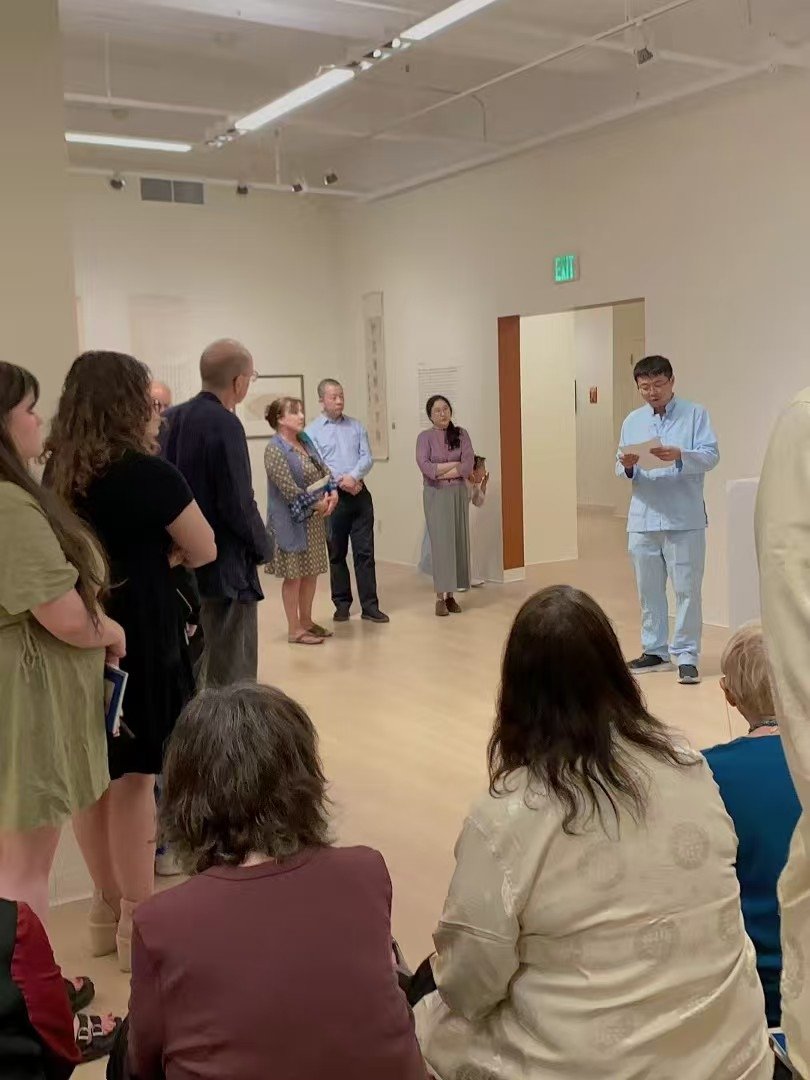
Zeng’s move to the United States in 2021 added another dimension to his practice. At the University of Wisconsin–Milwaukee, he curated Open Parameters: Late Nineteenth and Early Twentieth Century Chinese Calligraphy and Painting from the Zhou Cezong Donation (Figure 3). The exhibition reframed modern literary works not as static relics but as evidence of a living, evolving tradition. It was here that Zeng embraced what art historian Maura Reilly calls curatorial activism—the idea that exhibitions can challenge dominant narratives and restore marginalized voices to the cultural conversation.

An Extraordinary Tour of Art The Journey of Jingwei Zeng

Photo Courtesy: Jingwei Zeng (Opening Ceremony of Open Parameters, April 13th, 2023, Emile H. Mathis Gallery,University of Wisconsin, Milwaukee.)

For Zeng, this activism addresses two fronts: correcting Western misreadings of Chinese art and confronting the decline of literati culture in China itself. Too often in American academia, Chinese painting is interpreted without the grounding of poetry or calligraphy, stripped of the “three perfections” that give literati art its meaning. Zeng’s interventions—whether curating, teaching, or even writing letters in English with a brush—reinsert literati practice into global discourse as an integrated, living art form.

Beyond the Gallery

Zeng’s activism extends outside the white cube. In workshops at museums and universities across the U.S., he places the brush in others’ hands, inviting them to experience ink as reflection, poetry as thought, and calligraphy as dialogue. At the same time, he reverses the current of exchange: through WeChat, he introduces Western masterpieces to Chinese audiences, while on YouTube (The Literati Lens), he speaks in English about Chinese art for global viewers. This bilingual, bi-directional practice embodies cross-cultural curation not as theory but as daily work.

Toward an Extraordinary Tour

The Hong Kong exhibition gathered decades of labor into a coherent statement. Alongside Zeng’s own works were inscriptions from thirty prominent cultural and artistic figures, reviving the millennia-old literati practice of dialogue between brush and spirit. These inscriptions were not mere adornments, but integral acts of intertextuality—where painting and poetry intertwine, where colophons echo artistic integrity, and where community celebrates creativity. In this tradition, the artwork becomes not a solitary declaration but a shared cultural fabric, linking past and present, artist and audience, individual vision and collective voice.

The title, An Extraordinary Tour of Art (茲游奇絕), borrows from Su Shi’s verse on surviving a perilous sea voyage. For Zeng, the line resonates with his own trajectory: hardship transformed into resilience, solitude into vision, tradition into global dialogue. It also reflects the human trust that has sustained him—from family sacrifice to Yang Longqiang’s rare and historic support—showing that even in an age of markets, art can still be carried by faith and friendship.

Summary

Zeng’s career demonstrates that literati art is not an anachronism but a resource—one that can still shape global conversations about heritage, identity, and cultural justice. His projects show that curating is not neutral: it is a position, a responsibility, and sometimes an act of resistance. In refusing both the commercialization of art and the erasure of tradition, Zeng has built a practice that is at once rooted and transnational, scholarly and activist.

An Extraordinary Tour of Art is not just the story of an exhibition. It is the story of how literati ink, carried across oceans and strengthened by rare bonds of trust, can still find its way into the future.

From Marketing Films to Reimagining Education: How Saeed Tarawneh is Building for the Future

When people talk about the next generation of entrepreneurs, they often point to those working at the intersection of creativity, education, and technology. For Saeed Tarawneh, that intersection is where he feels most at home.

Tarawneh first made his mark in the marketing industry. He was the strategist behind “Lake George,” the indie film directed by Hamid Castro, which has built a loyal following on TikTok (@lakegeorgethemovie). As Marketing Manager, Tarawneh helped shape the film’s digital presence, crafting campaigns that highlighted the movie’s raw storytelling while connecting with audiences on platforms where cultural conversations are happening in real time. In an age when attention spans are fleeting and algorithms dictate what people see, Tarawneh demonstrated that he could cut through the noise, bringing an independent production into the broader cultural spotlight.

However, his ambitions extend far beyond film promotion. Tarawneh has also become closely connected with Alpha School, an unconventional educational model that challenges long-held assumptions about learning. At Alpha, students spend just two hours a day on structured academics, yet advance at roughly twice the pace of peers in conventional schools. The model emphasizes mastery, efficiency, and independence, freeing young people to pursue creative or entrepreneurial interests outside the classroom.

“Outcomes, not seat time, should measure education,” Tarawneh says. “Alpha represents what’s possible when you design learning around efficiency and curiosity.”

That philosophy—doing more with less, and rethinking outdated systems—threads through all of his projects. It’s also guiding his latest venture in the digital economy.

Tarawneh is the Co-Founder of Exla, a new platform for creators and brands looking to scale their reach more effectively. The creator economy has experienced explosive growth over the past decade, but the infrastructure to support sustainable development has lagged. Many creators struggle with scattered tools, inconsistent brand partnerships, and a constant demand for content. Exla aims to bridge that gap by providing creators and brands with a streamlined platform for collaboration, growth, and long-term impact.

For Tarawneh, Exla isn’t just another app—it’s part of a larger vision. “Whether it’s education, marketing, or creator tools, the question I always ask is: how can we build smarter systems that empower people?” he explains.

Observers note that what makes Tarawneh’s story distinctive is not just the industries he’s working in, but the connective tissue between them. A marketing campaign for a film, a school with a radically different model, and an app for creators might seem like separate pursuits. Yet taken together, they reveal a consistent worldview: that technology and strategy, when used thoughtfully, can unlock human potential.

It’s a perspective that feels particularly relevant in the current moment. Education systems across the country are grappling with how to adapt to a changing world—balancing technology with the need for critical thinking. Meanwhile, the creator economy is reshaping what it means to build a career, offering young people new ways to turn passion into a livelihood. Tarawneh sits at the overlap of these conversations, testing ideas and building ventures that reflect how younger generations think about learning, work, and influence.

As Lake George continues to attract attention, Alpha School pushes the boundaries of education, and Exla prepares to launch into the creator marketplace, Tarawneh’s trajectory suggests he is one to watch. His story is less about a single success than about a pattern: spotting inefficiencies, challenging conventions, and designing systems that allow people to do more with the time and resources they have.

In a world where industries are shifting faster than ever, that mindset isn’t just innovative—it may be precisely what the future requires.