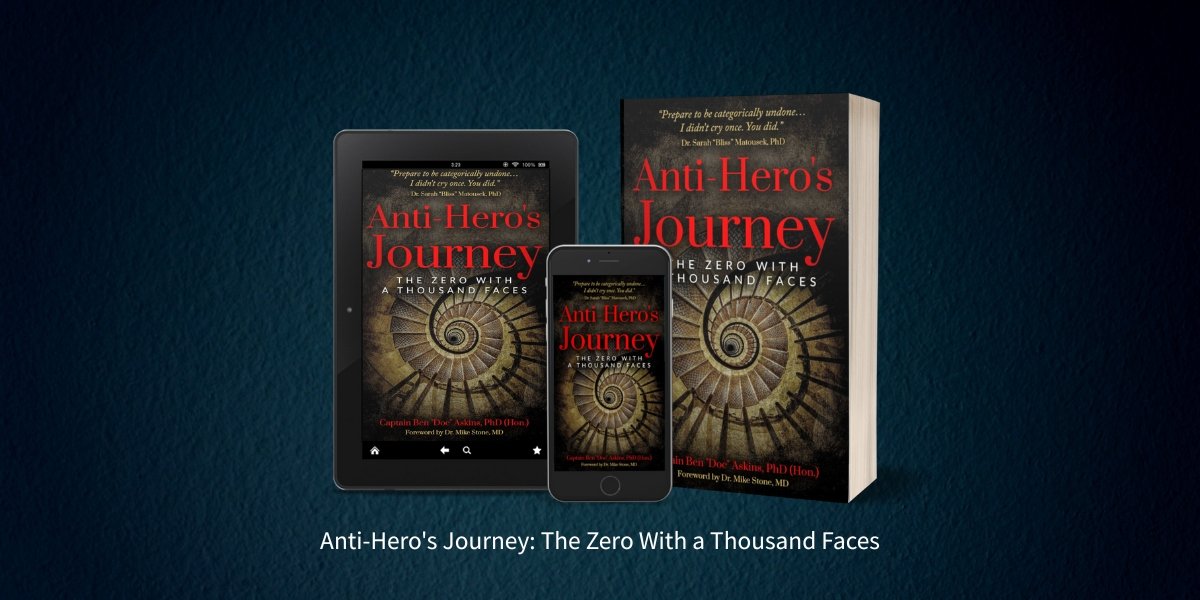
Why Read a Book That Promises to Destroy You? Ben “Doc” Askins on Anti-Hero’s Journey and the Brutal Beauty of Unmaking

By: Ann Kingsley

Ben “Doc” Askins’ book, Anti-Hero’s Journey: The Zero With a Thousand Faces, offers something audaciously different—and decidedly unsettling—in a culture obsessed with self-improvement, hero worship, and the search for meaning. This isn’t a roadmap to victory or valor; it’s a controlled demolition of ego, identity, and the myths we cling to for comfort. It promises no tidy revelations—only unflinching honesty and the possibility of something real emerging from the wreckage.

Why Should Anyone Read a Book That Promises to Destroy Them?

“I’m not selling nihilism—I’m offering a wrecking ball to the shaky scaffolding you’ve built your life on,” Askins explains. The metaphor of emotional demolition captures the essence of the book’s mission. When the labyrinth of beliefs, identities, and illusions collapses, space opens up for something sturdier to rise.

“It’s explosive, a bit terrifying, but ultimately liberating,” he says. “Most books want you comfortable. I want you uncomfortable—in the good way.” The breaking down is a prelude to feeling more deeply—doubt, grief, laughter, pain—and that feeling triggers clarity.

He doesn’t offer answers or neat solutions. Instead, he provides “brutal honesty and tough questions—about courage, fear, and meaning.” The choice of what to build next is left to the reader. “The slate’s clean. You build the next version of yourself.”

Is This Book Spiritual or Anti-Spiritual?

Askins’ answer is a paradox wrapped in a punch: “Yes.” The book is spiritual like “a fistfight in a church,” or “laughing during your own funeral.” It defies conventional spiritual categories, refusing to affirm traditional faith while still touching deeply on meaning born from trauma.

“If you bring traditional faith looking for affirmation, you might feel offended—or liberated,” he says. “If you come as a skeptic, you may get touched in places you didn’t realize still bleed.”

At its core, Anti-Hero’s Journey doesn’t promise salvation but might resurrect readers by forcing them “to believe nothing, so you can choose something real.” The refrain from the book’s Zeromyth theme is that “everything’s sacred and everything’s nonsense.”

Askins learned this lesson in war, holding “communion and cynicism in the same fist.” So yes, the book is spiritual — but only for those brave enough to find holiness in the wreckage, while burning every altar along the way.

What Will Readers Actually Feel?

The emotional ride Askins offers is intentionally disorienting. “You’ll feel disoriented. Seen. Punched in the psyche. Then suddenly, disturbingly free.”

He describes the book as a “controlled demolition” of the self. Between the humor and horror, readers are called into deep reflection, grappling with questions like, “What am I avoiding?” or “How do I reconcile pain and purpose?”

“If you’re paying attention, something in you might shift,” he says.

The feelings readers should expect? “Unsettled. Unlocked. Undefended. Unapologetically human.” Askins warns, “Bring your emotional armor—but be ready for it to shatter. That’s the point.”

Who Should Avoid This Book?

The author doesn’t mince words when advising who might not be ready for this raw and unflinching narrative. “People who like being lied to. People who think trauma is a personality trait. People whose Amazon cart is full of crystals, vision boards, and ‘Live, Laugh, Love’ decals. Stay away.”

The book “eats hope for breakfast.” It includes graphic battlefield scenes—blood, fear, trauma—rendered in brutal detail.

If you’re looking for medals, clear victories, tactical maps, or an “us versus them” story, you’ll find none here. “This isn’t about heroism or patriotism—it’s about human wreckage and how we attempt to rebuild it.”

If you want a polished, uplifting war memoir or safe spiritual balm, Askins recommends looking elsewhere. But if you’re curious about a laugh-tinged excavation of trauma, resilience, and messy humanity—welcome aboard.

How Does This Book Change People?

The transformative power of Anti-Hero’s Journey is not in changing people, but in stripping away the illusion that something about them needs to be fixed.

“It doesn’t change people. It strips away everything that thinks it can be changed,” Askins says. Readers expecting a tidy wartime valor story instead find “raw wounds and honest admission of fear.”

This initial shock cracks the veneer and opens the door to rebuilding meaning from the ruins. The book teaches that real strength is vulnerability, that courage means noticing the masks you wear and being curious about what’s underneath.

“Most books don’t smash your assumptions,” he says. “Anti-Hero’s Journey does.” The result? Readers walk away “uncomfortably more honest, more empathetic, more willing to hold everything and nothing at once.”

And that, Askins insists, is the only kind of change worth writing into your bones.

Final Reflections: The Invitation to Wreck and Rebuild

Ben “Doc” Askins invites readers to a journey that is anything but comfortable. He offers a brutal, funny, and deeply human path to unmaking and rebuilding the self, shattering heroic myths to reveal the raw core beneath.

Anti-Hero’s Journey is a call to courage, to laughter and tears, to embracing the absurd and the profound. It promises no safe harbor—only the freedom found in burning the old story down and daring to build anew.

For those ready to face the wreckage with eyes wide open, it’s a rare and necessary gift.
Albin Kaelin and the Future of Circularity: Building a Movement One Mind at a Time

By: Evelyn Marris

By the time most people start thinking about sustainability, Albin Kaelin has already spent decades redesigning it. Not as a corporate checkbox or green branding tactic—but as a deep-rooted, system-level shift that redefines the way we design, manufacture, and consume.

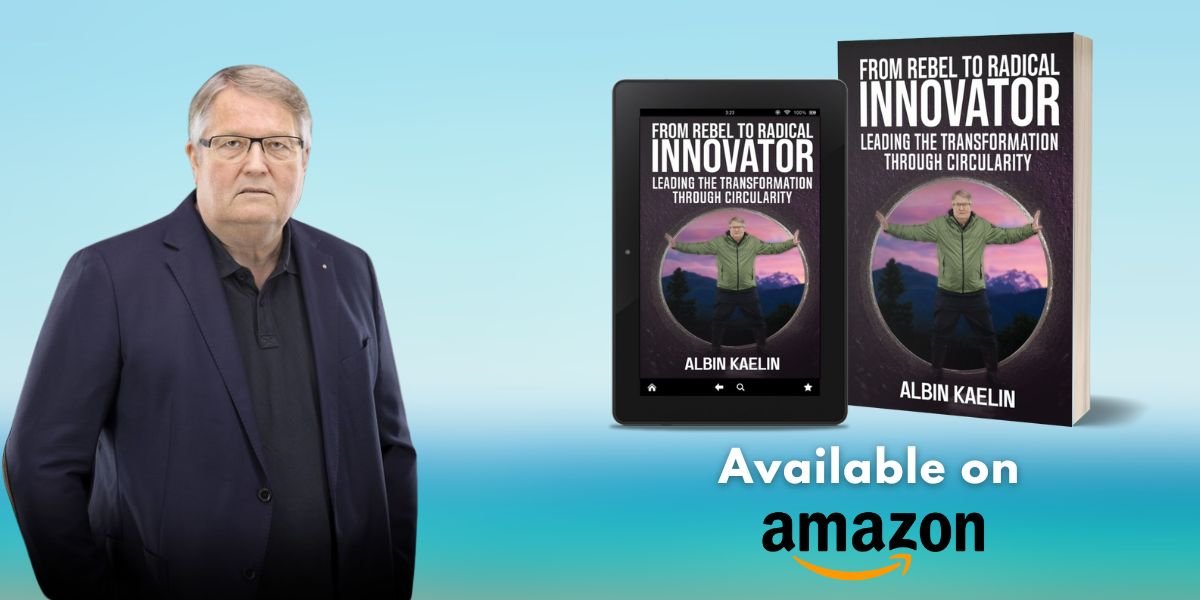
In his groundbreaking 2024 book, From Rebel to Radical Innovator: Leading the Transformation Through Circularity, Kaelin offers more than a philosophy—he delivers a field-tested, industrial-strength blueprint for creating closed-loop systems that eliminate waste and regenerate value. But his mission began with something far more personal: a pen.

“I’m left-handed,” Kaelin recalls. “But in school, I was forced to write with my right hand. I asked why—and got no answer. That moment taught me a lifelong lesson: never accept anything whose sense I do not understand.”

It’s this refusal to accept senseless norms—whether in education or in industrial design—that has propelled Kaelin’s life’s work. When he first encountered the Cradle to Cradle® (C2C) design framework, which emphasizes circular materials, clean energy, and social fairness, he instantly recognized its resonance with his personal values.

“It made klick,” he says. “I knew immediately what to do. Cradle to Cradle gave me the roadmap to build what I had only imagined before.”

That vision has since materialized into one of the most respected sustainability portfolios in Europe. As CEO of epeaswitzerland GmbH and former head of Rohner Textil AG, Kaelin helped pioneer the first C2C-certified textiles and has consulted dozens of companies toward transforming their supply chains and product design.

But he makes it clear: change didn’t come easily—and it still doesn’t.

“Convincing traditional industries was and remains extremely challenging,” Kaelin admits. “It’s contradictory. The systems are built for linear production—take, make, waste. You have to speak their language, understand their culture, and slowly guide them toward seeing things differently.”

His approach centers on personal connection and patience. Rather than lecture or impose, Kaelin works with individual managers, helping them evaluate the C2C philosophy through their own personal and professional lens.

“If they can judge for themselves that it makes sense, that’s where the motivation comes. Then we work toward a pilot project. That becomes the proof of concept,” he explains.

Still, the path from awareness to transformation isn’t a straight line. In From Rebel to Radical Innovator, Kaelin identifies one major roadblock: fear of change. For many companies, the transition to circular systems is perceived as risky, costly, and complex. Kaelin argues that this perception can only be overcome through what he calls “Building a Network of Trust.”

“You need to balance the perceived risks with the visible opportunities. That’s why building trust—not just between consultant and client, but across entire ecosystems—is so important,” he says.

It’s a method that seems to be working. Over the past few years, Kaelin has received more than 30 awards recognizing his leadership and innovation in sustainability—including repeated honors as Best CEO of the Year and Most Innovative CEO of the Year from the CEO Today Europe Award and Business Worldwide Magazine CEO Awards.

Yet for Kaelin, the significance of these awards goes beyond personal achievement.

“The recognition isn’t really about me,” he says. “It shows that circularity and regeneration are no longer fringe ideas. They’re being recognized as essential. That means the world is waking up.”

And not just governments and corporations. The public, too, plays a pivotal role. For decades, Kaelin notes, retailers—the main bridge between producers and consumers—resisted sustainability efforts. But in the age of digital transparency, consumers are better informed and increasingly vocal.

“The power of the consumer has never been greater,” Kaelin observes. “With digital tools, they can demand accountability. We’re seeing retailers like Migros in Switzerland finally embrace this shift.”

Still, Kaelin cautions that we’re far from the finish line. “We are still at the beginning. The impact needs to grow quickly. Large corporations still resist—they want to shape circularity on their own terms, often to preserve outdated systems.”

That ongoing struggle leaves Kaelin feeling, at times, like the underdog. “It still feels like David versus Goliath,” he admits. “But David was precise. Strategic. And he had truth on his side.”

What keeps Kaelin motivated after more than 25 years of pushing against inertia? A commitment to principles—and a clear moral compass. His leadership mantra is simple but unflinching: “Innovation and leadership are the only survival strategies.” He adds, “If you compare, you start to compromise.”

In other words, don’t water down your vision just to fit in. Stay the course. Be consistent. Let your work speak for itself.

That ethos runs through every page of From Rebel to Radical Innovator, a book that blends strategy, storytelling, and ethics into one cohesive call to action. It’s not written for the sustainability elite—it’s written for decision-makers, frontline designers, curious consumers, and anyone who believes the way we produce and consume must—and can—change.

As Kaelin puts it, “We’re not just talking about saving the environment. We’re talking about redesigning systems to make more sense—for people, for business, and for the planet.”

And for those looking to join this movement? It starts by questioning the systems that no longer serve us—and daring to build better ones.

To explore Albin Kaelin’s circular economy idea, visit book.epeaswitzerland.com or find his book on Amazon.