Escaping The Marketing Matrix: Why CEOs Can’t Rely on Marketing Software To Maximize AI For Growth

By: Tek Enterprise

Why CMOs Are Struggling with Tools — and What It May Take to Regain Control of Digital Strategy

Modern marketing is powered by technology. That much is clear. But as the number of tools grows exponentially — with over 15,000 MarTech platforms on the market and counting — a deeper issue is emerging: software companies are advancing marketing innovation faster than many businesses can adopt or adapt.

“Marketers aren’t just using tools — they’re being influenced by them,” said owner Zach Jalbert at a recent Tek Enterprise roundtable. “And in too many cases, the strategy is following the software, rather than the other way around.”

The Spending Paradox

CMOs are increasingly allocating significant portions of their budgets toward marketing software, reflecting the growing role of technology in modern marketing strategies. While this reflects the increasing sophistication of digital marketing, it also highlights a deeper imbalance: tool expansion without a fully aligned strategy.

The results?

  • Redundant functionality across platforms,
  • Low platform adoption rates,
  • Disjointed customer experiences,
  • Teams spending more time managing systems than executing marketing.

In the rush to automate, personalize, and track everything, many organizations are discovering that more tools don’t necessarily lead to more value, especially when core strategy, brand clarity, and cross-channel execution are not in place.

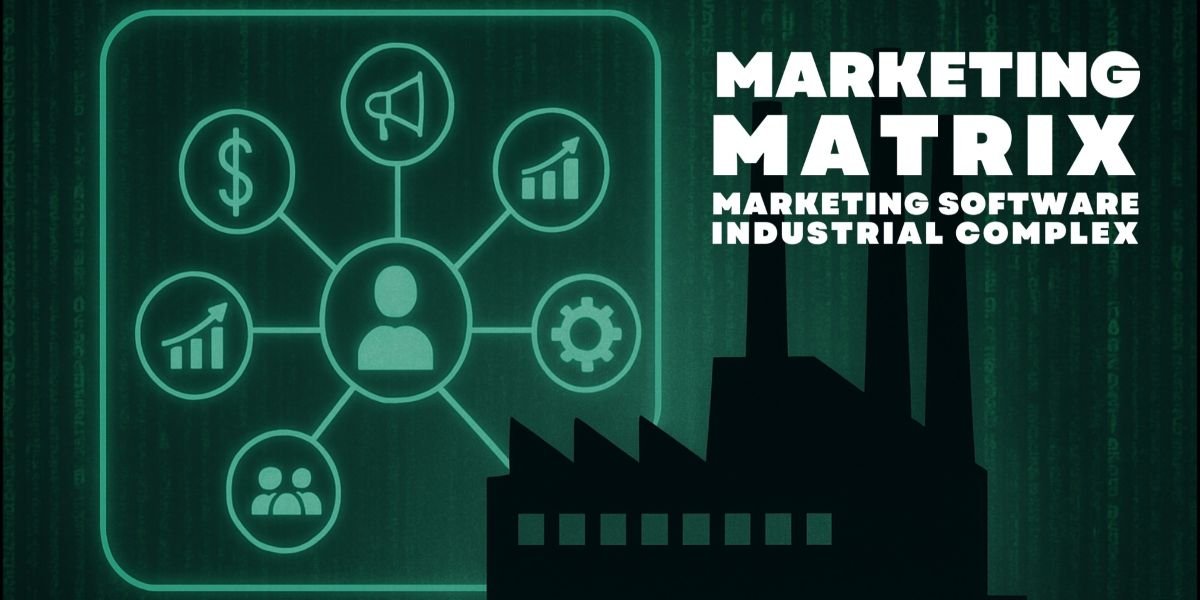
Welcome to the Marketing Software Industrial Complex

Behind every new acronym — DXP, CDP, CMP, DAM, MAP — there’s a sales cycle moving faster than an enterprise’s ability to implement, train, or extract value. This has led to what some leaders are now describing as the Marketing Software Industrial Complex: a landscape where:

  • Tool vendors often out-market the marketers,
  • “Innovation” is driven by quarterly product demos, not always by customer insights,
  • Strategic brand-building sometimes takes a back seat to software configuration.

“In too many boardrooms, the conversation is about what the tool can do — not what the customer truly needs,” one Tek Enterprise strategist remarked in 2024.

The Cost of Chasing the Stack

Beyond the financial burden, the hidden cost is a potential loss of strategic direction. When CMOs focus more on tech stack expansion than on brand strategy, creative alignment, or consistent customer narratives, marketing becomes fragmented — more of a patchwork of activity rather than a cohesive system of influence.

The more serious risk? Brand dilution. Inconsistent touchpoints, impersonal content, and fragmented messaging are often the result of tech-first, not audience-first thinking. When the platform roadmap begins to drive the marketing strategy, it’s no longer about innovation — it’s about dependency.

The Path Forward: Strategic Integration, Not Tool Acquisition

What’s needed is a new approach — one that puts strategy back in control and positions tools as facilitators rather than the main drivers.

This means:

  • Fewer platforms, with more effective integration: Audit and consolidate tools to eliminate noise and reinforce what works.
  • Cross-functional alignment: Ensure sales, product, customer experience, and marketing share systems and strategic language.
  • Experience-led branding: Focus on journey design, not just channel optimization. The customer doesn’t see tools — they experience the outcome.
  • Brand + Tech governance: CMOs and CIOs must collaborate on the conversation about digital infrastructure and customer storytelling.

CMOs Must Lead, Not Just Oversee

The modern CMO must evolve from channel orchestrator to brand systems architect. This means less time spent evaluating platforms and more time shaping how technology can support the brand’s voice, promise, and impact.

It’s not about abandoning MarTech. It’s about mastering it — selecting platforms that align with a long-term brand vision, not just responding to a quarterly use case. Leaders must ask not just, “Can this tool do more?” — but “Does this tool support what we’re trying to become?”

Future-Proof With Tek Enterprise

The future of marketing doesn’t belong to the brands with the most tools. It belongs to those who understand how to integrate, align, and communicate with clarity.

Marketing strategy must once again take the lead over technology, not follow it.

To explore perspectives on platform simplification, brand-led system design, or cross-functional digital strategy, visit www.tekenterprise.com.

Because in a world of infinite tools, the real advantage is knowing which tools to use — and which to leave behind.

Let’s Talk Sales.

Interview: Subham Ray on How the Middle East is Shaping the Future of AI and Cybersecurity

By: Emily Williams

As the Middle East accelerates toward becoming a global innovation hub, two technologies are at the heart of its transformation: Artificial Intelligence (AI) and Cybersecurity. In this exclusive interview, we speak with Subham Ray, renowned technology evangelist, cybersecurity strategist, and global thought leader, about how the region is merging ambition with responsibility to shape a secure and AI-driven future.

Q: Subham, how do you see the Middle East approaching AI adoption compared to other regions?

Subham Ray: What excites me most is how fast and focused the Middle East is in adopting AI, not just as a technology, but as a national priority. The Middle East is implementing national AI strategies that go beyond innovation—they’re aiming to make AI part of daily life.

We’re seeing AI used for smart cities, precision healthcare, public services, and more. In many ways, the Middle East is designing the future from scratch,and doing it with vision and scale.

Q: What are the cybersecurity implications of this rapid digital shift?

Subham Ray: Every equal leap must match every leap in digital capability in cybersecurity. As systems grow smarter and more interconnected, they also become more vulnerable. Cybercriminals are already using AI to enhance their attacks, phishing, ransomware, and infrastructure breaches are becoming more sophisticated.

The Middle East understands this urgency. Governments are investing in AI-driven threat detection, SOCs, zero-trust models, and more. But beyond tools and tech, what’s needed is a security-first mindset. That means boardrooms taking cyber seriously, public-private partnerships for cyber resilience, and most importantly, education and awareness at every level.

Q: You’ve written extensively about the convergence of AI and cybersecurity. Can you explain what that means for the future?

Subham Ray: Absolutely. We’re at a fascinating point where AI is both a challenge and a solution in the cybersecurity space.

While AI opens up new attack surfaces, it’s also our most powerful defense. Machine learning can now detect threats in real time, analyze patterns across massive datasets, and even automate incident responses. Soon, we’ll see AI systems that can self-heal, self-defend, and continuously learn, building dynamic, intelligent security frameworks.

The Middle East is well-positioned to lead in this space, meaning they can integrate security directly into the foundation, not as an afterthought.

Q: Ethics and responsibility in AI have become global concerns. What’s your take on how the Middle East is handling this?

Subham Ray: This is where I believe the Middle East has an opportunity to lead globally, not just in technology, but in values. The region is actively exploring AI governance, fairness, and inclusivity. For instance, the UAE’s AI Ethics Guidelines are a good step forward.

I strongly believe that ethical AI must be transparent, explainable, and inclusive, and the Middle East is building the right environment to make this happen.

Q: What role do you see yourself playing in this regional transformation?

Subham Ray: For me, it’s about giving back and sharing knowledge to support cybersecurity empowerment. I continue to empower organisations with cybersecurity, contribute to global communities, and advocate for ethical, secure innovation.

My goal is to support AI literacy, secure cloud adoption, and regional empowerment.

Q: Looking ahead, what message would you share with global investors and tech leaders watching the Middle East?

Subham Ray: The Middle East is no longer just a consumer of technology, it’s becoming a creator and exporter of innovation. With strong leadership, infrastructure, and talent, this region is ready to collaborate, experiment, and scale responsibly.

My message is simple: Don’t just observe, participate. This is the right time to invest, partner, and build with the region. The future of AI and cybersecurity is being shaped here,and it’s a future built on trust, vision, and collaboration.

About Subham Ray 

Subham Ray is currently holding the position as Senior Business Manager at Gulf IT. He is an internationally recognized technology author, cloud and cybersecurity strategist, and thought leader known for his impactful contributions to the global tech community. With deep expertise in Artificial Intelligence (AI), Data Science, Cloud Computing, and Cybersecurity, Subham has built a career that bridges innovation with education, and strategy with execution.

His work is featured across respected platforms, including C# Corner, Tutorials Link, and Alibaba Cloud MVP profiles. He has also served as a community mentor, speaker, and knowledge contributor for technology conferences and initiatives across the Middle East and South Asia.

Currently based in the UAE, Subham is actively involved in shaping the regional tech landscape. He supports AI literacy and secure digital infrastructure. His forward-thinking insights into how emerging technologies can align with real-world outcomes have made him a trusted voice among enterprises, startups, and digital policymakers alike.

Subham Ray holds prestigious recognitions such as Alibaba Cloud MVP, and is regularly featured in regional publications and thought leadership forums.

Silicon Valley Technologist Ishita Agrawal’s Fresh Take on Post-Purchase Marketing

By: Natalie Johnson

In a time when marketing strategies often focus on lead generation, clicks, and sales, the true connection between brands and customers may not be as strong as it could be.

If you ask, “How do you win customers?” many responses focus on the same idea: the quality of the product or service offered.

That answer may have held more weight in the past, but as professionals like Ish Agrawal have observed, customer experience has become increasingly important for winning and retaining customers.

Research shows that 65% of customers believe a positive customer experience holds more value than even great advertising. Additionally, surveys indicate that a significant portion of customers — about one in three — may leave a brand they’ve enjoyed after a single negative experience.

But where and when does this customer experience unfold? It isn’t typically in the social media feed or inbox, as many brands might assume. Rather, it occurs in the moments when a customer is actively using your product.

Many traditional marketing strategies overlook this key moment, but for Ish Agrawal, that moment is pivotal. It’s when the genuine connection between the brand and customer can truly take place.

Ish discovered this key insight during her time at Stanford, where she took a course on entrepreneurship called Lean Launchpad. She recalls, “Everyone obsesses over acquisition—email flows, paid ads, websites. But when we stepped back and mapped the actual customer journey, we saw something clear: the most emotionally engaged moment isn’t when someone clicks ‘buy.’ It’s when they’re using your product. That’s the moment they’re paying attention. That’s when they’re open. That’s where the connection is possible.”

Building on this idea, Ish has developed a tool that is reshaping how brands engage with customers: Tapp. Tapp focuses on creating intimacy and building the post-purchase media network, one product interaction at a time.

Tapp is a tech solution designed to help businesses connect with their customers directly through the products themselves, using an interactive interface. The key to Tapp’s approach is not simply pushing out more marketing messages, but designing the product to facilitate engagement as the customer uses it.

With Tapp, brands can build a stronger presence in the moments their products are actively being used. By placing a smart sticker on each product, customers can tap on it, and without needing to download anything, they are immediately transported into a personalized world filled with interactions, promotions, games, surveys, support, rewards, and brand messages. This design allows customers not just to use a product, but to engage with it meaningfully. This may represent a new direction for customer engagement.

Tapp isn’t just a new solution; it’s a tool that has been shown to generate impressive results, with notable increases in customer spend and a significant boost in Return on Ad Spend (ROAS) for businesses that have adopted it

Ish’s vision for Tapp extends beyond just technology — she sees it as a way to create a new post-purchase media and marketing channel. Her goal is simple yet profound: to deepen and enhance the brand-customer relationship each time a customer interacts with a product. Whether it’s a coffee brand sharing recipes and routines or a skincare product offering tips, new products, and discounts, the aim is to create an experience that feels both authentic and enjoyable.

Ish believes that attention should shift towards post-purchase marketing and customer experience building in the coming years, with an emphasis on more genuine, real-life interactions.

Through Tapp, Ish and her team offer brands a refreshing alternative to the overload of emails and SMS that currently dominate commerce today. The goal is not to flood customers with more messages but to provide meaningful content, delivering more delight rather than just more data. It’s about that one tap that can help nurture customer loyalty, creating connections that are harder to break.

With Tapp, the future of customer experience building is already underway, one smart sticker and one personalized experience at a time!